




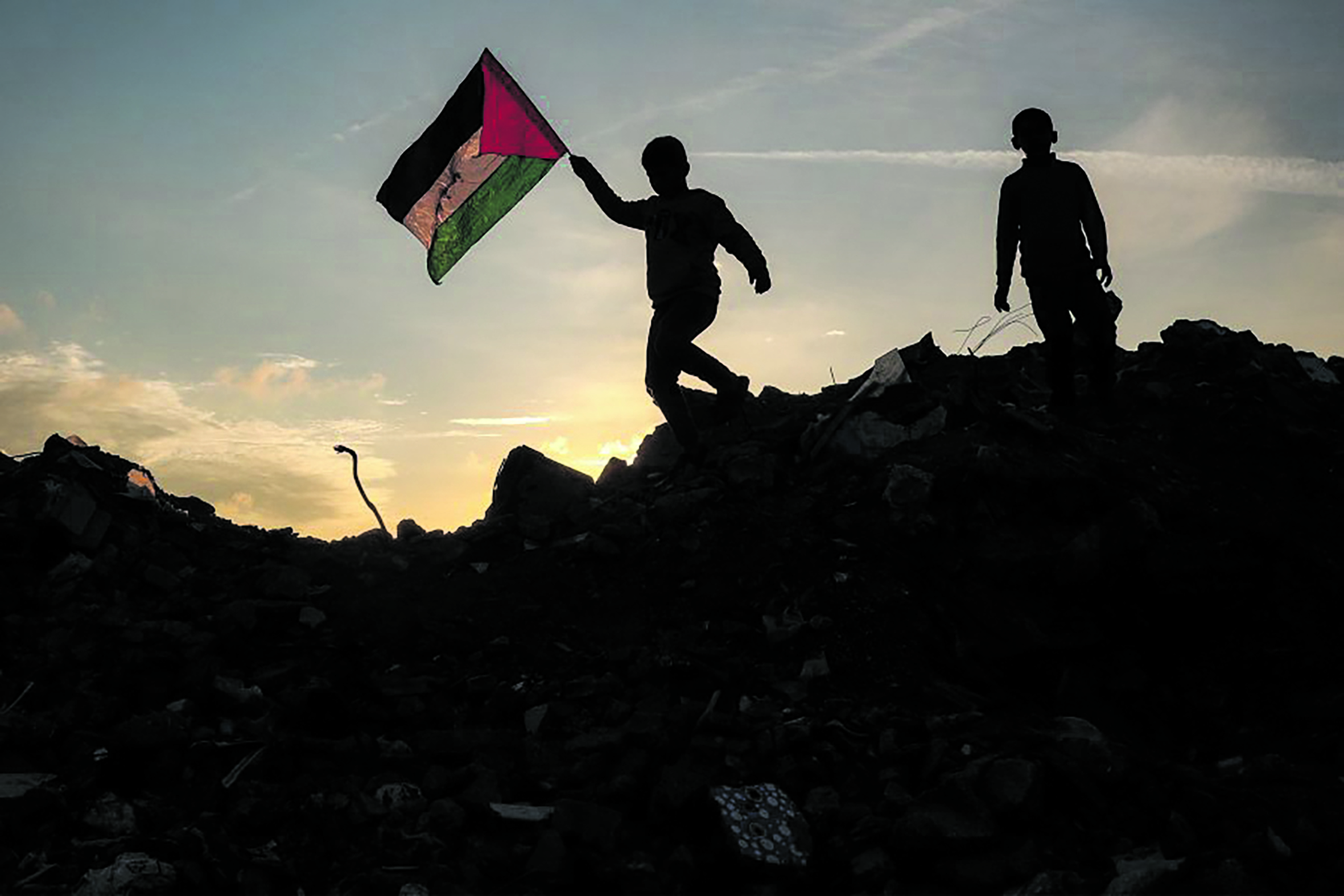
 A boy runs with a Palestine flag atop a mound of rubble at a camp for people displaced by conflict in Bureij, in the central Gaza Strip, on 17 January after the announcement of a truce that did not last long. (Photo: Eyad Baba / AFP via Getty Images)
 A possible Gaza ceasefire is awaiting Hamas’ approval after Israeli Prime Minister Benjamin Netanyahu agreed on Monday to a new ceasefire proposal by US President Donald Trump.
Trump’s 20-point plan outlines Hamas’ banishment, the demilitarisation of Gaza, the withdrawal of Israeli forces to an agreed line, the release of all the Israeli hostages and thousands of Palestinian political prisoners - and the eventual reconstruction and development of the coastal territory following the successful implementation of the agreement.
If the ceasefire is implemented, this will be followed by the renewal of humanitarian aid flowing into Gaza, the establishment of a temporary International Stabilisation Force and a transitional governance in the form of a technocratic and apolitical Palestinian committee, which would in turn be overseen and supervised by an international “Board of Peace”, headed by Trump.
The board would include other heads of state and international officials, including the former British prime minister Tony Blair.
The proposal has received broad international support from the Arab countries and the Europeans while some members of the UN have said the plan could be positive.
However, there are also serious reservations and criticism of the plan from some quarters, with critics arguing the terms favour Israel’s position and overlook basic Palestinian rights.
Heads of state and government gathered at the UN headquarters in New York on Monday, 22 September, for a special summit aimed at reviving the two-state solution and resolving the Israeli-Palestinian conflict.
The summit, held on day one of the UN General Assembly’s annual September gathering of world leaders, was spearheaded by France and Saudi Arabia. A number of countries, including Australia, the UK, Canada, Portugal and France, officially announced their recognition of the State of Palestine.
Although this sparked hope, Palestinians were aware that it would not halt the continuing Israeli land grab in the occupied Palestinian West Bank or the carnage in Gaza, and would change nothing on the ground in the short term. The road to full independence would be both bloody and difficult.
Israeli Prime Minister Benjamin Netanyahu reacted with anger, promising there would never be a Palestinian state, and adding that the move rewarded Hamas. He was supported by many Israelis, even moderate Israeli politicians such as former defence minister and centrist Benny Gantz, who also said statehood would never happen.
/file/dailymaverick/wp-content/uploads/2025/06/1473931408.jpg "Israeli Prime Minister Benjamin Netanyahu. (Photo: Sean Gallup / Getty Images)")
In 1947, the UN proposed the partitioning of Palestine into two independent states, one Palestinian Arab and the other Jewish, with Jerusalem internationalised, acting as a framework for the two-state solution.
Netanyahu is on record over the decades as rejecting a Palestinian state and arguing for Israeli regional hegemony and the expansion of the Jewish state to absorb the surrounding land belonging to its Arab neighbours.
Critics of Israel say that although Arab states rejected the 1947 partition of Palestine and attacked Israel, launching the first Israeli-Arab war, Israel’s Zionist founders argued that the establishment of the state was a first step towards the expulsion of the Palestinians and the expansion of the fledgling Israeli state’s 1948 borders by conquest.
Many Israelis also labelled the independence move for Palestinian recognition as “British colonialism”, seeming to overlook Israel’s colonialism and expansionism in the West Bank. The International Court of Justice ruled in July last year that Israel’s continued occupation of the West Bank and other Palestinian territories was illegal under international law.
Within hours of the UN summit, far-right Israeli National Security Minister Itamar Ben-Gvir said he would push for the immediate annexation of the occupied West Bank. Moves to annex the West Bank have been in the pipeline for some time, as the expropriation of Palestinian land and the ethnic cleansing of it have accelerated in the past few years.
According to the UN Office for the Coordination of Humanitarian Affairs, Israel has demolished more than 13,000 Palestinian-owned structures and destroyed nearly 2,000 donor-funded structures in the occupied territory since 2009, affecting more than 800,000 Palestinians.
More than 1,000 Palestinians have been killed in the West Bank alone by Israeli forces and settlers since the beginning of 2023, and more than 2,780 Palestinians have been injured by Israeli forces or settlers across the territory since January 2025, including 500 specifically by settlers.
Israel’s accelerated building of settlements, specifically the E1 corridor, will separate East Jerusalem from the rest of the West Bank. Other settlement expansion will turn the territory into a Bantustan of bits and pieces of land.
Israel is in effect preventing the establishment of a contiguous Palestinian state by establishing what is known as “facts on the ground”. How this will be overcome in practice remains to be seen.
/file/dailymaverick/wp-content/uploads/2025/02/12815293.jpg "Residents inspect the damage done as Israeli troops withdraw from Al Farea refugee camp following a four-day campaign, near the West Bank city of Tubas on 12 February. (Photo: Alaa Badarneh / EPA-EFE)")
Internal conflict
Another obstacle is the geopolitical chasm between the Gaza Strip, ruled by Hamas, and the West Bank, which is under the nominal control of the Fatah-affiliated Palestinian Authority (PA).
These two main political factions have been at loggerheads since Hamas won the 2006 parliamentary elections fairly and democratically, according to observers.
Hamas’ victory was not so much about Palestinians supporting Islamists. Rather, it had to do with the corruption and brutality of the PA, an issue that continues to the present day as the international community calls on the West Bank’s rulers to implement much-needed reform.
PA President Mahmoud Abbas’ term officially ended in 2009, but he has clung to power and increasingly narrowed the space for criticism and opposition — with the full economic and political support of Western donors.
/file/dailymaverick/wp-content/uploads/2024/11/12583752.jpg "PA President Mahmoud Abbas. (Photo: Alexander Zemlianichenko / Pool / EPA-EFE/)")
Hamas is problematic because of its extremism and indiscriminate attacks, but the claim of “rewarding” it ignores historical context and that Palestinians are supported by international law in their claim to a future state. The recognition of a state is not giving them a gift, but returning what should have been returned to them decades ago, recognising their inalienable rights, said Husam Zomlot, Palestinian ambassador to the UK.
Furthermore, it has been reported extensively that Netanyahu facilitated the delivery of millions of dollars from Qatar to Hamas in an attempt to inflame tensions between the two Palestinian political entities. In addition, Brigadier General Yitzhak Segev, who served as Israel’s military governor in Gaza in the early 1980s, openly admitted to providing financial assistance to the Palestinian Islamist movement, which he saw as a useful counterweight to the secularist Palestine Liberation Organization.
And there is no doubt that the most extreme, messianic Israeli government yet under Netanyahu — who has every reason to save his political skin from corruption charges by waging wars on several fronts — will fight back hard to prevent a Palestinian state from coming into being.
So it remains to be seen if the Gaza ceasefire will be agreed to and successfully implemented, and if the recognition of a Palestinian state by major Western countries is more than just assuaging guilt for ignoring Palestinian rights for decades.
/file/dailymaverick/wp-content/uploads/2025/08/file-20250817-56-lvzuqo.avif "Palestinians walk through the destruction in Jabaliya, Gaza Strip, on 29 January. (Photo: Mohammad Abu Samra / AAP)")
“The recognition of Palestine doesn’t stop the genocide,” Jared Sacks, of South African Jews for a Free Palestine, told Daily Maverick. “The international community repeats rhetorical statements while continuing to arm Israel and do business with it, including South Africa.”
Although the State of Palestine is now recognised by more than 150 of the UN’s 193 member states, as things stand, it will still not have an official seat at the UN, as this can only be approved by the Security Council, where the US is sure to veto any resolution calling for a seat.
Netanyahu has also made very clear that he will never agree to a Palestinian state.
Chris Gunness, a former spokesperson for the UN Relief and Works Agency for Palestine Refugees, told Daily Maverick: “Recognition is part of a process that could go two ways. It could go in the direction of peace, but there is no sign at all that Israel is interested in that, or it could go in the direction of the deepening isolation and pariah status of Israel.”
It also remains to be seen if the Arab states will implement action to accompany their hardening collective attitude towards Israel after the latter’s recent attack on Doha, Qatar, in a failed attempt to assassinate several Hamas leaders. The attack came despite Mossad regularly travelling to Qatar for ceasefire negotiations and US and Israeli requests for the Qataris to mediate these talks.
The United Arab Emirates warned that this could include reviewing the Abraham Accords, which started normalisation with Israel, and Saudi Arabia warned that any annexation of the West Bank would prevent it from signing the accords.
Gunness added that although the Trump administration had been fully supportive of Israel and refused to recognise a Palestinian state, nuances were emerging in Washington, with splits between evangelical extremists and those supporting the rescue of the Abraham Accords as momentum builds towards Palestinian independence. DM