



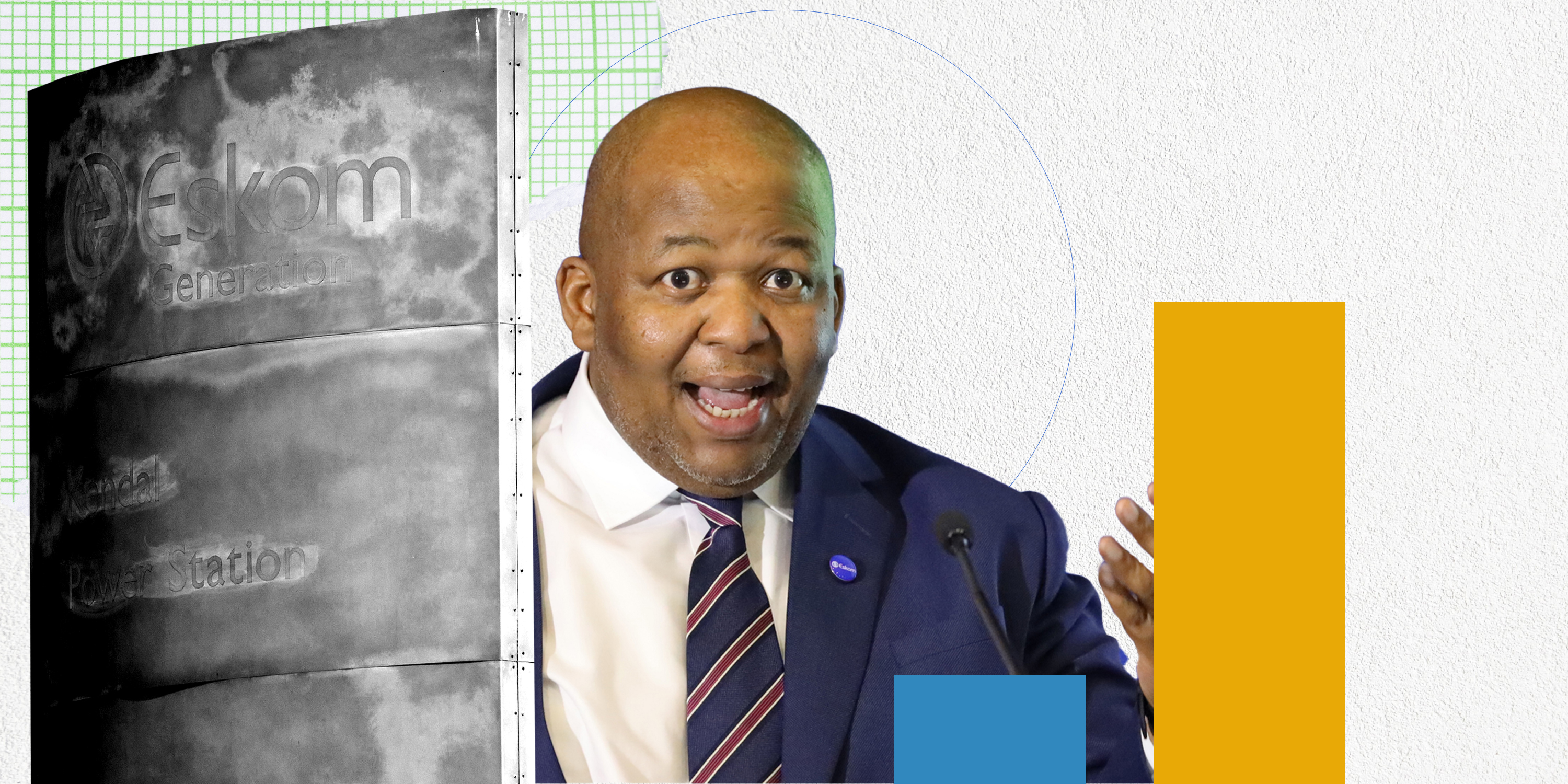
 Illustrative image | Dan Marokane, Group Chief Executive of Eskom, during the utility's annual results announcement. (Photo: Gallo Images / Lubabalo Lesolle) | Eskom signage. (Image: Gallo Images / Waldo Swiegers | Rawpixel | Freepix)
 There is finally light at the end of the long dark tunnel that is Eskom.
The state-owned power utility posted an after-tax profit of R16-billion for the 2025 financial year, a remarkable surge into the black from last year’s staggering loss of R55-billion — the first year the SOE made cash instead of burning it since 2017.
Eskom attributed its return to profit in large part to its unpopular 12.74% standard tariff increase, debt relief support and a 14% reduction in primary energy costs.
/file/dailymaverick/wp-content/uploads/2025/09/profit-factors.jpg "Source: Eskom financial results presentation")
The slashing of energy costs reflected improved coal plant reliability, which in turn reduced the company’s reliance on costly Open-Cycle Gas Turbines. This all added up to year-on-year diesel savings of R16.3-billion, underscoring the gains that can be made when the engineers are allowed to do their jobs properly.
/file/dailymaverick/wp-content/uploads/2025/09/OGCT.jpg "Source: Eskom results presentation")
Meanwhile, the R64-billion debt relief support “enabled the redirection of cash from operations to vital capital expenditure and working capital, supported by upfront planning and ordering of spares”, Eskom said.
It all points to an impressive turnaround in a financial year that was marked by a dramatic reduction in the rolling power cuts known as “load shedding” to 13 days, with 310 consecutive days of no nationwide blackouts imposed to protect the integrity of the grid.
“We are reinvesting profits back into national assets. Over the next five years, with continued rigorous focus, we will invest more than R320-billion in sustaining and expanding our infrastructure for the long-term benefit of the nation,” said Eskom chief executive Dan Marokane.
“In a break from the past, we are accelerating the review and restructuring of our cost base. This is being done within the framework of the expected future single-digit tariff increases allowed by the National Energy Regulator of SA (Nersa), as we drive efficiencies and take control of the factors within our control to address the affordability of electricity.”
Stakes sky high
The stakes for the South African economy of getting Eskom back on the right path are sky high.
A report by the Council for Scientific and Industrial Research (CSIR) in March said that the rolling power cuts had cost South Africa’s economy R2.8-trillion. This was cut 83% to R481-billion in 2024, and at this trajectory should be less this year.
And Eskom is entering a new era with new power providers on the scene and no further prospects of bailouts from the cash-strapped Treasury.
“The era of monopoly is gone. Eskom will not be getting any bailout going forward,” Electricity Minister Kgosientsho Ramokgopa said in remarks just before Eskom made the results presentation.
Eskom is hardly out of the woods yet.
It received a qualified external audit opinion “due to incomplete or inaccurately maintained records in terms of the Public Finance Management Act. These records did not comply with legislative requirements relating to irregular expenditure and losses due to criminal conduct.
‘Material uncertainty’
“Furthermore, there is material uncertainty regarding Eskom’s going concern status, driven by dependence on government support, uncertainties related to operational assumptions and regulated revenue by Nersa, as well as growing municipal arrears debt and energy losses,” the company said.
The municipal arrears debt bill was R94.6-billion as of 31 March 2025 — a 27% increase from the previous year. Eskom warned this could soar to R300-billion by 2030 “without urgent intervention”.
“Despite the implementation of the National Treasury’s municipal debt relief programme, the growth has not slowed. Most participating municipalities are failing to meet the basic requirement of paying their current accounts on time and in full,” Eskom said.
Pointedly, it said this was a threat to Eskom’s standalone distribution company and its broader process of separating into distribution, generation and transmission units.
Eskom’s own debt stood at R372-billion at the end of March compared with R412-billion the previous year. It said it planned to return to the capital markets in FY28 but net borrowings would be limited to R25-billion per year.
Speaking to Alishia Seckam during the latest PSG Think Big webinar, Eskom chairperson Mteto Nyati noted that between independent power producers (IPPs) and households, South Africa now has “close to about 12,000 megawatts of renewables. Responding to criticism that Eskom had signed high-cost IPP contracts, Nyati stressed that earlier contracts were signed at globally high solar costs at the time, but “what we’re signing now is cheap. If you want to be driving down the cost of energy in South Africa, that’s the route we need to be taking, which is what we are doing.”
Eskom’s own cost structure has also come under scrutiny.
“Our big focus within Eskom right now is to take costs out of our production. So, we’ve set up a core programme called cost optimisation and revenue enhancement. Over five years, we want to be taking out R112-billion of costs,” he said.
Tipping point
On tariff increases, Nyati said that Eskom had reached the tipping point.
“In fact, as the board, we are very clear that going forward we should not see tariff increases that are above CPI.”
This aligns with Eskom’s next big mission of affordability.
“We are done with energy security. The next drive is energy affordability. That is what we are focusing on,” said Nyati. He also addressed competition concerns as private electricity traders enter the market, saying that policy changes were required in order to “level the playing fields”.
With mounting municipal debt and other challenges, Eskom’s future may not look bright. But compared with a couple of years ago it has arrested its decline and started the long process of digging itself out of the huge hole that emerged from years of mismanagement and State Capture. DM