




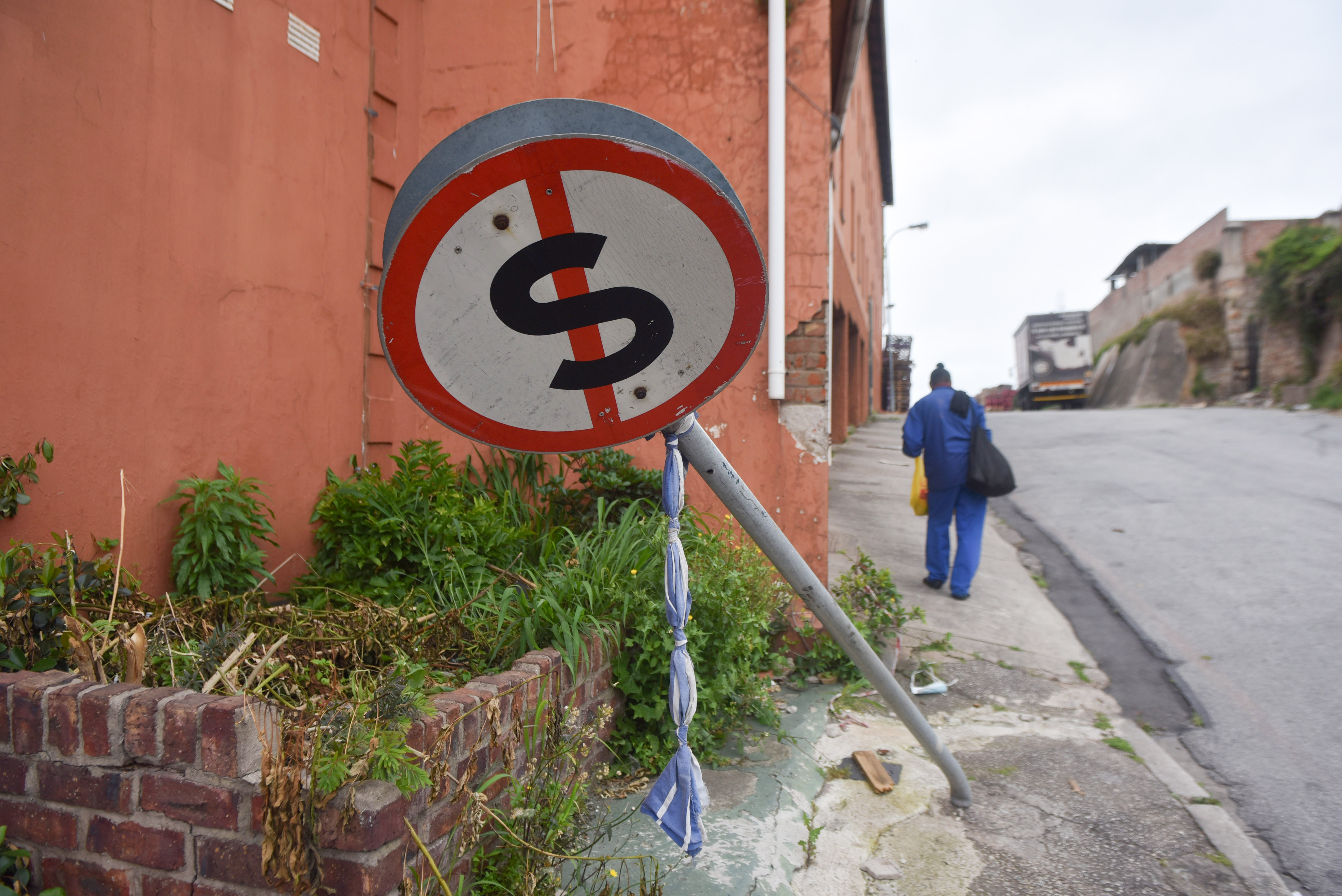
 The state of Military Road in Nelson Mandela Bay — just a stone's throw away from the seat of the local government — is a reflection of the municipal dysfunction in the metro. (Photo: Deon Ferreira)
 The Nelson Mandela Bay metro battled sky-high overtime claims, continuing electricity and water losses, and a low collection rate of municipal tariffs to run up a loss of R1.518-billion in the financial year that ended in June, the Budget and Treasury Committee heard last week.
The metro managed to reach only 53% of its service delivery targets during that year.
The overview of the financial year put water losses in the metro — which only recently emerged from a drought — at 52.74%. This means more than half of the metro’s water has been lost to theft and leaks. That is equal to 67.95 million kilolitres of water, up from 48.6% in 2023/24.
Non-revenue electricity losses, caused by factors including meter tampering and illegal connections, amounted to R1.196-billion (26.34%) in 2023/24 and escalated to R1.323-billion (26.81%) in 2024/25.
Read more: From plan to prophecy — how exiting boss foresaw chaos in NMB’s energy directorate
These devastating figures were revealed as the city entered the third week of phone lines for its Call Centre and some ward offices being disconnected because the metro failed to settle its R9.6-million bill with service provider MTN.
By late Thursday afternoon, the Democratic Alliance’s caucus was still staging a sit-in at the council chambers to demand that the problem be resolved.
The metro issued a statement that reads, “As a responsible organ of state, the municipality is obliged to manage public resources in strict compliance with the Municipal Finance Management Act and related regulations. A due diligence process is currently under way to verify the service account in full before payment is processed. This ensures that the municipality only pays for services legitimately rendered and that every cent of ratepayers’ money is responsibly accounted for.”
The metro’s communications director, Sithembiso Soyaya, said: “As soon as all disparities and issues are resolved, we will pay. We cannot pay until we are completely satisfied.”
This, he said, was being treated as a “top priority”.
Read more: Mcebisi Jonas spells out his vision to revitalise Eastern Cape’s ailing economy
With regards to electricity losses, the DA’s Brendon Pegram said: “In the previous financial year we collected R707-million less through electricity sales than what we had to pay Eskom for bulk electricity purchases.
“The electricity department now poses a significant threat to the financial sustainability of [the metro]. The persistent increase in electricity losses, now spanning three consecutive years, underscores a systemic failure in addressing both technical and non-technical losses.”
Two turnaround strategies for electricity and water were approved by the council, but it appears that no implementation plan has yet been actioned.
Read more: ‘We’ve had enough’ — churches mobilise communities amid NMB governance crisis
Overtime expenditure for 2024/25 was R415.2-million.
Last week, the ACDP’s Lance Grootboom filed a motion of exigency in the council to scrutinise the management of overtime in the metro.
Unsustainable
Pegram said the current overtime payments were unsustainable given the municipality’s financial position.
“Without decisive intervention, rising personnel costs will further exacerbate operating deficits and undermine long-term financial sustainability,” said Pegram.
For the 2024/25 financial year, which ended in June, the total operating revenue was R17.44-billion, while operating expenditure was R19.02-billion, resulting in an operating deficit of R1.58-billion.
“In respect of electricity,” said Pegram, “the municipality paid R707-million more to Eskom for bulk electricity cost than the total revenue received in electricity sales. This figure obviously excludes additional operational departmental costs, which further increase the deficit.
“It is evident that the current turnaround strategies are not producing the desired results, and the matter requires urgent review and corrective measures.”
Pegram highlighted that underspending of grant funding continued, and in the past financial year the metro spent R1.3-billion of a R1.740-billion budget.
“The underspending of our conditional grant funding is a massive concern. If one takes into consideration the fact that during the 2024/2025 financial year National Treasury already cut R309-million from our conditional grant funding, the actual rate of expenditure against the originally approved capital budget declines further to a dismal 63.59%. This underperformance not only undermines service delivery but also reflects poorly on financial planning and implementation.”
Pegram noted that a R750.6-million loan secured from Nedbank had not been spent, meaning the metro was paying interest on a loan that was not being used.
“The inclusion of the unspent portion of this loan in the 2024/25 budget seems nonsensical after the fact. Imagine including loan funding (on which you pay interest) in your budget, but you are unable to spend all of your other funding on which you don’t have to pay interest,” said Pegram.
The metro’s debt is growing, and the collection rate of municipal tariffs is falling. The average collection rate for the year was 71.07%, falling short of the adjusted target of 75%. In June, the collection rate dropped to 58.07%.
Pegram said the inability of the metro to meet even the reduced collection target reflected significant weaknesses in debt management.
“Reliance on debt relief programmes alone is insufficient; a comprehensive and effective debt recovery strategy is urgently required,” he said.
“Without decisive action to curb wasteful expenditure and implement strict cost containment measures, the municipality faces serious cash flow risks over the next three financial years.”
Lack of political stability
The CEO of the Nelson Mandela Bay Business Chamber, Denise van Huyssteen, said businesses were deeply concerned about the municipality’s parlous financial state.
“And along with this, the rapidly declining levels of service delivery. This situation has been coming on for a number of years and is a result of the lack of political stability since 2016, which has impacted upon the operational and financial stability of the municipality.
“This has been exacerbated by the high turnover and lack of permanent appointments in the role of city manager and other key leadership positions within the municipality. In fact, since 2016, there have been 17 different city managers / acting city managers and 15 of these have been since 2020.
“This lack of stable leadership has resulted in [capital funds] not being invested into [the] upgrading and maintenance of critical electricity, water, sanitation and roads infrastructure. Equally concerning is … the massive electricity losses, which are budgeted to reach R1.8-billion in the current financial year, and if left unaddressed, could in the future result in the municipality defaulting to Eskom.
“The underspending of budgets and return of grant funding to the national fiscus, and the operating deficit of over R1.5-billion is an unacceptable situation, given the current state of the metro, and the impact this has on the continuity of the operations of businesses and the wellbeing of communities.
“Given this dire situation, it is worrying [that] there do not appear to be any decisive actions to rein in electricity losses, declining debt collection levels, get municipal vehicles and tools of trade operational and vital contracts executed to ensure that streetlights are fixed and other basic services are delivered.”
/file/dailymaverick/wp-content/uploads/2025/05/NMBBC-25May-0321-1.jpg "NMB Business Chamber CEO Denise van Huyssteen (Photo: Supplied)")
Mayor warned
Six months ago, Mayor Babalwa Lobishe was warned about the impending crisis in the metro’s budget by the outgoing acting city manager, Mandla George.
In the report he filed at the end of his tenure at the metro, George, who is now employed by the National Treasury, was gloomy about the city’s prospects unless drastic changes were made.
“These results are symptomatic of a metro that has been plagued by poor and collapsing governance for several years, poor service delivery and low levels of performance,” he said.
“The metro has not had a city manager who finishes his/her term of employment. With the advent of coalition governments in 2016, the crisis became even worse in the [metro]. The problems affecting the functionality of the metro are systemic and require bold leadership, both politically and administratively, and with the right support from other spheres of government.
“To effect a set of reforms that can turn the metro around is always possible if there is consistency in the leadership across the levels (politically and administratively).”
George added that increased focus and support were needed to meet service delivery priorities across the metro.
Read more: Recurring sewage spills, collapsing pipelines and beach closures threaten Kings Beach tourism
In a letter written to President Cyril Ramaphosa, Mayor Lobishe said they were addressing the metro’s dire financial issues. She said these included the “serial non-compliance” with legislation, mismanagement of diversions, concerning findings about consequence management, material misstatements in audit reports, and a failure to implement 80% of recommendations made by the Auditor-General
/file/dailymaverick/wp-content/uploads/2025/08/ED_560569.jpg "Nelson Mandela Bay Executive Mayor Babalwa Lobishe. (Photo: Lulama Zenzile / Gallo Images / Die Burger)")
The metro’s religious leaders have written to Ramaphosa asking him to place the metro under administration.
Read more: Tick-tock … what Ramaphosa’s speech on local government means for Nelson Mandela Bay
Last week, at a roll-call event for all ANC councillors, Ramaphosa said mayors would be required to report quarterly on their efforts to improve service delivery in their municipalities and wards.
Pheello Oliphant, the spokesperson for the Eastern Cape MEC for cooperative governance and traditional affairs, Zolile Williams, said: “The metro’s R1.58-billion [loss] clearly shows signs of a non-cash-backed budget, which threatens the viability of the municipality and its future resilience against unforeseen financial shocks.
“The municipality’s immediate policy instrument is to be steadfast in the implementation of its credit control policy, reduce water and electricity losses, implement consequence management for unauthorised, fruitless and wasteful expenditure and increase its workforce productivity.” DM