




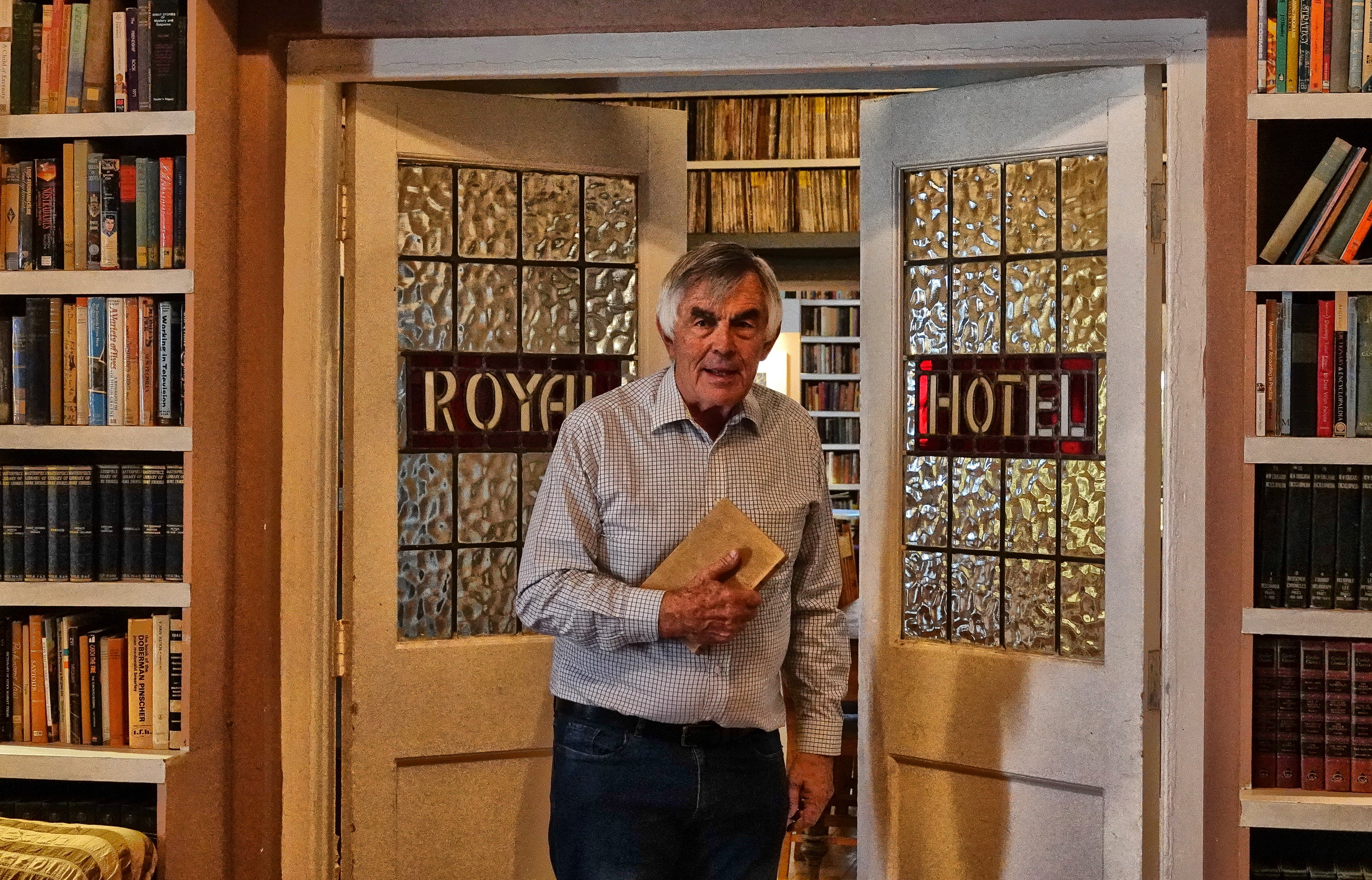
 Anthony Hocking also owns an incredible collection of old vinyl records. (Photo: Chris Marais)
 Hostelries around South Africa will tell you the items most stolen by their guests are not the bathroom smellies or the towels – it’s the novel on the nightstand.
And who can blame you for running off with that copy of The Girl with the Dragon Tattoo that you’ve become so involved in?
Now try doing that at South Africa’s first Book Hotel, the Royal, in Bethulie. It would be like stealing a choc drop from Willy Wonka – you wouldn’t know where to start.
Owner (and writer) Anthony Hocking says no one has made off with a single tome from the Royal, which has nearly every available space lined and stacked with something like 20,000 books – just a part of his 120,000-strong collection.
For bookworms like this writer, the Royal Hotel in Bethulie is indeed the candy cottage deep in the woods – except there’s no wicked witch here, only a very polite ghost occasionally seen disappearing down a corridor, deep in thought. It probably reads a lot, too.
In fact, over the years, we’ve often speculated about who that ghost could be. A previous owner, the Randlord Sir JB Robinson? The notorious Lord Kitchener, scourge of the South African War camps?
Is it perhaps the ghost of the hotel piano player who, when the British occupied Bethulie in 1900, was in the street thumping out God Save the Queen as the troops galloped by?
Or is it a certain General Charles Knox, who was at the hotel with a bunch of Canadian cowboys fighting under the flag of Strathcona’s Horse? Their rakish cowboy hats set something of a military fashion in these parts. Scoutmaster and Chief Mafeking Man Robert Baden-Powell ordered 10,000 Strathcona Stetsons for his troops.
And these Canucks, mostly recruited from the ranks of the Canadian Mounties and cow towns of the Great Northwest, were large as well. When Kitchener saw them, his eyebrows lurched skywards in shock. Their commander was also equipped with a sense of humour, assuring the Big Chief:
“My apologies, sir. I combed all of Canada and these are the smallest I could find.”
The Bethulie Camp
Which brings me to another highlight of a visit to the Bethulie Royal: Anthony Hocking’s encyclopaedic knowledge of lots of things, in particular South African War events around Bethulie.
Anthony will gladly take his guests around the historic town, revealing insider facts of the war or telling you about the life of Patrick Mynhardt, one of the town’s most famous sons, or the origin of Gariep Dam.
The main historical focus of Bethulie is the concentration camp outside the town. This infamous camp, said to be one of the worst, housed about 5,000 people, mainly Boer women and children. Of the 1,700-odd who died, more than 1,200 were children. Conditions were so bad that for months there were as many as 25 deaths every day.
/file/dailymaverick/wp-content/uploads/2025/09/manybooks-4.jpg "The Bethulie concentration camp cemetery. (Image: Chris Marais)")
/file/dailymaverick/wp-content/uploads/2025/09/manybooks-3.jpg "Headstones of some of the victims of the Bethulie concentration camp. (Image: Chris Marais)")
During the 1960s there were fears that the old camp graveyard would one day be submerged under Gariep Dam, so remains of the dead were exhumed and moved to a new site on higher ground.
The monument erected there includes an alcove bearing gravestones, and their hand-carved inscriptions comprise a bizarre kind of folk art. Pain is etched into every one.
Sunset on Orange
We drive through the township streets to get a clear sunset view of Bethulie Bridge which carries both road and rail over the Orange River. It’s the typical evening scene in a peaceful rural South African township: kids playing last-light soccer in the streets, moms getting dinner together, the old guys hanging out and shooting the breeze.
Anthony says the Dutch explorer Robert Jacob Gordon (who was here in 1777 and named the river after the House of Orange) fell into a Koranna hippo trap on the bank and lost his horse.
/file/dailymaverick/wp-content/uploads/2025/09/manybooks-10.jpg "The Orange River at sunset. (Photo: Chris Marais)")
We mention the fabled River Snake of the Orange, and he has a great local story for this:
“The old railway bridge was a lot lower than the new one. Special trains carried thousands of mineworkers travelling between Transkei and the Reef, and many of them believed that the river contained a monster snake. As the trains crossed the bridge they tossed coins from the carriages as a peace offering.
“The young boys growing up in Bethulie were well aware this was happening. When the trains were due they hid under the bridge waiting to catch the falling coins, and maybe to dive for them. I hear they did very well out of it…”
The Old Station
The next morning, before breakfast, we are at Bethulie’s old Railway Station, retired in the 1960s when the main line was diverted as part of the Gariep Dam scheme.
/file/dailymaverick/wp-content/uploads/2025/09/manybooks-2.jpg "The nearby railway bridge over the Orange River. (Photo: Chris Marais)")
This is where the Boer women and their children waited to be interned in the camp nearby. In many cases they were detained here for days, sleeping in open coal or cattle trucks with tarpaulins draped over them. The station guards prevented them from entering the buildings, even on the coldest nights. A number of people died at the station before they reached the camp.
Back at the hotel, we ask Anthony Hocking what would happen if, say, this writer fell in love with an EL Doctorow novel taken from the wall outside our room.
“Look, while you’re staying here, you can read any book you like,” he says. “But I generally don’t encourage guests to walk off with the décor. However, if you simply must take the book home with you, then just make me an offer…” DM
/file/dailymaverick/wp-content/uploads/2025/09/manybooks-8.jpg "The Royal Hotel on the main road of Bethulie. (Photo: Chris Marais)")
/file/dailymaverick/wp-content/uploads/2025/09/manybooks-6.jpg "A speed reader’s delight – it’s all about books at Bethulie’s Royal Hotel. (Photo: Chris Marais)")
/file/dailymaverick/wp-content/uploads/2025/09/manybooks-1.jpg "Owner Anthony Hocking in the lounge of the Royal Hotel in Bethulie. (Photo: Chris Marais)")
To book at the Royal Hotel, Bethulie, you can email: info@royalbethulie.co.za
Julienne du Toit and Chris Marais have co-authored many books on the Karoo. To buy their Karoo Roads Heritage Quartet for R960 including courier, email julie@karoospace.co.za.