



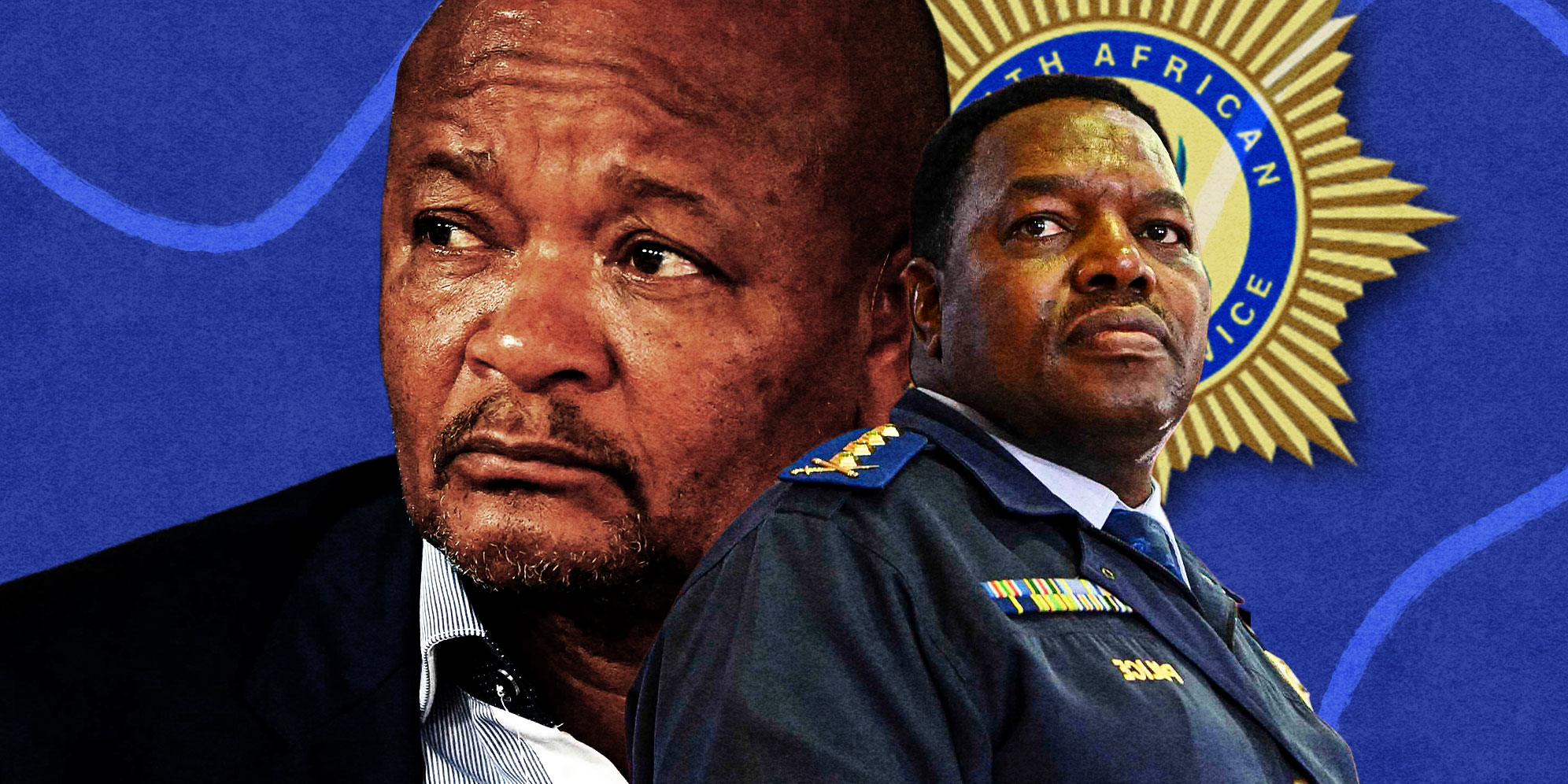
 Illustrative Image: SAPS logo. (Image: Wikicommons) | From left: Senzo Mchunu, the police minister on special leave. (Photo: Gallo Images / Mlungisi Louw) | National Police Commissioner Fannie Masemola. (Photo: Gallo Images / Mlungisi Louw)
 It was inappropriate for Senzo Mchunu, in his capacity as police minister, to order the disbandment of KwaZulu-Natal’s political killings task team (PKTT).
/file/dailymaverick/wp-content/uploads/2025/09/ED_575110.jpg "Major-General Petronella van Rooyen at Day 6. (Photo by Gallo Images/Frennie Shivambu)")
He did not have the authority to do so, and his action equated to the “usurping of powers of the national commissioner” Fannie Masemola, Major General Petronella van Rooyen, the governance, legislation and policy head at the South African Police Service (SAPS) Legal Services Division, told the Madlanga Commission of Inquiry on Thursday, 25 September 2025.
‘Unlawfully strayed’
“The minister unlawfully strayed into the constitutional competence of the national commissioner when he issued the letter for the disbandment of the PKTT,” she said.
“What would have been an appropriate path is for the minister to express that he no longer considers political killings to be a priority and direct the national commissioner to consider and take steps to align it with his directive.”
Van Rooyen was the commission’s third witness after testimony by Masemola and KwaZulu-Natal police boss Nhlanhla Mkhwanazi.
President Cyril Ramaphosa ordered the establishment of the Madlanga Commission to investigate a series of astounding accusations that Mkhwanazi initially made during a press conference in July.
During their testimony to the commission over this week and last week, Mkhwanazi and Masemola separately spoke about how they discovered that Mchunu had suddenly issued a directive on 31 December 2024 to disband KwaZulu-Natal’s PKTT.
Mkhwanazi said it appeared that someone had influenced Mchunu to make this decision, which would have benefited crime suspects who were under the impression that the PKTT was investigating them.
Read more: ‘You do your job, I’ll do mine’ — Cachalia, Masemola make amends over political murder dockets
/file/dailymaverick/wp-content/uploads/2025/09/ED_575105.jpg "Former judge Mbuyiseli Russel Madlanga at the Madlanga Commission Of Inquiry on Day 6 at Brigitte Mabandla Judicial College on September 25, 2025 in Pretoria. (Photo by Gallo Images/Frennie Shivambu)")
Both Mkhwanazi and Masemola also testified about the instruction from the deputy national commissioner of crime detection, Lieutenant General Shadrack Sibiya, to remove from the PKTT 121 case dockets that the unit was investigating.
These dockets ended up at the police head office, where they remained for five months until Masemola recently ordered that they be returned to the PKTT in KwaZulu-Natal.
While Mchunu and Sibiya both previously denied wrongdoing, both were placed on leave. Sibiya was subsequently suspended.
‘Usurping of power’
Van Rooyen testified on Thursday, the sixth day of the Madlanga Commission’s hearings, on issues related to Mchunu and Sibiya.
She made it clear that while the police minister’s role was on policy and legislation, the national police commissioner dealt with day-to-day operational matters.
/file/dailymaverick/wp-content/uploads/2025/09/ED_575118.jpg "Major General Petronella van Rooyen arrives at the Madlanga Commission Of Inquiry on Day 6. (Photo by Gallo Images/Frennie Shivambu)")
Van Rooyen said a minister could identify areas that needed special attention, for example, gangsterism and cash-in-transit crimes.
“However, a minister cannot prescribe or direct at an operational level how policy is to be implemented; that is to be left to the national commissioner,” she said.
All SAPS officials had to act in accordance with the Constitution or the law and not in the interests of a political party.
Read more: Mkhwanazi alleges SA’s new capture — malicious corruption-busters and classified intelligence leaks
Van Rooyen also said officers “cannot obey a manifestly illegal order”.
She focused on Mchunu’s directive to disband the PKTT.
“It can never be appropriate for a minister to instruct the national commissioner not only to disband the PKTT, but also to say that the disbandment must be done immediately,” Van Rooyen said.
/file/dailymaverick/wp-content/uploads/2025/09/ED_575109.jpg "Sesi Baloyi SC at the Madlanga Commission Of Inquiry on Day 6. (Photo by Gallo Images/Frennie Shivambu)")
“That constitutes not only a usurping of the powers of the national commissioner, but also undermines the constitutional objectives of the SAPS… especially in respect of ongoing criminal investigations and the potential risk that further crimes may be committed.”
She reiterated this a few times during her testimony.
At another point, Van Rooyen said: “From a regulatory standpoint… I am of the view that the decision to disband the PKTT as a task team lay within the exclusive authority of the national commissioner [Masemola] and that the minister did not have the legislative authority to disband the PKTT, let alone in the manner in which he did.”
Masemola, when testifying earlier this week, on Tuesday, said that he had tried to get Mchunu to provide him with reasons about why, on 31 December 2024, he directed the PKTT to be disbanded.
He said Mchunu at some point told him that political killings had only happened before 1994, when South Africa became a democracy, and that “what is happening now is just murders”.
Mchunu had therefore tried to use this alleged stance, which Masemola countered was false because political killings were clearly happening, to suggest the PKTT was no longer necessary.
‘Stagnant investigations’
Van Rooyen also focused on the 121 PKTT dockets linked to Sibiya.
Mkhwanazi previously said he removed the dockets from the PKTT on Mchunu’s orders. Van Rooyen said that an instruction relating to the movement of the dockets should have come from Masemola.
Read more: Dithering Ramaphosa may have to testify before policing inquiries
/file/dailymaverick/wp-content/uploads/2025/09/ED_575101.jpg "Major General Petronella van Rooyen. (Photo by Gallo Images/Frennie Shivambu)")
She said an issue that “raises alarm” about the dockets was that removing them from the PKTT meant that related investigations became “stagnant”.
In the time that the dockets were removed from the PKTT (about five months), Van Rooyen said evidence could have been lost, and witnesses’ recollections may have faded.
She also said that if firearms formed part of the investigations, which effectively became stagnant, it meant that these could “be used to commit crime”.
Van Rooyen acknowledged that the removal of the dockets from the PKTT could be tantamount to suppressing investigations.
Parliamentary oversight ‘failure’
During her testimony, she pointed out that Parliament’s police committee had flagged that the Independent Police Investigative Directorate had a backlog of 14,469 cases.
Delays in dealing with these cases could affect police accountability, she said.
Van Rooysen also referred to a parliamentary police committee meeting in March this year – roughly four months before Mkhwanazi held his press conference, during which he made the accusations that led to the Madlanga Commission.
/file/dailymaverick/wp-content/uploads/2025/09/ED_574152.jpg "KwaZulu-Natal (KZN) Police Commissioner Lieutenant-General Nhlanhla Mkhwanazi at the Madlanga Commission Of Inquiry on Day 3. (Photo: Gallo Images / Lefty Shivambu)")
Mkhwanazi and Mchunu had been among those present at the March meeting in Parliament. Issues touched were among those addressed in Mkhwanazi’s subsequent press conference.
Van Rooyen said on Thursday that she would have expected the parliamentary police committee to have acted on the issues discussed in its March meeting.
“The fact that the portfolio committee didn’t act on that is, in my mind, a failure of their mandate,” she said.
“Even if they initiated an investigation [or] called the management of the police to come and explain, that would’ve already been an exercise of oversight on their part to ensure that the matter received attention.”
After Mkhwanazi’s July press conference, it was decided in Parliament that an ad hoc committee would run parallel to the Madlanga Commission to investigate Mkhwanazi’s allegations and related issues.
Parliament’s ad hoc committee has not yet officially begun its hearings, which are expected next month.
The Madlanga Commission, meanwhile, is expected to continue on Friday. DM