




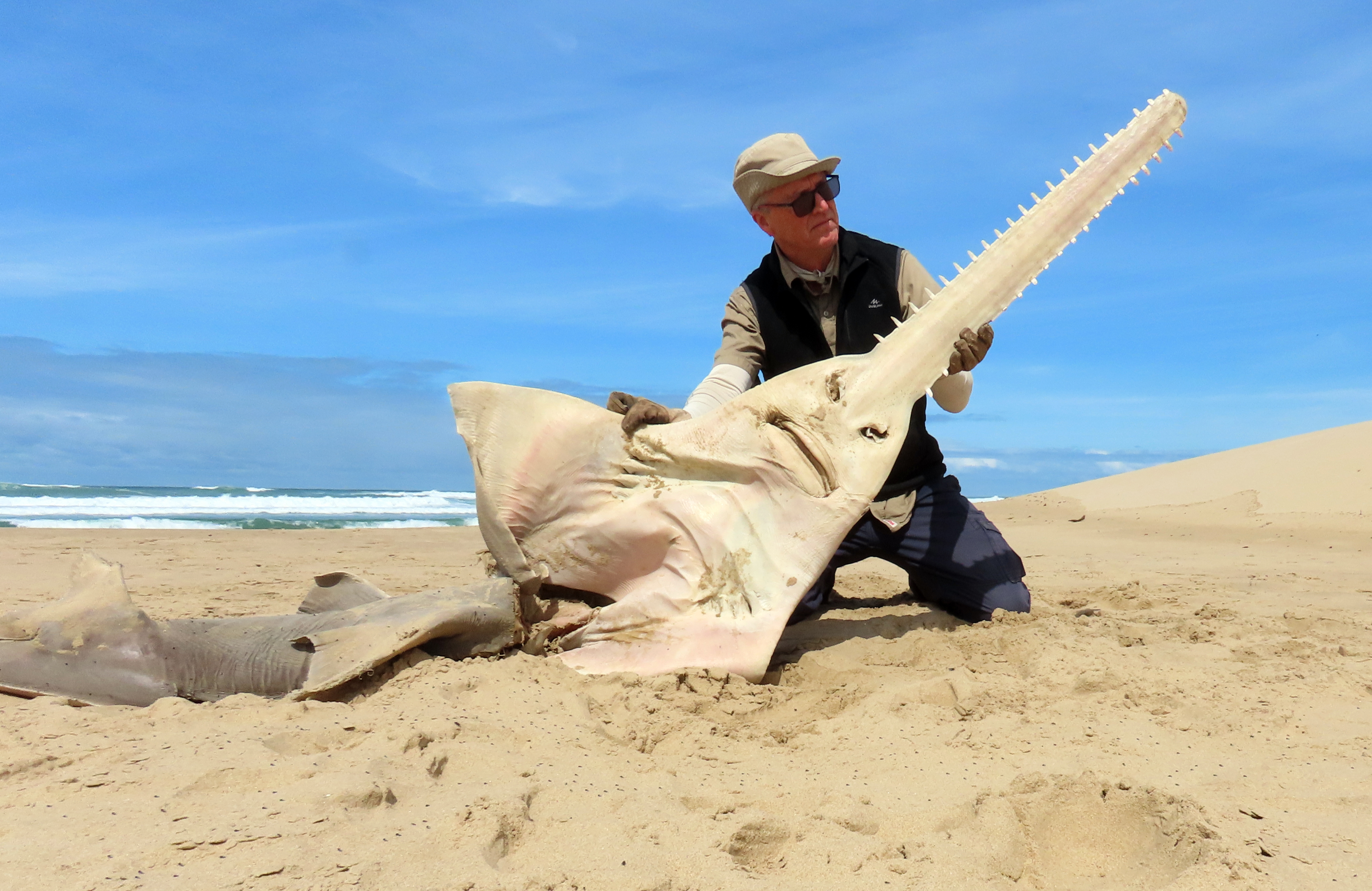
 East London Museum natural scientist Kevin Cole with the sawfish. (Photo: Supplied)
 The carcass of a 3m-long largetooth sawfish, long thought to be extinct along the South African coast, was discovered at the Birha River mouth last week.
“Man, we are very excited. The last record of this fish was from 26 years ago,” Geremy Cliff, division head at the KwaZulu-Natal Sharks Board said. “The ocean is very big and they can hide away from us in many places. It is really good to know that they might still be out there somewhere.”
Kevin Cole, a natural scientist at the East London Museum, said he was first contacted by a resident who had found and photographed the carcass on the beach at the Birha River mouth. “It is a big one,” he said.
“On Friday, 19 September 2025 I received a message in the morning from Mike Vincent at Birha village that he had photographed a sawfish. Recognising that the species was rare, I immediately set off to investigate, having received a pin location that the sawfish was west of the Birha River mouth.
“The carcass of the sawfish was reasonably intact. However, I noted that it had been predated upon, with a good piece of the underside missing as well as the internal organs. The area behind the head had also been sliced, with large bits of flesh and skin missing – this had been done post mortem with a knife,” Cole said.
/file/dailymaverick/wp-content/uploads/2025/09/IMG_2486-001.jpg "A close-up picture of the dead sawfish, with gloves for scale. (Photo: Kevin Cole)")
“Unfortunately, the sawfish was in a state of active decay, noted by the many gulls feeding on the carcass when I arrived. It was difficult to get an accurate total length so I measured it from the tip of the toothed rostrum (beak-like snout) to the insert of the caudal (tail) fin. This measurement was 2.93m.
“I was reluctant to immediately make a call on the species but after examining the position of the dorsal fin set just in front of the pelvic fins and by counting the large teeth (21 on either side, with a few missing), these morphometrics should confirm the species to be a male largetooth sawfish (Pristis pristis).
“I didn’t recognise the full significance of the discovery until shark scientist Geremy Cliff contacted me and referenced a scientific paper published in 2015… He further commented in an email: ‘This is a highly significant event as the last documented sighting of a sawfish along the South African coast was a capture in 1999, 26 years ago!".
“After taking two skin and muscle samples for shark researchers who would like to undertake genetic studies, I also removed the head with the 70cm rostrum to secure it for further study. It was a task securing the weighty head as it had to be dragged almost 700m on a canvas tarpaulin to the museum vehicle to be frozen later at work.”
/file/dailymaverick/wp-content/uploads/2025/09/IMG_2688-002.jpg "The heavy head of the sawfish, with a 70cm snout, had to be dragged on a canvas to a museum vehicle. (Photo: Supplied)")
/file/dailymaverick/wp-content/uploads/2025/09/IMG_2524-002.jpg "A picture taken while the carcass of the sawfish was examined. (Photo: Kevin Cole)")
Cole said he was initially working by himself to recover the carcass and had to drag the heavy fish back to his vehicle on his own for most of the way. “There was not another person in sight at first but I must say thank you to a guy called Stoffel who is from the Free State who helped me the last bit of the way.
“This is a valuable record for a number of reasons: it revitalises research interest in the species in our area, the question around the type of predator on the largetooth sawfish, and highlights the conservation status of the species.”
Cliff said sawfish are easily entangled in gill nets because of their snouts. “They live on the seabed and mostly eat shellfish because they have flat teeth that are designed for crushing. Their mouths are fairly small,” he explained, adding that they also venture into river mouths and had previously been seen in estuaries.
Sawfish also eat small fish. “When a shoal of fish senses danger they will make a ball and the sawfish will then use its snout to slash through the ball.” The little fish gets stuck on the snout which the sawfish then rubs on the sand to dislodge and eat its prey.
Pristis pristis was classified as critically endangered in 2022 and possibly extinct in South Africa, according to the International Union for Conservation of Nature. Another species, the green sawfish (Pristis zijsron), has also been declared critically endangered and possibly extinct on the South African coast.
/file/dailymaverick/wp-content/uploads/2025/09/IMG_2478-001.jpg "Measurements being taken of the dead sawfish. (Photo: Kevin Cole)")
Dr Bernadine Everett, a scientist at the Oceanographic Research Institute and the regional coordinator for WIOFIsh, the Western Indian Ocean Fisheries Database, said the find was exciting.
Sawfish are recognised globally as one of the most endangered species of sharks and rays. Everett points out that there is a record of them coming as far down the East Coast as Port Alfred.
In a paper she wrote with Cliff in 2015 she explained that during the 1930s sawfish were reported as one of the most common elasmobranchs [a subclass of rays and sharks] found in KwaZulu-Natal and Delagoa Bay (now Maputo Bay) along the Mozambique coast.
The paper continues that they were common along the KwaZulu-Natal Coast and the East Coast, with records dating to the 1960s, but “apparently have disappeared from this area”.
She said she could find records of 150 green sawfish, seven largetooth sawfish and 89 unidentified sawfish. Most sawfish (115) were caught during a four-year (1967 to 1970) gillnetting survey conducted by the Oceanographic Research Institute in the St Lucia estuarine system while 91 were caught in the bather protection nets installed and maintained along the KZN coast by the KwaZulu-Natal Sharks Board.
In South Africa, both species were reported to have occurred off KZN and the Eastern Cape, as far south as Port Alfred.
/file/dailymaverick/wp-content/uploads/2025/09/IMG_0439-001.jpg "A wide view of where the sawfish was found at the Birha River mouth, about 90km from East London. (Photo: Kevin Cole)")
Cliff said they were calling on the public who have historic records of the sawfish along the East Coast or have seen the species recently to get in touch so they can update their research.
He cautioned that the sawfish must not be confused with the sawshark, which has a similar-looking snout but it is found in deeper water and is much smaller.
“Ideally we want a photograph because then there will be no doubt,” he said.
He added that, because the sawfish is a tropical species it would be more common along the KZN coast and part of the Eastern Cape coast, since going down too far will take them into lower temperatures.
“Historically there were many of these fish along the East Coast,” he added.
Referring to the current specimen, he confirmed it does look like something took a bite out of it and noted researchers are doing genetic tests to determine if the bite was from scavengers feeding on the carcass or if the bite caused its death.
Cliff added that researchers who are looking into orca attacks on white sharks will also get involved to see if they can determine whether the sawfish may have been killed by an orca.
He said that, while all their research points to the last sighting of the sawfish along the South African coast being in 1999, it is possible that since then someone has seen it, so they are also looking for historical records.
Also read: Relic of the past — Eastern Cape storm uncovers what could be a historical find
Cole said they had received a few reports since the recovery of the carcass that similar fish had been seen at Kayser’s Beach, about 35km from East London.
In addition to taking a picture and noting its geographical location, it would be important to measure the fish, if possible. DM
If anyone has seen this species recently or has caught one, please contact Bernadine Everett (bernadine@ori.org.za), Geremy Cliff (gcliff21@gmail.com) or Kevin Cole (kcole@elmuseum.za.org).