



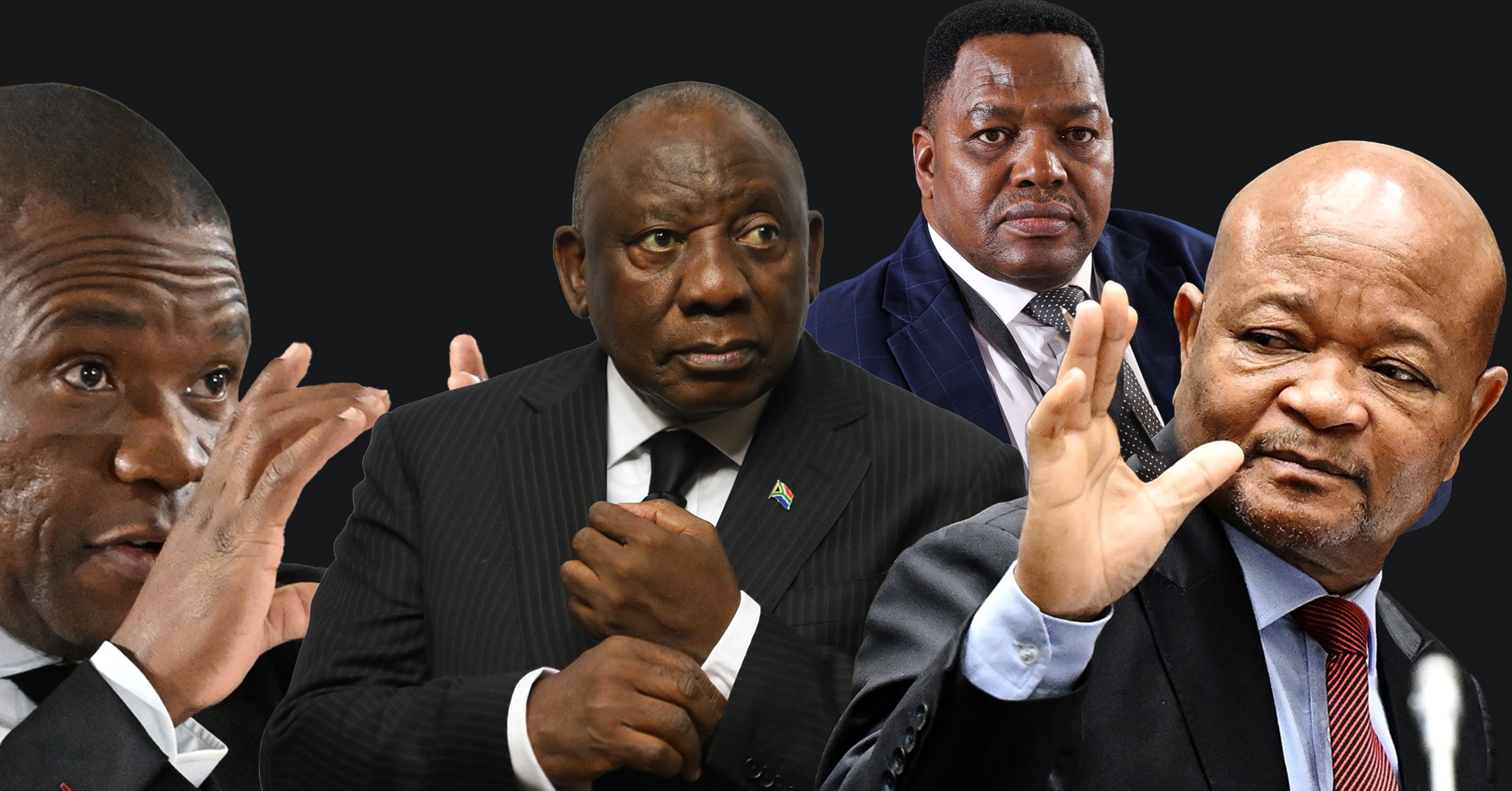
 Illustrative image | KwaZulu-Natal Police Commissioner Lieutenant General Nhlanhla Mkhwanazi at the Madlanga Commission of Inquiry. (Photo by Gallo Images/Lefty Shivambu) | President Cyril Ramaphosa. (Photo: Dwayne Senior/Bloomberg via Getty Images) | National Police Commissioner Fannie Masemola. (Photo by Gallo Images/Luba Lesolle) | Suspended police minister Senzo Mchunu. (Photo: Phando Jikelo / RSA Parliament)
President Cyril Ramaphosa may have hoped to stay well clear of the Madlanga Commission — but things aren’t working out that way.
After the testimony of National Police Commissioner Fannie Masemola on Tuesday, there must be a possibility that Ramaphosa will appear before the commission — either voluntarily or involuntarily. The commission’s terms of reference give it the power to summon witnesses.
In Parliament’s parallel inquiry probing the alleged infiltration of law enforcement by criminal syndicates, Ramaphosa has also been named as a potential witness.
The Presidency told Daily Maverick on Tuesday it would not respond to evidence piecemeal, but would “look at the entity of the evidence delivered before deciding the manner and approach of our response”.
Some four years after Ramaphosa was seated in front of a commission of inquiry, testifying about — in part — murky crime intelligence matters, he may find himself in that situation again.
But, while at the Zondo Commission he was given partial political cover by the fact that the events he was testifying about took place while he was only the country’s Deputy President; in 2025, the buck stops with him as the man at the top.
And observers might be forgiven for asking: What has really changed between those two commissions?
Task teams and commissions of inquiry for everyone
Ramaphosa has thus far entered the proceedings of the Madlanga Commission in two contexts.
The first mention was during the testimony of this saga’s original whistleblower, KZN Provincial Police Commissioner Nhlanhla Mkhwanazi, and was relatively neutral.
In his evidence, Mkhwanazi sketched the history of the contested KwaZulu-Natal Political Killings Task Team (PKTT), which itself grew out of a previous task team, which was then followed by another commission of inquiry — in itself a bleak reflection of how intractable the problem of KwaZulu-Natal political violence has been.
It also reflects the two favourite political instruments of ANC presidents: task teams and commissions of inquiry, often costing vast amounts and taking years.
Following the work of the Moerane Commission, which was established to look into KZN political violence in 2016, Ramaphosa appointed an interministerial committee (IMC) in 2018 drawn from the security cluster to address the problem.
It was this IMC that gave the green light to a reformulated task team, officially known as the Integrated Multi-Disciplinary Political Killings Task Team, which Mkhwanazi described in his evidence as: “essentially an ad hoc, interdisciplinary unit within SAPS, tasked with investigating political killings, with an initial operational focus in KZN that later extended nationally”.
So far, Ramaphosa had acted entirely according to brand. He had taken note of the findings of a commission of inquiry and appointed a team to consider the problem, which concluded that another team should be constructed to address it.
Mkhwanazi’s testimony, in other words, didn’t pose any difficulties to Ramaphosa.
Those started when Masemola took the stand.
Competing versions of Ramaphosa’s role
Masemola’s narrative has been that he was shocked when he received the instruction from Police Minister Senzo Mchunu to disband the PKTT on 31 December 2024 because, in his estimation, the PKTT was so successful that the decision was downright sinister.
Masemola said he was distressed that Mchunu had not sought to consult more widely about this decision and took his concerns to Ramaphosa on 1 February 2025.
“During this meeting, I mentioned the minister’s directive to disband such a successful team, and the President told me that he would speak to the minister,” Masemola testified on Monday.
“The President did come back to me to say he talked to Mchunu but did not tell me about the outcome,” he said.
At this stage, nothing further is known about the discussion between Ramaphosa and Mchunu.
On Tuesday, however, Masemola testified that Mchunu subsequently told him that “he [Mchunu] did not understand why we were so adamant that the PKTT must not be disbanded. He said the President was in agreement that the PKTT be disbanded.”
Masemola made it clear to the commission, however, that he did not believe Mchunu, because during his own meeting with the President, Ramaphosa was “taken aback” when he heard of the PKTT disbandment.
Mchunu has yet to testify, so we don’t know what his version of these meetings will be.
Not a pretty picture of political decisiveness
The picture that is building of Ramaphosa’s involvement, however, is not favourable.
If Masemola’s account is accurate — and presidential meetings can usually be verified through the official diary — Ramaphosa knew from the beginning of February both that there were plans afoot to disband the PKTT, and that the decision was extremely controversial, opposed by several leading police officers, and likely to bring the factionalism at the highest echelon of the SAPS to a boiling point.
What did the President do in response?
That is the question that Ramaphosa may want to account for at the Madlanga Commission.
Did he give his private assurances to his police minister — a staunch Ramaphosa ally, in part responsible for delivering him the ANC presidency at Nasrec 2017 — that he supported the move, after expressing shock to his foremost police officer at the thought?
Did Mchunu give him information about the PKTT that convinced him the closure was necessary and changed his mind?
These issues are important, because what we have heard at the Madlanga Commission is that Mkhwanazi and Masemola did everything in their power to alert colleagues and political seniors to an alleged conspiracy to protect Gauteng crime cartels, warnings that went unheeded. In their version, it was sheer desperation that prompted Mkhwanazi to go public with his allegations at his July press conference, complete with menacing sidekicks in army fatigues as a show of strength.
After this, Ramaphosa did act, but, as is plain to see, because his hand was forced. The remedy, as always: a commission of inquiry.
These are very early days in the Madlanga Commission, and the evidence to come from the likes of Mchunu and Deputy National Commissioner for Crime Detection Shadrack Sibiya — both currently on ice, professionally speaking — may yet turn all this on its head.
/file/dailymaverick/wp-content/uploads/2025/07/ED_555442-1.jpg "Lt-Gen Shadrack Sibiya. (Photo: Frennie Shivambu / Gallo Images)")
Yet the impression gleaned from the commission so far does nothing for Ramaphosa’s reputation as a ditherer who delays, defers or refuses to make hard decisions — particularly when they involve useful political allies.
The wider underlying question raised by the chilling allegations heard by the inquiry, however, is: What of the New Dawn?
The Madlanga Commission has heard allegations that private citizens have had access to information from the very top of the security cluster, including on hiring decisions before they have been publicly announced. The spectre of the Guptas, who had access to the same kind of classified intel, is impossible to ignore. Did the capture of the state move seamlessly into the hands of hitmen and drug cartels in the post-Zondo era?
We don’t know anything categorically yet.
But listening to South Africa’s leading police officers lay bare their factionalism and infighting at the commission, one was reminded of one man’s assessment of the historical state of the country’s crime intelligence: “In the past it tended to serve certain factional interests, be it in the governing party or otherwise.”
That was Cyril Ramaphosa, testifying before the Zondo Commission in 2021. Can he tell the country with a straight face that much has changed since? DM