




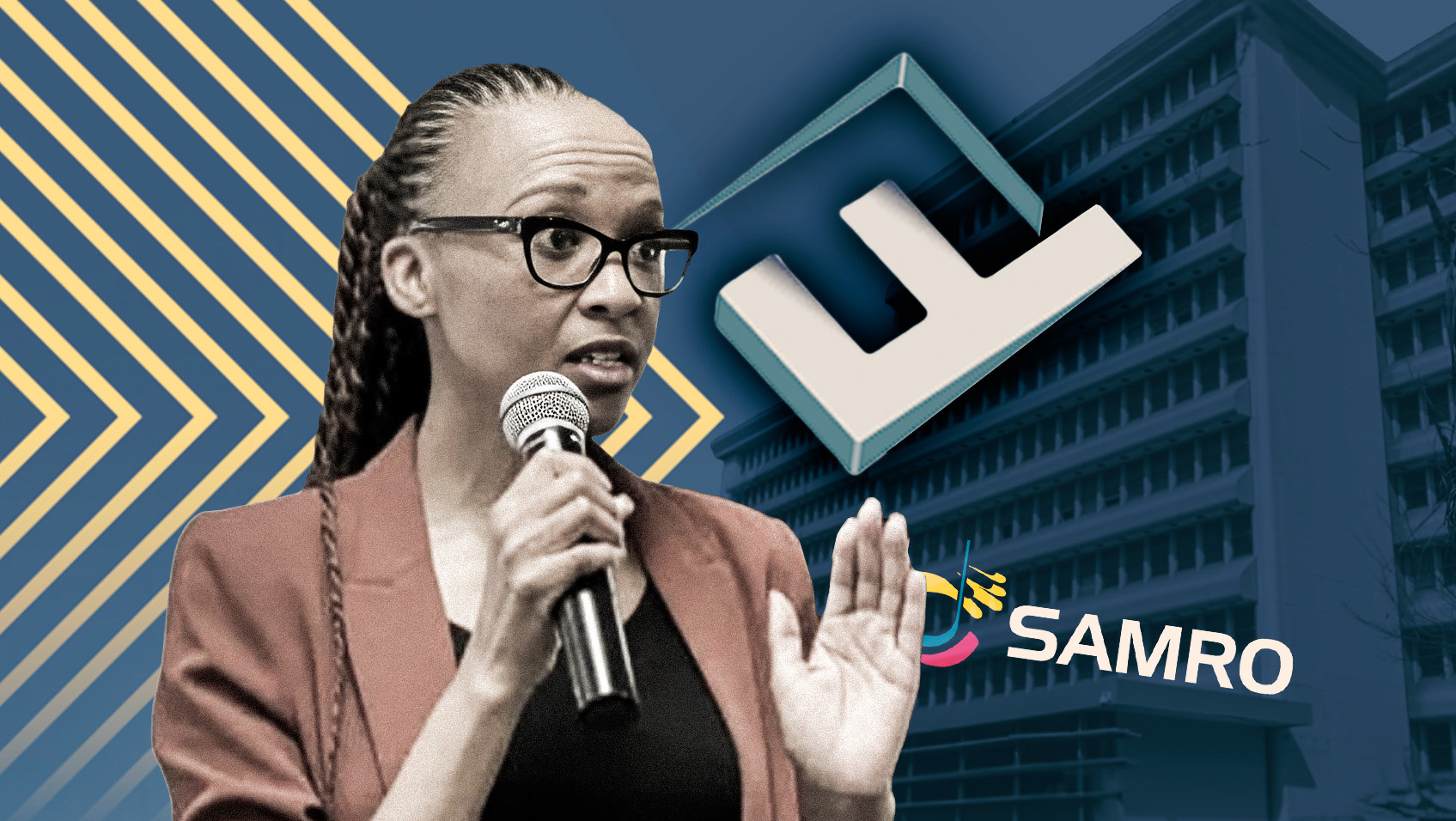
 Samro COO Mpho Mofikoe speaks to members about findings in the Fundudzi forensic report into allegations of fraudulent royalty claims, before her suspension in July 2025. (Photo: Supplied)
 In 2020, the Southern African Music Rights Organisation (Samro) launched a new digital platform that opened up its entire undocumented works catalogue to all 156,000+ of its members, instead of just the larger music publishers who dominate the industry.
Despite Samro’s stated good intention of opening the portal to make the claims process easier and more transparent for members, this proved to be a catastrophic decision.
“These royalties are not the property of Samro but belong to our members and cannot remain unclaimed indefinitely,” wrote the organisation in a prepared response to questions from Daily Maverick. “Allowing members to claim their works ensures that the rightful owners receive their due compensation.”
In 2022, almost R62-million in claims made via the platform were investigated by Fundudzi Forensic Services, triggered by a multimillion-rand payment to a company called Sheer Publishing, which was intercepted and deemed irregular.
According to Fundudzi’s report, “Members claimed a combined amount of R61,985,176 for the GY2020 to FY2022 period; of [that] R31,384,854 was paid by Samro.”
Crucially, the report stated, “There is no indication that [the] members [who were] paid submitted proof of copyright for the works claimed.” The report called for further investigation.
Two of the world’s largest music publishers, Sony Music Publishing and Universal Music Publishing Group, were collectively implicated to the tune of millions. Whether their claims were fraudulent or not is the subject of ongoing investigations. These publishers’ record labels have been embroiled in various scandals in South Africa over the past 15 years.
/file/dailymaverick/wp-content/uploads/2025/09/IMG_4491.jpg "(Photo: Screengrab)")
Read more:
- Tribe One Dinokeng – Almost 10 years later, details emerge of South Africa’s disastrous ‘Fyre Festival’
- An Embarrassment of Royalties (Part One): What can break the music industry’s culture of impunity?
A tsunami of broken data links
Samro was established in 1961 to ensure artists, composers, authors and publishers of music receive royalty payments whenever their work airs in a public manner or forum. In 2024, those royalty revenues amounted to R683.8-million, according to the organisation.
Those hundreds of millions of rands represent millions of songs, and hundreds of thousands of artists, composers and publishers. In short, a tsunami of data to process, week in and week out. Unfortunately, those data are the only link artists have to the asset they have created after it’s been released into the world — and the system is extremely easy to abuse.
The system Samro has built to administer that tsunami of data links is, confoundingly, still manual in many ways. Administrators receive data that’s been filled in by a radio station manager or a big-box store clerk, sometimes digitally, sometimes by hand. Samro still keeps physical lists of whose songs were played where and for how long.
Administrative mistakes, like leaving the “l” out of the surname of an artist named Katlego or the “g” out of Lategaan, disconnect that unique piece of music from its creator. The link is broken. That piece of music is known as “undoc” — undocumented work. It has earned royalties, but its creator may not know that and, as a result, doesn’t claim them.
To make matters more complicated, there are very few songs on the airwaves that have been made by a single person. The asset is “split” into percentages of ownership. The work’s inherent value belongs in part to the person who wrote the melody or the lyrics; in part to the person who sang it into a studio microphone or laid down a drum track for it, and in part to the person who was asked to publish it, so that it could obtain a commercial value in the first place.
That complex piece of undoc becomes just one of a catalogue of other undocumented works that contains everything from Bach’s Brandenburg Concertos to radio jingles for kitchen cleaners. In other words, a pool of assets so large, opaque and difficult to administer that it can only be classified as a slush fund, as this reporting will reveal.
In the 2021/2022 financial year alone, Samro declared R24-million worth of works undoc, according to the forensic report.
/file/dailymaverick/wp-content/uploads/2025/09/IMG_4285.jpg "Samro member William Mthethwa stands outside the Samro building in Johannesburg. Although he is a popular gospel composer with hundreds of works registered, he says he hasn't received a commensurate amount of royalties from the organisation. (Photo: Diana Neille)")
A vending machine of musical works
A musical work in undoc is like a soda inside a giant vending machine. In theory, if you can prove it’s yours with documentation, it gets released, drops to the dispenser, and you can take it out and claim it. But the “Forensic investigations into allegations of irregular payments of undocumented works”, completed in July 2023 by Fundudzi Forensic Services and now in Daily Maverick’s possession, shows just how easy it could be for Samro’s vending machine to be robbed blind. It also shows how its own employees and board members could have been some of the first to try to shake it down.
Instead of accidentally leaving the “l” out of Katlego or the “g” out of Lategaan, publishers and artists, some of whom were Samro board members, were working with employees on the inside to purposely take them out — changing data in subtle ways, to help them claim works as their own, or claiming works with obscure or general-sounding titles to begin with.
Before the new “undoc claim tool” was launched in 2020, it was only larger publishers, some represented by the board, who were able to access undocumented works.
Daily Maverick can now reveal that Sheer Publishing has been recommended for criminal investigation “in respect of undocumented musical works” that had been claimed, which were “alleged to have been irregular”, between 2020 and 2022.
The report found that Sheer Publishing made these irregular claims on behalf of several different clients, who are all included in the top 60 list — evidence of which will be laid out in an upcoming story.
The report also revealed how Sheer and others could have gone about making those claims, several of which were flagged and intercepted before they could be paid out. The report found that a manager named Clint Louw worked at Samro until March 2018, according to the organisation, and was subsequently “recruited by David Alexander and [Sheer stakeholder relations manager] Mandrew Mnguni to work for Sheer Publishing as a consultant”.
He also went on to work for Sony Music Publishing, which the report also recommended for further investigation. Sony Music Publishing, headquartered in New York, is the world’s largest music publishing company.
Louw did not respond to multiple requests for comment, and Sony Music Publishing declined to comment as the investigation is ongoing.
In a written response to questions, Alexander defended the recruitment of Louw as a necessity and “a common practice for large publishers to use consultants to assist with the practical challenges of properly analysing the undocumented claims.
“These large publishers are responsible for significant amounts of data, which has resulted in practical challenges,” he wrote. “It is for this reason that many large publishing organisations, including Sheer Publishing, have had to use individuals that would assist in the process of working through the information on the portal, to help serve their writers as much as possible, despite these challenges.”
Despite having been a Samro employee at a managerial level, Louw told investigators he was “of the view that members can submit claims against undocumented works, even though [they] do not have any proof that such works belong to them.” Should they be caught out, “such claims can simply be reversed without any consequences”, he told them.
Louw also revealed to investigators that, while at Samro until his resignation in 2018, his clients included David Alexander and Mandrew Mnguni of Sheer Publishing, Rowlin Naicker at Sony Music Publishing and EMI and Ryan Hill at Universal Publishing, as well as the local record label Gallo.
Hill did not respond to a request for comment.
Alexander wrote that Sheer was as defrauded as Samro and the rights-holders were, because Louw abused his role and his access to Sheer’s database to misdirect claims, despite having been hired to assist in the legitimate process of “making accurate claims on the undoc list”.
Alexander, Mnguni, Naicker and Hill are all past and present board members of Samro, and were all sitting board members at the time the Fundudzi investigation was commissioned.
Alexander served from 2018 until 2022, and Mnguni from 2021. In an extraordinary general meeting on 10 July, the then board chair, Nicholas Maweni, told Samro members that Alexander and Mnguni had been asked to resign, a claim which Alexander denies, saying he stepped down because his term was up. Naicker and Ryan were removed from the board in July 2025 by member vote, but were reinstated in August.
Read more: SA Music Rights Organisation board and executives flee offices to avoid members’ ire
/file/dailymaverick/wp-content/uploads/2025/09/View-recent-photos.jpeg "Members of Samro listen to an Extraordinary General Meeting through a loudhailer in an empty office at the organisation's HQ after they found the offices deserted and staff logging in to the meeting online from undisclosed locations. (Photo: Diana Neille)")
Damage control
In the course of its investigation — which Samro tasked COO Mpho Mofikoe with setting up, before suspending her earlier this year — Fundudzi investigators identified 60 publishers and authors or composers who submitted “the most value of undocumented works” and “the highest number of claims from undocumented works”. Where they identified possible fraudulent activities, they recommended that criminal charges be opened.
Mofikoe was suspended before all 60 of those implicated could be fully investigated by Fundudzi investigators or the Hawks, who launched an investigation of their own. According to the report, “the investigation only covered a small part of undocumented works”.
On June 22, 2023, ostensibly on the basis of the Fundudzi recommendations, an affidavit filed in the public domain at Hillbrow Police Station shows that Mofikoe opened a case with the Directorate for Priority Crime Investigation, “in accordance with [her] obligations as Chief Operating Officer as well as for and on behalf of [her] employer, Samro with the view to complying with section 34 of the Prevention and Combating of Corrupt Activities Act 2004”.
In the affidavit, Mofikoe confirmed that publishers and composer/authors who submitted irregular claims were “paid for the works claimed, even though the works did not belong to them … by misrepresentation”, and that “the criminal elements of fraud … is reasonably suspected [but] subject to formal criminal investigation [sic].”
The affidavit further stated that Mofikoe had been formally tasked by Samro to first investigate fraud allegations and then to open a criminal case.
In the forensic report, its authors state that, in its primary role to administer royalties to its members, “any allegations of irregularities made in relation to how Samro deals with its members … should be dealt with decisively by the organisation”.
Instead, Samro buried the report — although it denies this — and suspended Mofikoe two weeks after she revealed details from the investigation at an extraordinary general meeting. Samro said in its response to questions that Mofikoe’s suspension was “precautionary … to allow for a thorough internal investigation into allegations of misconduct”. DM