





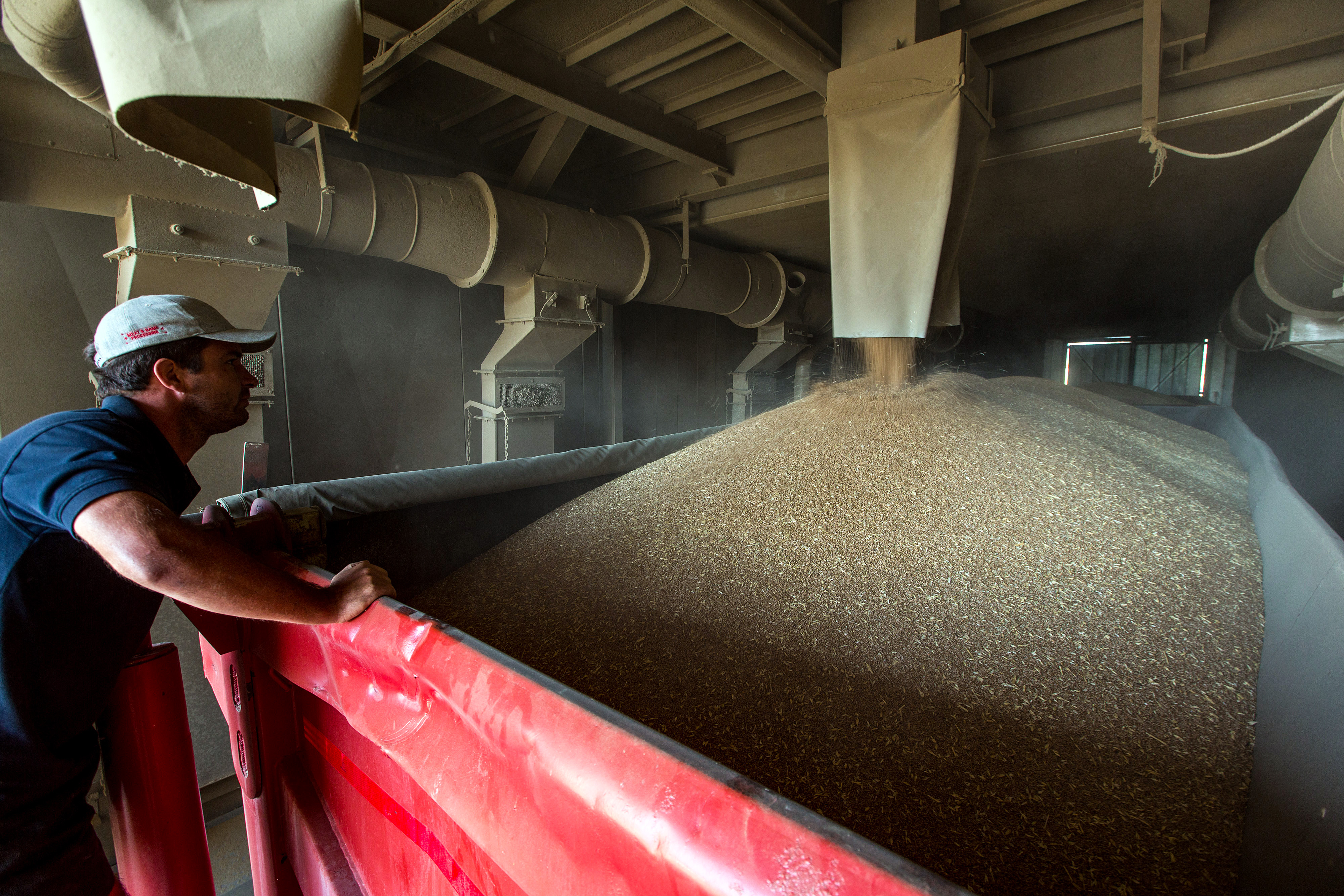
 Researchers suggest buffer stocks could help keep prices for certain foods like wheat, maize and oil stable despite market fluctuations.(Photo: Dwayne Senior / Bloomberg via Getty Images)
 Since 2020, South Africa has experienced persistent food price increases and volatility, linked to climate change, global market disruptions, high input costs and the concentrated corporate control of food value chains. The price spikes include staples such as maize, wheat and cooking oil, which has a big impact on low-income households especially, where food accounts for more than 50% of monthly expenditure.
One way to address this is buffer stocks, according to economic researchers at a dialogue on 17 September 2025, held alongside the food security G20 working meetings in Cape Town this week by the Institute for Economic Justice, Heinrich Böll Stiftung Southern Africa and Rosa Luxemburg Stiftung.
Buffer stocks are government-managed reserves of commodities aimed at stabilising market prices by buying excess supply during good harvests and releasing stocks during shortages.
Refiloe Joala, who manages the Food Sovereignty Programme at Rosa Luxemburg Stiftung Southern Africa, explained how buffer stocks can help the country have physical access to food when there is a scarcity usually created by climate change and related to lower harvests or conflict.
Citing the example of the 2022 cooking oil price spike due to the Russia-Ukraine conflict, she said the increase was due to the anticipation of input costs even though oil seed prices were low at that time. “So there was no tangible reason for the price increase.”
Joala said the buffer stock model could help to protect consumers from this.
“There are examples in Ghana where the government is able to ensure that farmers get fair prices that are above market price,” she added.
Mervyn Abrahams, the programme coordinator at the Pietermaritzburg Economic Justice and Dignity Group, said he could see how buffer stocks could protect against price shocks and help people to afford foods such as fruit and vegetables.
/file/dailymaverick/wp-content/uploads/2025/09/07816fe2-b8f5-4586-a3f4-654d7fbf64b2-1_all_50512.jpg "From left: Mervyn Abrahams of the Pietermaritzburg Economic Justice and Dignity Group, Andrew Bennie of the Institute for Economic Justice, and Refiloe Joala from the Rosa Luxemburg Foundation at the dialogue in Cape Town on 17 September 2025. (Photo: Naledi Sikhakhane)")
“In August of 2021… the cost of that basket of 44 (basic food items) stood at R4,241. Today, at the end of August this year, that has increased to R5,380. So in that period, we have seen a more than R1,000 increase, just in the cost of that basket…”
Abrahams said his understanding of buffer stocks was that the state buys when prices of certain cereals are low, and when the prices spike (“what we call the inflationary impact”) the state releases the stocks into the market to keep prices as stable as possible. “So, the objective really is to do away with this massive spiking in prices that we see. Because the spiking of prices, when your income level and your budget is fixed, means that you, of course, cannot afford it.”
The G20 Dialogue Series on Food Justice and Buffer Stocks aims to connect grassroots and community-based experiences to global policy debates.
New initiatives
Since 14 September there have been different food security and agriculture meetings, which will culminate in Minister of Agriculture John Steenhuisen and his deputy, Nokuzola Capa, leading the G20 Agriculture Working Group and Food Security Task Force ministerial meetings on 18 and 19 September at the Lord Charles Hotel in Somerset West.
The Department of Agriculture is hosting these meetings under the themes “Data-Driven Approaches to Addressing Food Security” and “Promoting Inclusive Agricultural Investment and Market Access”. The meetings form part of a broader public participation programme implemented by the government, aimed at profiling and promoting South Africa’s presidency of the G20, the theme of which is “Solidarity, Equality, Sustainability”.
The minister, at the third working group meeting on 17 September, proposed the launch of five joint initiatives during South Africa’s presidency: a G20-B20 Food Systems Blended Finance Compact, a Climate-Smart Inputs and Insurance Facility, a Digital Trade and Compliance Accelerator, a Rural Energy for Cold Chain Partnership, and a Skills and Inclusion Deal for young people and women.
/file/dailymaverick/wp-content/uploads/2025/09/ED_262431.jpg "Price spikes for staples such as maize, wheat and cooking oil have a big impact on low-income households especially, where food accounts for more than 50% of monthly expenditure. (Photo: Gallo Images / Jacques Stander)")
“These initiatives can build on the kinds of trends we already see in agribusiness finance, long-term and asset-based investments growing, but gaps in inclusive and specialised finance still widening,” he said.
“The outcomes of this cycle will reflect not only the needs of advanced economies, but the perspectives and opportunities of the African continent as well. Africa’s youthful workforce, expanding markets and vast agro-ecological diversity make it central to global food security and climate resilience. Our collaboration through the G20 and B20 is an opportunity to turn this potential into practice, transforming policy into pipelines and ideas into implementation.”
Steenhuisen said the success of the meetings will be measured by whether farms withstand the next climate shock, or whether small and medium enterprises make their first export, “packhouses run on clean energy, and children attend school nourished by a food system that works”.
“South Africa commits to stewarding this agenda with humility and resolve. We will listen, convene and act, so that the partnerships we form are durable, the capital we mobilise is catalytic, and the progress we make is undeniable.”
Steenhuisen acknowledged the urgency but said there was also optimism for innovation. There was “urgency because (of) volatility – from climate shocks to conflict, from input price spikes to logistical bottlenecks – (that) continues to strain food systems; and optimism because never have we had this combination of scientific insight, technological capacity and shared platforms to act decisively together.” DM
This article was updated to reflect that the G20 Dialogue Series on Food Justice and Buffer Stocks is a parallel discussion to the G20 meetings.