




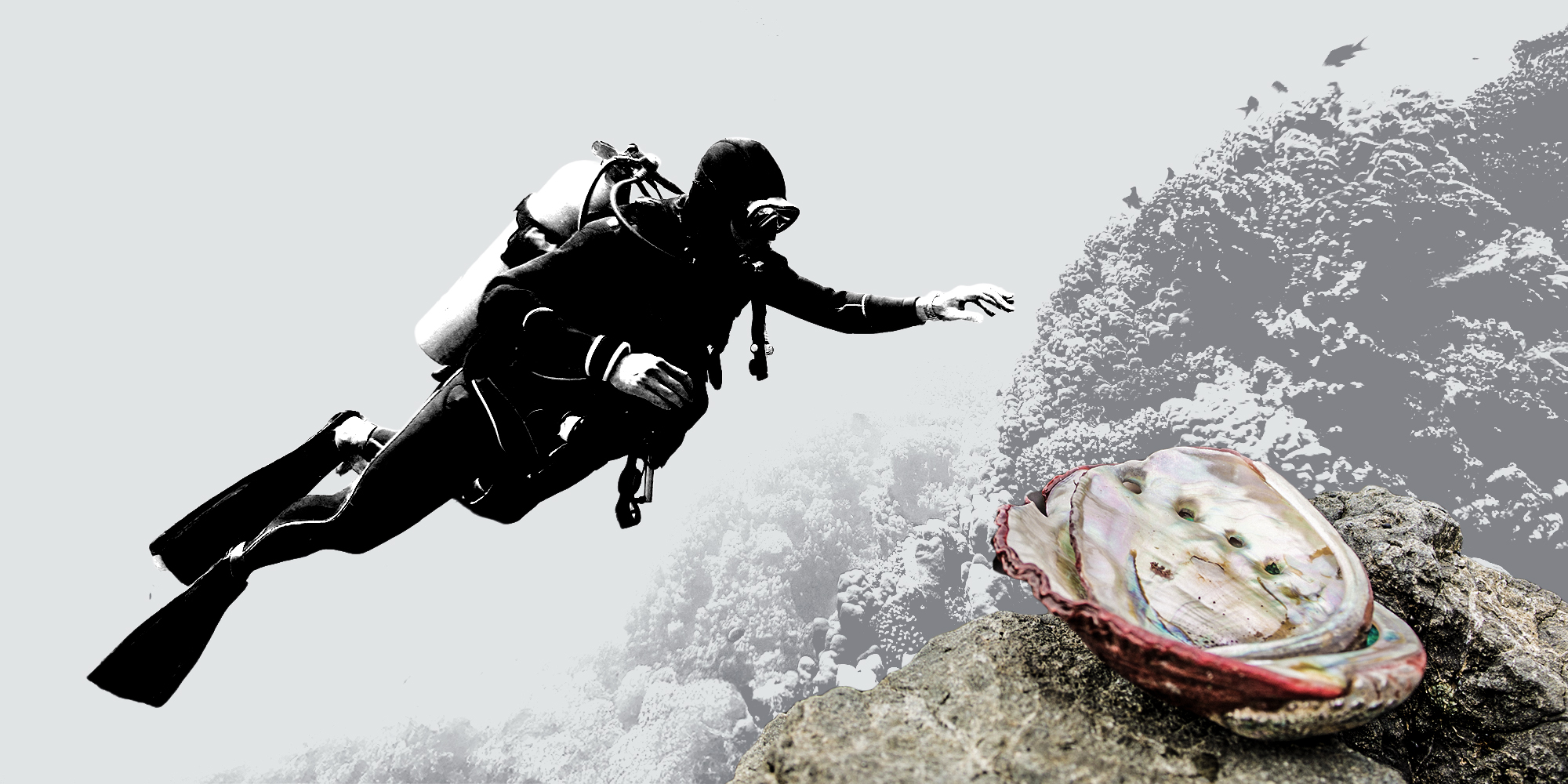
 Illustrative image: Diver. (Photo: Tunatura / iStock) Abalone shells. (Photo: fusaromike / iStock) |
 In 2024, poachers stripped the Nelson Mandela Bay coastline of an estimated R1.2-billion worth of perlemoen, which ends up in Asia via the black market.
Hundreds of illegal divers operate along the rocky coastline and submerged reefs around Gqeberha, stripping the ocean of the shellfish, which is considered a delicacy and is reputed to be an aphrodisiac.
Besides the environmental impact of perlemoen poaching, those who fight it have raised concerns about how it is funding the criminal underground in South Africa.
“Prior to Covid-19, the illegal perlemoen trade in Nelson Mandela Bay had dwindled to the point where it was nearly non-existent. However, poaching and the black market have boomed, post-Covid, and more players have entered the game in recent years,” said Nicky Erasmus, operations director at the private security firm Dark Water Ops (DWO).
Erasmus heads up the firm’s anti-poaching unit, which is contracted to monitor and enforce along the 20km of coastline between Cape Recife and Schoenmakerskop, where perlemoen ranching takes place.
The unit works closely with the police, the Department of Forestry, Fisheries and the Environment, and a network of other key role-players.
According to DWO research, before Covid-19 and the hard lockdown that severely limited diving and export activities, working in the perlemoen value chain was not nearly as lucrative as it is today.
Divers earned around R250 per kg, while runners and lookouts earned less. The black market value was R1,200 per kg of “wet” (fresh or unprocessed) perlemoen. “Dry” (processed and ready for export) perlemoen fetched as much as R2,500 per kg.
However, in the last three years, these prices have increased drastically. Drivers reportedly earn as much as R1,700 per kg, while a kg of wet perlemoen sells for R3,900 on the black market, and dry perlemoen for as much as R7,500.
Erasmus said skilled divers can harvest as much as 20kg of perlemoen in a single dive, which lasts around one hour, and some divers scour the reefs two to three times per day if weather conditions permit it.
This equates to a potential income of more than R100,000 per day.
In 2024, DWO personnel arrested 157 people along the 20km stretch of coastline they police and confiscated diving equipment, including boats, wetsuits and oxygen cylinders, worth R12-million.
The operatives recovered 64,300 units of wet perlemoen, with an estimated value of R56.2-million, and 489kg of dry perlemoen, estimated at R3.5-million.
Erasmus said modest estimates put the total value of the illegal perlemoen trade along the Nelson Mandela Bay coastline at R1.2-billion per year.
“Based on our figures and taking into account what we recovered along our section of coastline, we estimate that close to 1.3 million units of wet perlemoen were stripped from the Bay last year. We also calculated that close to 9,800 kilograms were processed here before being exported,” said Erasmus.
/file/dailymaverick/wp-content/uploads/2025/08/WhatsApp-Image-2025-08-05-at-16.41.35.jpeg "Perlemoen recovered from the scene of an accident in Summerstrand during the first week of August, when authorities say perlemoen poachers were particularly active due to ideal conditions for diving that included a full moon and calm seas. (Photo: Supplied / SAPS)")
/file/dailymaverick/wp-content/uploads/2025/08/WhatsApp-Image-2025-08-05-at-16.41.34.jpeg "In just one week, more than R400,000 worth of perlemoen was recovered in four separate incidents in Nelson Mandela Bay. (Photo: Supplied)")
Hundreds of divers
On one night, DWO operatives counted 325 divers in the water in the 20km of coastline they patrol, meaning there were far more they could not see, and even more outside of their mandated region.
“The problem is, diving and owning diving equipment is not illegal. We cannot arrest people on suspicion that they might poach. Only when we catch them with perlemoen in their hands can we really arrest them.
“The best we can do is disrupt their activities as much as possible. We make it difficult for them to bring their loot out, frustrate them, and maybe we get lucky and catch them off guard.
“But even if we managed to arrest them, the divers will probably be slapped with a fine and be back in the water the next day,” said Erasmus.
DWO has been synonymous with anti-poaching operations since 2017, when it was established. Before that, Erasmus was one of the founding members of an anti-poaching unit at another private security firm in Gqeberha.
When the government launched Operation Phakisa in 2014 as part of the National Development Plan, perlemoen was identified as one of the ocean-based commodities that needed to be expanded.
One initiative saw a private company reintroduce spawned baby perlemoen to the reefs along Nelson Mandela Bay.
The custodians of this initiative contracted DWO to provide security services at their operations.
DWO employs about 50 security operatives who specialise in perlemoen anti-poaching enforcement.
/file/dailymaverick/wp-content/uploads/2025/09/Perlemoen-DWO-1.jpg "Operatives from Dark Water Ops conduct daily operations along a 20km stretch of coastline in Nelson Mandela Bay to disrupt perlemoen poaching. (Photo: Riaan Marais)")
How to spot perlemoen poachers and what action to take
- They wear diving equipment — wetsuits and oxygen cylinders — and often head to the ocean in large groups.
- Their getaway vehicles often do not have number plates.
- Do not approach them: They are often belligerent and could be armed.
- Remain inconspicuous: If they see that you are watching them, they could become aggressive. Take note of locations, direction of travel and the make, model and colour of vehicles without being noticed.
- Contact authorities. If you are unsure who to contact, phone the Dark Water Ops control room at 087 898 8982.
Two major impacts
Erasmus said the illegal perlemoen industry has two major impacts — environmental and criminal.
“On the environmental front, perlemoen filters impurities from seawater, creating a cleaner habitat for other sea creatures. Perlemoen is also the main food source for other animals, for example, musselcrackers, which were nearly extinct along the Gqeberha coast when perlemoen numbers were very low.”
But the criminal impact, said Erasmus, is far more alarming. He said the illegal perlemoen trade bankrolled many other criminal activities, including drugs, illegal firearms and violent crime.
“Our investigations have shown that gangs who were notorious for cash-in-transit heists started employing divers because the risk-to-reward ratio was so much better. With the money they make from perlemoen, they can buy better firearms, bulletproof vests and vehicles, and better equip their soldiers for committing violent crimes.”
Erasmus said they are often criticised, especially on social media, by people who claim they arrest “family men” who provide for their families by doing nothing more than harvesting shellfish.
“The criticism is what often frustrates us most. Because the people fail to see the far-reaching impact of poaching. This goes far beyond just fish, and it has a dire impact on many innocent lives,” said Erasmus. DM
This is the first of a series of perlemoen poaching stories Daily Maverick will be publishing.