



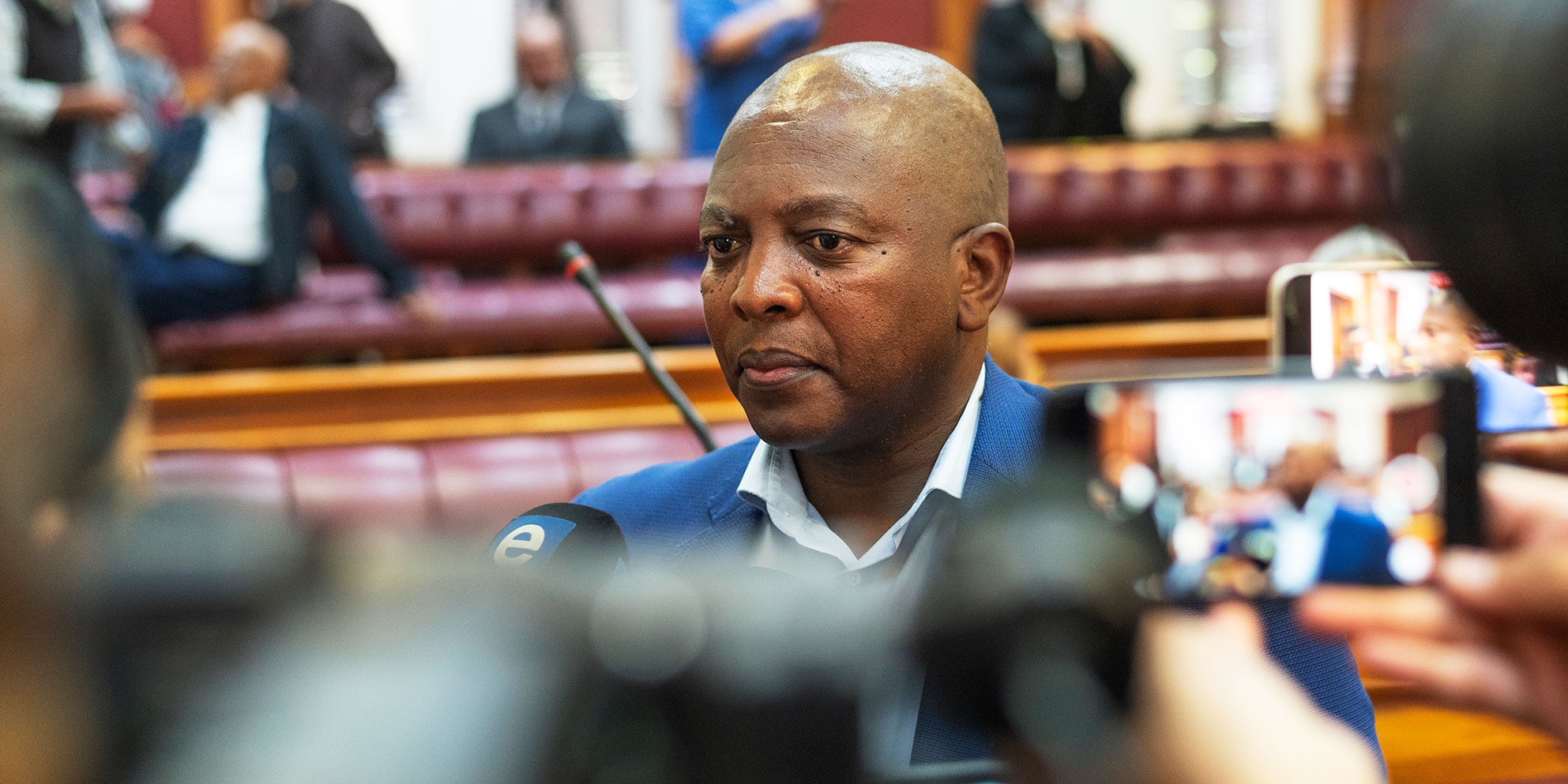
 Steve Biko’s son, Nkosinathi, attends the inquest into the apartheid-era death of Imam Abdullah Haron in Cape Town in 2022. Biko has welcomed the reopening of the inquest into the death of his father in police custody 48 years ago. (Photo: Brenton Geach / Gallo Image)
 Nearly five decades after anti-apartheid activist Steve Biko was tortured and killed in police custody, Justice Minister Mmamoloko Kubayi has directed that the inquest into his death be reopened, a move his family has welcomed with caution.
Previous inquiries have not led to any prosecutions. The first attempt at getting justice was in the 1978 inquest, which, despite strong medical and eyewitness evidence of brutality and neglect, concluded that no one was legally responsible for his death.
Speaking to Daily Maverick, Biko’s son, Nkosinathi, who was just six years old at the time of his father’s killing, said his family welcomed the decision but was mindful of past disappointments.
“We are cautious… We’ve been around the block a couple of times.”
Read more: Remembering Biko: Black Consciousness Movement leader’s killers must sit in the dock
Another attempt at getting justice was in 1996 at the Truth and Reconciliation Commission (TRC), which investigated apartheid-era atrocities and heard admissions from the policemen involved in Biko’s death that they had lied in earlier statements.
The amnesty bids by the five Security Branch policemen involved – Harold Snyman, Gideon Nieuwoudt, Ruben Marx, Daantjie Siebert and Johan Beneke – were denied, but no prosecutions followed.
On Friday, 12 September, the National Prosecuting Authority (NPA) confirmed that it had enrolled the matter in the Gqeberha High Court. During proceedings, the court heard that there are two surviving persons of interest in the case, Beneke and Siebert, now both in their 80s.
In a statement last week, the NPA said the five Security Branch members claimed: “Biko had attacked one of their colleagues with a chair after he sat down without asking for permission. In the ensuing scuffle to restrain him, Biko hit his head against the wall […].
“They admitted that they colluded and fabricated their versions, submitting false affidavits during the initial investigation into Biko’s death.”
In April, GroundUp reported on a ruling in the Johannesburg High Court that confirmed that there was no statute of limitations on prosecuting apartheid-era crimes and that alleged perpetrators could be charged with committing crimes against humanity.
Read more: Understanding the landmark court ruling on apartheid-era crimes
Kubayi’s decision to reopen the Biko inquest followed a formal request from National Director of Public Prosecutions Shamila Batohi.
Justice and education
/file/dailymaverick/wp-content/uploads/2023/09/MC-Abahlali-Gower_3.jpg "The Biko inquest will return to the Gqeberha High Court on 12 November 2025. Previous attempts at finding justice for Biko, who died in police custody in then Port Elizabeth in 1977, have failed. (Photo: biopgraphy.com / Wikipedia)")
/file/dailymaverick/wp-content/uploads/2022/12/20V5382.jpg "The decision by Justice Minister Mmamoloko Kubayi to reopen the Biko inquest follows a formal request from National Director of Public Prosecutions Shamila Batohi. (Photo: Felix Dlangamandla)")
For the Biko family, the reopening of the inquest is not simply a moment of closure, as previous attempts to hold perpetrators accountable have failed.
“Our hope is that it will lead to some justice emerging out of this. So we look forward to supporting the court as best we can and supporting the NPA to ensure that the killers are still held accountable,” Nkosinathi said.
“Healing is a much more complex process. It involves justice, but it involves other layers of justice, including seeing that people who died for this country can at least rest in the knowledge that those who continue to run this country are accountable. This democracy is hard won,” Nkosinathi said.
Asked whether new evidence was likely to emerge at the inquest, Nkosinathi was confident it would.
“So we should expect that there will be new narratives emerging. But in any event, there are many voices that relate to the experience of Steve Biko. […] We are assured from the vast body of data that we have amassed over the years. But there should be no reason why an inquest cannot establish the facts.”
Nkosinathi said: “This is as much a matter for me that is about the law as it is also about public education.”
Case against time
One of the major hurdles facing the inquest is the age of the suspects.
“We are cautious also, because we do learn that the people implicated are now in their 80s, and we have seen in many cases, they have tended to die before you get to the element of prosecution.”
In the last decade, the NPA has launched a string of inquests into the killing of anti-apartheid activists. Few of the policemen involved are alive to testify, and if found responsible, prosecutions can still take years.
Despite these challenges, Nkosinathi insists the family will persist.
“As a family, we will not tire from doing what we need to do. We are not doing this because of expectations. We are doing it because it is a constitutionally guaranteed process […] and we will do what we need to do to ensure that we close that chapter. Our sense of healing transcends this process.”
The reopening of the inquest comes five months after President Cyril Ramaphosa announced he was in the process of establishing a commission of inquiry that would look into allegations of improper influence in delaying or hindering the investigation and prosecution of apartheid-era crimes that have persisted from previous administrations.
The inquiry relates to the more than 400 cases the TRC referred to the NPA in 2003. One of the most well-known cases is that of the Cradock Four, who were murdered by apartheid security forces in June 1985.
The inquiry, led by former Constitutional Court Justice Sisi Khampepe, is expected to begin hearing oral evidence in November.
Read more: Ramaphosa ‘must act quickly’ on new TRC inquiry
Nkosinathi said that over the years, he had heard personal accounts from different people revealing how the police unit that killed his father functioned as one of apartheid’s most notorious killing machines, with the same names linked to the cases of James Calata, Biko and many other atrocities, evidence he believes will be brought to light at the inquest.
/file/dailymaverick/wp-content/uploads/2023/09/ED_0006973.jpg "A protester holds a poster of Steve Biko during a demonstration during the Truth and Reconciliation Commission hearings in East London in 1996. (Photo: Oryx Media Archive / Gallo Images)")
Conflicted country
As the son of a leader who stood for black consciousness, dignity and justice, Nkosinathi reflected on how far South Africa has strayed from those ideals, describing the country as deeply conflicted.
“I think our country is schizophrenic.”
On one hand, he praised South Africa’s “principled” foreign policy, pointing to its support for Palestine and its role within BRICS.
“So when you look at things like that, you can’t help but be proud, but when you turn inward and look at the internal political play […],” he said, expressing alarm at poverty, corruption and crime, which he said have become entrenched.
Read more: Former policeman gets 15 years’ jail for 1987 murder of Cosas activist Caiphus Nyoka
“You can’t have a democracy that has got 54% of its citizens living beneath the bread line. […] We can’t have the kind of crime statistics that we have, the matter of women and children and others in general in South Africa, and be happy about that,” added Nkosinathi.
The Biko inquest will return to the Gqeberha High Court on 12 November 2025. DM