




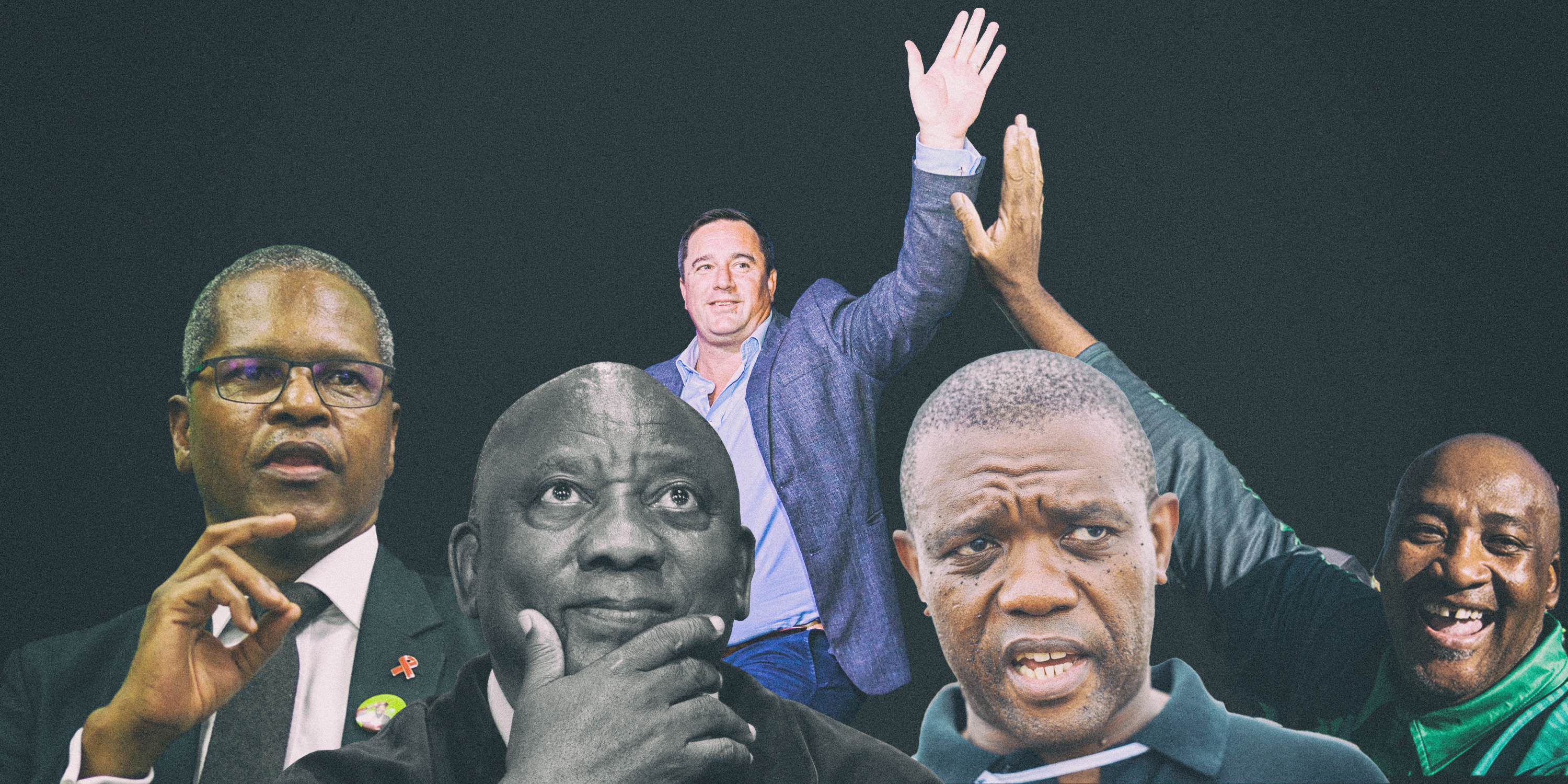
 Illustrative image, (from left): IFP president Velenkosini Hlabisa. (Photo: Darren Stewart / Gallo Images) | ANC president Cyril Ramaphosa. (Photo: Leila Dougan) | DA leader John Steenhuisen. (Photo: Darren Stewart / Gallo Images) | Rise Mzansi leader Songezo Zibi. (Photo: OJ Koloti / Gallo Images) | Patriotic Alliance leader Gayton McKenzie. (Photo: Brenton Geach / Gallo Images)
 The web-based global What Worries the World study reveals a decline in positive sentiment in South Africa following a post-election surge last year when the Government of National Unity (GNU) was formed. Hailed at the time, the rocky marriage between the ANC and DA (with eight smaller parties) has kept the power-sharing pact on the edge, and defined itself as crisis-prone, which has driven down sentiment.
The parties fight about everything from the Budget to healthcare, land, employment equity, education and international relations policy. Still, there are areas of strength, including reform at the SA Revenue Service and Home Affairs, a crackdown on organised crime in Public Works, and infrastructure projects.

“South Africans remain deeply pessimistic about their country’s direction, with 80% saying SA is on the wrong track,” said Ipsos’ Robyn Williams. Yet, most people still want parties to cooperate at a local level, which is where their pain points (outside of employment) are most oppressive: water, electricity and transport.
“They wish that political parties would stop bickering. That’s the message coming from the ground up,” said veteran pollster and Ipsos director Mari Harris.

It may seem counterfactual that people want more local versions of the GNU even as sentiment in the national power-sharing arrangement falters — but South Africans, on the whole, prefer cooperation.
This is clear from how local communities, often across race and class lines, work together to step in where government fails, as Anna Cox showed in this report on how Joburg has become a DIY city.
“When basic service delivery is failing this comprehensively across the country, with even our best-performing province seeing only 18% of citizens rating their municipality as doing ‘very well’, citizens naturally look for solutions that transcend party politics to find a solution for their everyday struggles with councils, electricity, clean water supply and potholes,” says Williams.
The chart shows that 65% of DA supporters want their party to cooperate, a sentiment shared by 57% of ActionSA and 56% of ANC supporters. At the left and right of the political spectrum, the numbers which favour cooperation are also high for EFF, MK and FF+ supporters.
SA is likely to never again see a single party win a majority in national, provincial or local government. The clear message from the survey is that South Africans are not interested in intra-coalition squabbles and crises but want cooperation for progress. It’s not a message any political party appears to heed, but the survey may change that.
Point-scoring
“Political parties don’t always keep their eye on the ball — for them, it’s often more about point-scoring,” says Harris.
The second survey is a little more hopeful.
Ipsos also measures in-house sentiment with its larger Pulse of the People survey twice a year. The results just released show that 41% of those surveyed still believe the GNU participants are governing in the interest of all South Africans, while a further 36% remain satisfied.
Scepticism remains high and is probably a factor in the smaller web-based global study. Four in 10 Pulse of the People respondents say the GNU has changed nothing, while an almost equal number say it will fall apart soon. The GNU participants had a muted first birthday in June with no cake and candles, as they were too busy fighting.
Unemployment continues to drive sentiment, with municipal performance a close second. Thousands of job losses and possible retrenchments were announced this week at Ford (probably caused by US tariffs and loss of Agoa benefits), Glencore-Merafe (cheap imports, high electricity prices), Arcelor-Mittal SA (cheap steel imports, high electricity prices, did not get subsidy it wanted) and Daybreak, the troubled chicken business funded by the PIC at R1.2-billion but which is in business rescue, as Lindsey Schutters reports here.
The Pulse of the People study reveals widespread dissatisfaction with local government, with nearly six in 10 South Africans (59%) dissatisfied with their municipality’s performance, and just 39% satisfied.
The reasons for this are well set out in the Auditor-General’s latest municipal report, which highlights, again, a map of dysfunction outside of most (but not all) parts of the Western Cape. (See Victoria O’Regan’s report here.) It’s not surprising that worry and political sentiment follow municipal collapse.

Nobody’s doing “very well” in government on the whole.
The map shows that, outside of the Western Cape and Mpumalanga, citizens tend to fail to engage with their local government. And even in the top province, local government is rated as doing “very well” by a thin 18% of those surveyed.
In Gauteng, only 42% of those surveyed said they felt positive, with a mere 10% saying municipalities (largely metros) were doing “very well”. Business Day’s Hajra Omarjee reported here that the ANC could tumble to below 20% in Johannesburg in the local government election slated for late 2026 or early 2027, according to DA polling. DM