




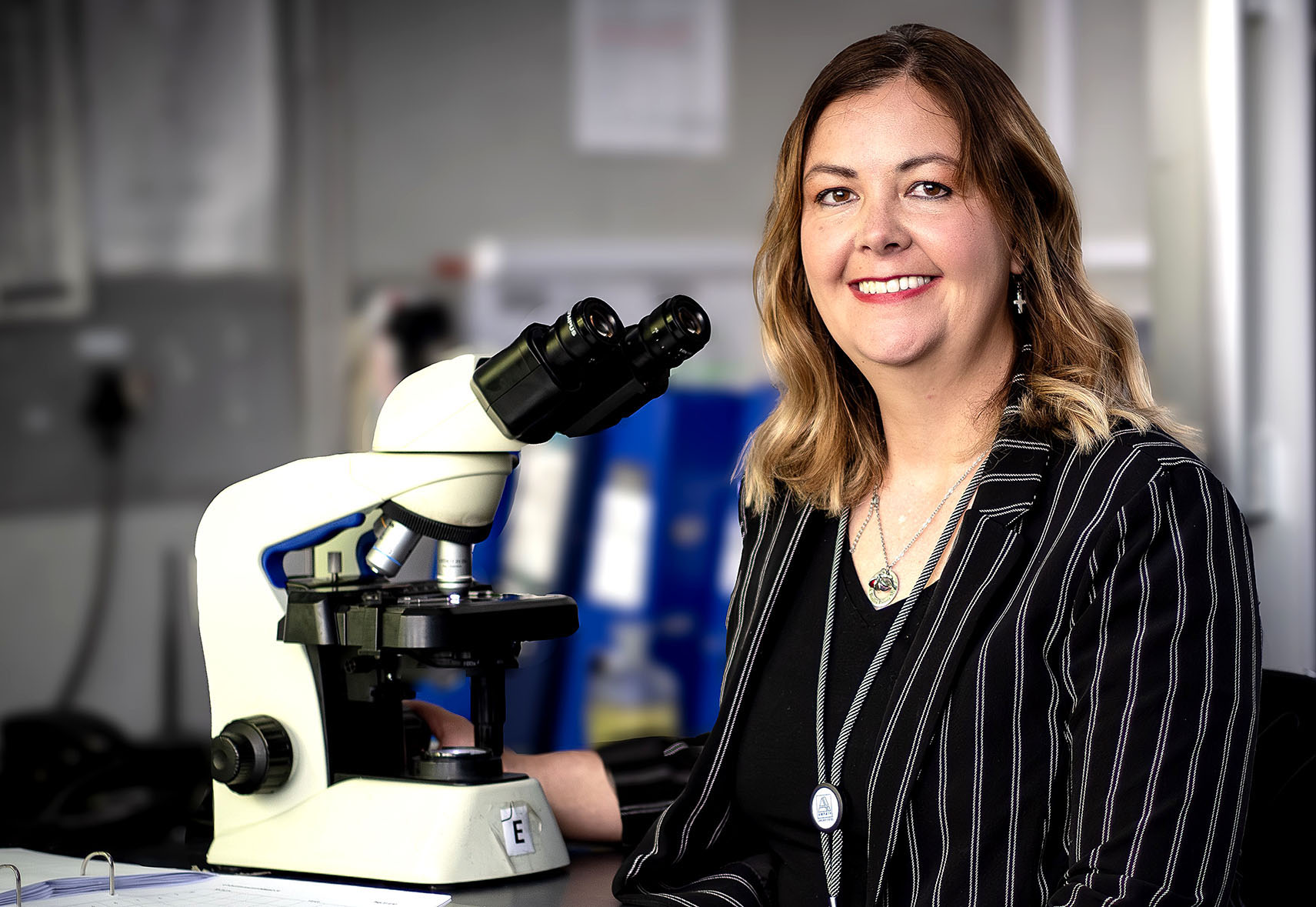
 Dr Bonita van der Westhuizen, a senior lecturer and pathologist in the University of the Free State's Department of Medical Microbiology, identified a fungal infection in a patient that has never been seen before in sub-Saharan Africa. (Photo: Supplied)
 Doctors and microbiologists at the University of the Free State and the National Health Laboratory Service have positively identified a first-of-its-kind fungal infection for sub-Saharan Africa in a patient at the Universitas Hospital in Bloemfontein.
It is the first known infection of a patient with the fungus known as S. oblongispora mucormycosis in sub-Saharan Africa and among HIV-positive patients. It does not spread between humans.
According to information supplied by the team that identified the fungus, a 32-year-old male patient was admitted to Universitas Academic Hospital after the right side of his face started swelling. When admitted the patient had a critically low CD4 count even though he was on antiretroviral therapy. A low CD4 count is caused by an infection of some sort, either bacterial, viral, parasitic or fungal.
The patient was HIV-positive, with a CD4 count of 50 cells/µl, and on antiretroviral therapy (ART), together with a broad spectrum antibiotic.
The World Health Organization (WHO) describes Mucormycosis (previously called zygomycosis) as a rare but serious infection caused by a group of fungi called mucormycetes.
Where does it come from?
“Spores of these ubiquitous fungi (commonly found in soil, fallen leaves, compost, animal dung and air) can be inhaled and then infect the lungs, sinuses, and extend into the brain and eyes. Less often, infection may develop when the spores enter the body through a cut or an open wound.
Mucormycosis is not a contagious disease, it cannot be spread from one person to another,” according to the WHO’s factsheet on the infection.
Who is at risk?
- People who are immunocompromised, or patients already infected with other diseases.
- People living with HIV, diabetes and organ recipients.
While the case found in the Free State was an example of a rhino-orbital infection, the fungus can also attack the brain, lungs and digestive organs, according to the WHO.
The team that attended to the Free State patient said his face kept swelling every day. After a CT scan they collected tissue biopsies. However, they were unable to help him in time and he died a week after admission.
Dr Bonita van der Westhuizen, a senior lecturer and pathologist in the University of the Free State Department of Medical Microbiology, who identified this rare fungus, said it was previously unrecognised or underreported in South Africa and sub-Saharan Africa.
“It now raises awareness about the diversity of fungal infections affecting immunocompromised populations and underscores the need for improved diagnostics, surveillance and treatment strategies in the region,” she said.
She added that although it was unclear where the deceased might have picked up the infection, moulds were ubiquitous in the environment. Patients usually got infected through the inhalation of spores, or through trauma.
The rest of the team, doctors Liska Budding and Christie Esterhuysen from the university’s Department of Anatomical Pathology and the NHLS, and Professor Samantha Potgieter, an infectious disease expert at the university’s Department of Internal Medicine, and Van der Westhuizen published the case in August in the journal Case Reports in Pathology.
South African first
In their article they wrote: “These fungi do not typically cause infections in immunocompetent individuals apart from the other risk groups.” They added that current or past Covid-19 infection could also create an infection risk in individuals.
“Mucorales have also been linked to outbreaks in healthcare settings and following natural disasters,” the authors added.
In their article they described that the infection had rapidly progressed and that they could not save the patient.
“Due to his rapid deterioration, he neither underwent surgical intervention nor received any antifungal therapy, and subsequently demised. This is the first case of S. oblongispora infection described in sub-Saharan Africa and in the setting of HIV,” the authors noted.
“Infection by this fungus accounts for approximately 3% of human mucormycosis cases. S. oblongispora-associated rhinosinusitis is extremely uncommon and has been associated with rapid progression with high morbidity and mortality. A combination of different testing platforms was required to make a diagnosis. This case emphasises the challenge of diagnosing invasive mold infections timeously,” they added.
Progresses rapidly
“Mucormycosis, which is caused by fungi in the order Mucorales, progresses rapidly due to a combination of factors related to the fungus, the host, and external influences. Mucorales fungi are known for their fast growth and ability to invade blood vessels. This allows the infection to spread quickly through the body, potentially reaching vital organs,” Van der Westhuizen said.
The fungi, she explained, can resist being killed by immune cells, allowing them to establish infection. Some Mucorales fungi can produce toxins that disrupt blood vessels, further aiding the spread of the infection. Additionally, certain host conditions weaken the body's defences, allowing the infection to spread quickly.
“External factors that may play a role are traumatic injuries, and endothelial damage (referring to the lining of blood and lymph vessels and rarely hospital acquired infections).
“In essence, the aggressive nature of Mucorales fungi combined with weakened host defences and external factors creates a perfect storm for rapid disease progression in susceptible individuals,” Van der Westhuizen said.
She also confirmed that those most at risk were patients with diabetes, cancer, transplant recipients and traumatic inoculation. Traumatic inoculation refers to the fungi entering the body through a wound.
She added that there was no existing data on this fungus in sub-Saharan Africa.
“The diagnostic complexities and rapid disease progression may contribute to the paucity of data in developing countries,” she said.
She further explained that the infection could be treated through surgery and available anti-fungal medicine, but treatment was made difficult due to the rapid disease onset and progression to death.
“There is only a tiny window to help the patient. That is why clinical suspicion is so important, as immediate aggressive surgical debridement with antifungal agents is the only way to improve patient outcomes. Unfortunately, this infection still has a high mortality rate, despite therapy,” she said.
She added that the team was only able to identify the patient’s cause of death after he had died as they needed a combination of different testing platforms to do so.
Specialised field
“This is unfortunately the case with mould infections as most readily available diagnostic methods lack sensitivity and these pathogens take a long time to grow in the laboratory. Fungal diagnostics is a specialised field that requires expertise. However, if clinicians are aware of these infections and they have an increased index of suspicion, appropriate therapy can be initiated even before the results are available.
“If clinicians suspect this type of infection early and they involve the infectious diseases physicians, microbiology and histopathology for support and advice, they will be guided to collect the most appropriate samples to ensure that an accurate diagnosis is made,” she added.
She said fungal infections remained very tricky to identify as there was no highly sensitive stand-alone test to make a rapid diagnosis available.
In April the WHO issued a statement calling on better diagnostic tests and treatment for fungal infections worldwide, saying that there was a critical lack of medicines and diagnostic tools for invasive fungal diseases.
“Invasive fungal infections threaten the lives of the most vulnerable, but countries lack the treatments needed to save lives,” said Dr Yukiko Nakatani, WHO Assistant Director-General for Antimicrobial Resistance ad interim. “Not only is the pipeline of new antifungal drugs and diagnostics insufficient, there is a void in fungal testing in low- and middle-income countries, even in district hospitals. This diagnostic gap means the cause of people’s suffering remains unknown, making it difficult to get them the right treatments.” DM