




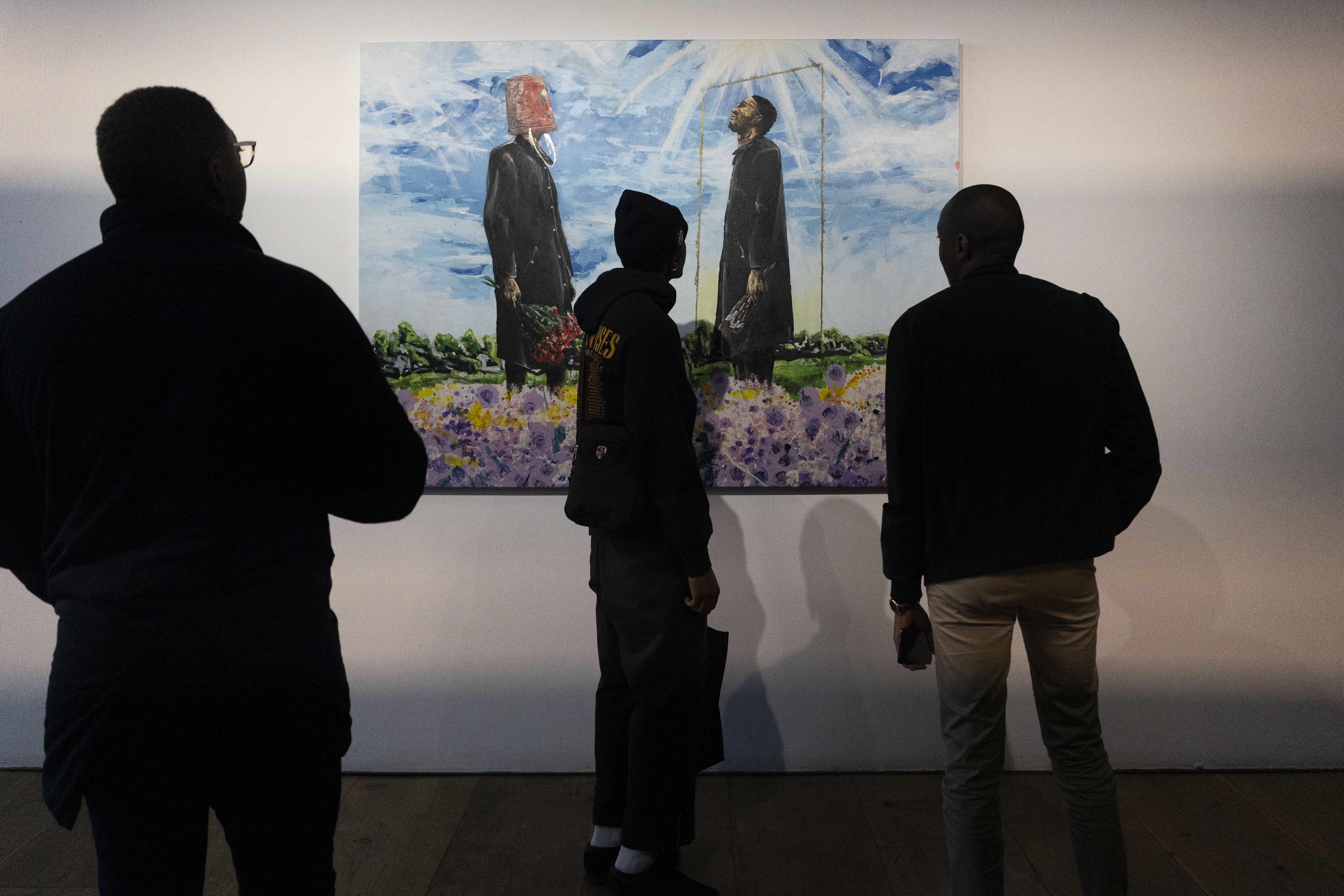
 Art-lovers in the Keyes Atrium. Looking Back, Seeing Now at Gallery 1 on Keyes Art Mile in Johannesburg. (Photo by Alet Pretorius)
 Gallery 1 has a new look. The small but active art space, located on Keyes Art Mile in Johannesburg, has moved away from a conventional white-cube format and adopted a museum-style approach.
Ebony wood panels line one side of the space while the curved walls of the gallery have been painted a dark chocolate brown. Artworks are individually lit, prompting a more focused engagement with the objects in the space — paintings and sculptures alike — while gesturing to the collective atmosphere of the exhibition.
It’s a fitting makeover — an elegant design, well suited to the calibre of work being exhibited.
For the past while, Gallery 1 has been staging non-selling group exhibitions of predominantly modernist South African artworks, all drawn from the Tortilis Collection, for public viewing. Featuring works from artists such as Christo Coetzee, Irma Stern, Walter Battiss, Louis Maqhubela, J H Pierneef and Ezrom Legae, the exhibitions have been a welcome addition to a city without easy access to its public museums.
While the Johannesburg Art Gallery continues to crumble, and institutions with private collections like Standard Bank shift focus from their gallery in the old Central Business District to pristine new venues in Sandton, it’s increasingly difficult to view South African art history in the city.
/file/dailymaverick/wp-content/uploads/2025/08/B6B4085.jpg "The opening of the group exhibition 'Looking Back, Seeing Now' at the newly re-launched Gallery 1. (Photo by Alet Pretorius)")
/file/dailymaverick/wp-content/uploads/2025/08/B6B3684.jpg "The opening of the group exhibition 'Looking Back, Seeing Now' at the newly re-launched Gallery 1. (Photo by Alet Pretorius)")
Gallery 1 launched its new look in early June with another retrospective group exhibition, Looking Back, Seeing Now. The show features works by just over 20 South African modernist artists: Laubser, Pierneef, and Battiss are all there, as is Gerard Sekoto, Robert Hodgins, Ephraim Ngatane and others. Paintings and sculptures from the mid-1940s through to the early Seventies populate the show.
In the absence of a prescribed curatorial theme or thread, there is space for incidental association. Here, South African Modernism is a movement of adaptability and exchange, refusing a fixed style or historical moment. The conversation between Gerard Sekoto’s Blue Head and Maggie Laubser’s Composition with Head and Birds, for example, is one of differing styles of figuration, while Cecily Sash’s Concept No. 3 and Guiseppe Cattaneo’s Thorned Condition provide a view of the kind of abstract art being made in South Africa in the early 60s — exhibited next to one another, the two paintings look like they might be siblings. Interesting, given that the two artists were both affiliated with the Amadlozi Group, a collective that embraced African sculptural traditions and sought to create a distinctly local modernism.
In fact, many of the artists exhibited here shared some kind of connection — either through their formal training, artistic communities or exhibition histories. Cecil Skotnes and Ezrom Legae, both central to the development of black artistic training in apartheid South Africa, were connected through their work at the Polly Street and Jubilee art centres. Together with Edoardo Villa and Sydney Kumalo, Skotnes was also part of the Amadlozi Group.
Villa’s Vertical Form, a slightly surreal bronze sculpture composed of thin lines and negative spaces, casts a striking and somehow solid shadow on the adjacent wall. To the left, in luminous blue and gold, sit the three torsos of Alexis Preller’s Marathon Man. Together, they’re a brilliant study in light and form.
Two different animal bones make up the other sculptures in the exhibition: Guiseppe Cattaneo’s Incised Composition makes use of a carved, incised and painted elephant scapula, while Lucky Sibiya’s Mythical Creatures is a carved and incised giraffe femur.
Elsewhere, Ezrom Legae’s abstract bronze Seated woman with bird continues the theme of humankind’s relationship to nature, be it harmonious, extractive, spiritual or long forgotten.
/file/dailymaverick/wp-content/uploads/2025/08/B6B3679.jpg "The opening of the group exhibition 'Looking Back, Seeing Now' at the newly re-launched Gallery 1. (Photo by Alet Pretorius)")
/file/dailymaverick/wp-content/uploads/2025/08/B6B3677.jpg "The opening of the group exhibition 'Looking Back, Seeing Now' at the newly re-launched Gallery 1. (Photo by Alet Pretorius)")
/file/dailymaverick/wp-content/uploads/2025/08/B6B3673.jpg "It’s a fitting makeover to Gallery 1 — an elegant design, well suited to the calibre of work being exhibited. (Photo: Alet Pretorius)")
/file/dailymaverick/wp-content/uploads/2025/08/B6B3672.jpg "Looking Back, Seeing Now at Gallery 1. (Photo: Alet Pretorius)")
These are all rarely seen works by some of the country’s most significant artists, yet their inclusion in Looking Back, Seeing Now doesn’t demand the kind of reverent, rigorous viewing we’ve come to associate with most collection-based shows.
Many artists in this exhibition, among them Maud Sumner and Maggie Laubser, were also internationally recognised with works exhibited at the likes of the Guggenheim Museum, Sao Paulo Biennale and the Venice Biennale in the 1950s — a welcome reminder to contemporary artists and art lovers alike that South African artists have been contributing to global conversations around art-making for decades.
In this way, the gallery is becoming something of an anchor in the continuously shifting landscape of Johannesburg’s arts infrastructure, along with other private art institutions producing regular public programming like the Johannesburg Contemporary Art Foundation in Forest Town, or Strauss & Co in Houghton.
The new Gallery 1 also hints at larger developments in the Rosebank district. In mid-May, Anton Taljaard from Tomorrow Co — the development company behind Keyes Art Mile — announced plans for Keyes Art Mile 2.0, an expanded urban precinct situated at the intersection of Jan Smuts and Jellicoe avenues.
Similarly, the equally porous and precarious relationship between Johannesburg’s public and private institutions, between the city and the suburbs, continues to be an urgent topic in the arts.
As Looking Back, Seeing Now shows us, South African art has always been produced in a state of flux, uncertainty and adaptability, showcasing art and art-making practices alike on a global scale. Perhaps there’s no better place than Johannesburg, then, to be making and engaging with contemporary art today. DM