



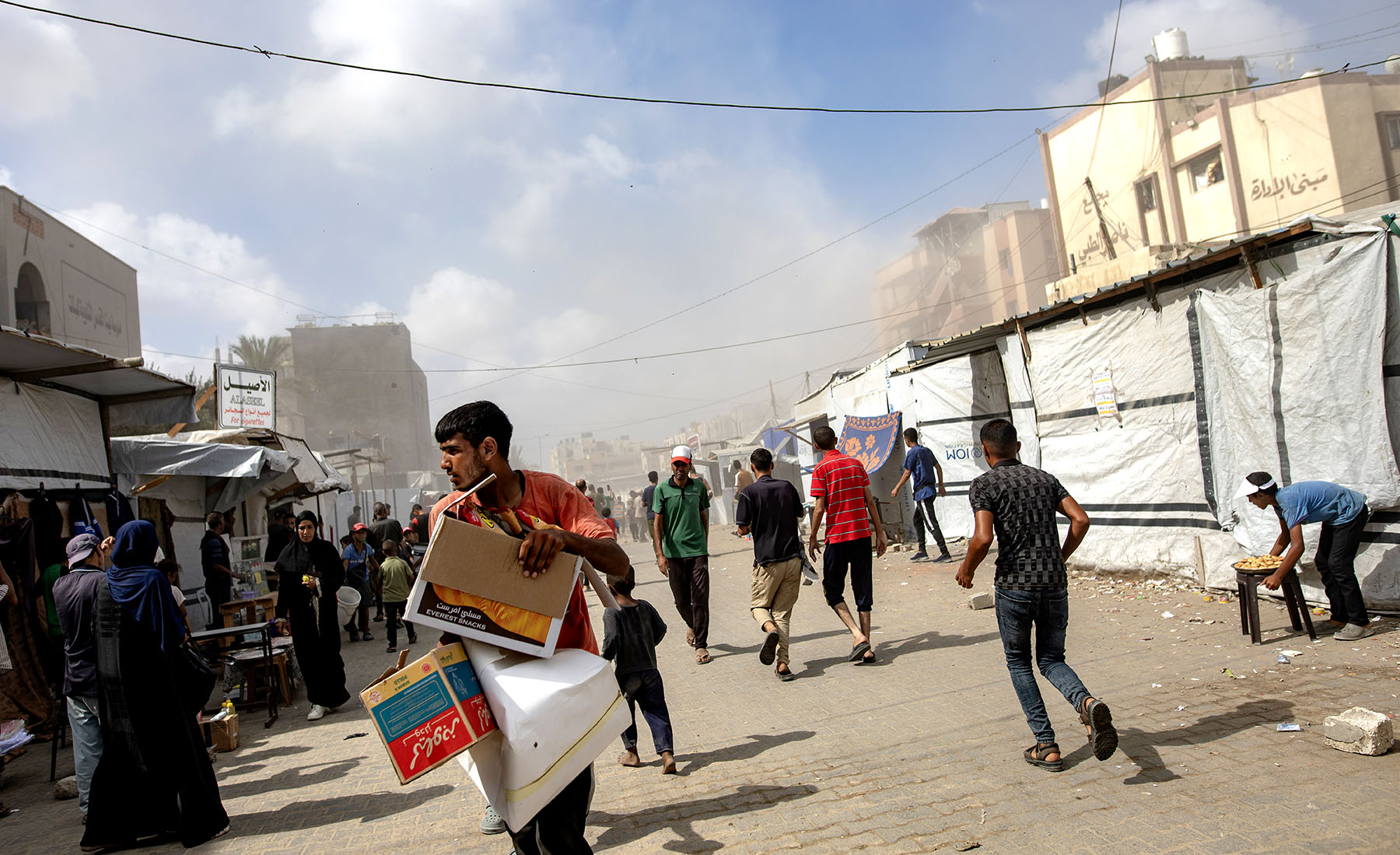
 Palestinians flee following an Israeli airstrike targeting Nasser Hospital in Khan Younis, Gaza, on 25 August 2025. According to the Palestinian Health Ministry, the airstrike hit the fourth floor of the Nasser Medical Complex, followed by a second attack upon the arrival of ambulance crews to retrieve the injured and the dead, leaving 21 killed, including five journalists. (Photo: EPA / Haitham Imad)
 The Committee to Protect Journalists (CPJ) and international media organisations have condemned yet another attack on journalists in Gaza, after Israeli airstrikes on Nasser Hospital in Khan Younis killed five media workers on Monday, 25 August 2025.
In total, 21 people were killed in the double-strike attack on the hospital, with a second missile hitting first responders who had arrived to help those injured in the initial bombing, according to reports by Al Jazeera and BBC.
The journalists killed were Hussam Al-Masri, a Reuters contractor; Mohammed Salama, an Al Jazeera camera operator; Mariam Abu Dagga, freelance photojournalist with Independent Arabia and the Associated Press; freelance journalist Ahmed Abu Aziz, who contributed to Quds Feed; and freelance video journalist Moaz Abu Taha.
Al-Masri was killed in the first strike, while the others were killed while covering the aftermath of the previous attack, according to the Committee to Protect Journalists. Three other media workers — journalist Jamal Baddah from Palestine Today TV; photographer Hatem Khaled, a Reuters contractor; and Mohammed Fayeq, a freelance photographer — were injured in the attack.
The strikes also killed four health workers, according to Tedros Adhanom Ghebreyesus, Director-General of the World Health Organization (WHO).
.@WHO received reports of two strikes on the Nasser Medical Complex this morning, resulting in the deaths of at least 20 people, including four health workers and five journalists. Fifty others were injured, among them critically ill patients who were already receiving care.
The… pic.twitter.com/XzTM4u0pAt
— Tedros Adhanom Ghebreyesus (@DrTedros) August 25, 2025
“Israel killed at least five journalists in Nasser Hospital on Monday morning. Israel’s broadcasted killing of journalists in Gaza continues while the world watches and fails to act firmly on the most horrific attacks the press has faced in recent history,” said Sara Qudah, Committee to Protect Journalists’ Regional Director for the Middle East and North Africa.
“These murders must end now. The perpetrators must no longer be allowed to act with impunity.”
Read more: ‘Journalism is not a crime’ — SA journalists demand justice for slain colleagues in Gaza
Read more: Cape Town journalists march in solidarity with media workers targeted and killed in Gaza
These deaths bring the number of journalists killed in Gaza since 7 October 2023 to at least 197, of which 189 were Palestinians killed by Israeli forces in Gaza, according to the Committee to Protect Journalists. Some organisations have estimated that the death toll is higher.
Just two weeks before the attack on Nasser Hospital, an Israeli airstrike on a media tent near Al-Shifa Hospital in Gaza City killed six journalists.
‘Heartbreaking’ news
Gazan journalist Hind Khoudary described Monday’s strike as “heartbreaking news” during a report for Al Jazeera, adding: “I have no idea how many times we are going to continue reporting on the killing of our colleagues, the killing of other journalists working with Al Jazeera and other news outlets.”
Al Jazeera released a statement condemning the attack, noting that Salama’s death brought the number of Al Jazeera journalists killed by Israeli forces in Gaza since the start of the war to 10.
“Al Jazeera Media Network condemns, in the strongest possible terms, this horrific crime committed by the Israeli occupation forces, who have directly targeted and assassinated journalists as part of a systematic campaign to silence the truth,” said the network.
“The ongoing campaign by the Israeli occupation against journalists has violated all international norms and laws, amounting to war crimes under the Rome Statute and the Geneva Conventions, both of which strictly prohibit the deliberate targeting of civilians and journalists in conflict zones.”
Al Jazeera called for a “robust response” to the crimes against journalists from the international community and all relevant governments.
The Associated Press (AP) said it was “shocked and saddened” to learn of the deaths of Dagga and others at Nasser Hospital.
“Mariam [Abu Dagga] regularly based herself at the hospital for coverage. Her recent work included strong stories of starving and malnourished children in Gaza,” said AP.
Calls for accountability
AP and Reuters published a joint open letter to Israeli officials in which they expressed outrage that independent journalists were among those killed in the strike on the hospital, and demanded a clear explanation for the attacks.
“These journalists were present in their professional capacity, doing critical work bearing witness. Their work is especially vital in light of Israel’s nearly two-year ban on foreign journalists entering Gaza,” said the letter.
“The IDF [Israel Defense Forces] has a duty under international law to protect journalists and civilians and to take all feasible precautions to prevent harm. Striking a hospital, followed by a second strike while journalists and rescuers were responding, raises urgent questions about whether these obligations were upheld.”
/file/dailymaverick/wp-content/uploads/2025/08/13284434.jpg "Palestinians inspect the damage at Nasser Hospital. (Photo: EPA / Haitham Imad)")
/file/dailymaverick/wp-content/uploads/2025/08/13284432.jpg "People pray in front of the bodies of those killed in the airstrike. (Photo: EPA / Haitham Imad)")
The Israel Defense Forces acknowledged that its troops had carried out the attacks and claimed that it did not “intentionally target civilians”. It said that an inquiry was being conducted in relation to the incident.
In a post on X, Israeli Prime Minister Benjamin Netanyahu called the events at Nasser Hospital a “tragic mishap”.
“Israel values the work of journalists, medical staff and all civilians. The military authorities are conducting a thorough investigation. Our war is with Hamas terrorists,” he said.
However, Israel’s past investigations into the actions of the IDF have seldom led to accountability.
In their open letter, AP and Reuters said: “Unfortunately, we have found the IDF’s willingness and ability to investigate itself in past incidents to rarely result in clarity and action, raising serious questions including whether Israel is deliberately targeting live feeds in order to suppress information. ”
Standing in solidarity
Slindile Khanyile, the Media Freedom Chairperson at the South African National Editors Forum (Sanef), said the organisation sent its deepest condolences to the slain journalists’ families, the media organisations for which they worked and the media fraternity at large.
“We are at a loss for words because... just two weeks ago, we had put out yet another statement, joining numerous other organisations such as the Committee to Protect Journalists and Reporters Without Borders in condemning these killings, but they continue. And there are no consequences,” said Khanyile.
She added that Israel’s actions in Gaza should be added to the list of sustainability challenges facing the journalism industry, alongside issues such as shortages of journalists and newsroom resources; peddlers of mis- and disinformation, and evolving technologies.
Reflecting on what the South African media community could do in the face of continued killings in Gaza, Khanyile said: “There’s something powerful about consistency. There’s something powerful about solidarity. I think that keeping at it, as much as it may sound like we are repeating the same things, is part of what we can do.
“I don’t necessarily think that it will solve anything overnight, but hopefully our messaging and position as South Africa, if we can be consistent, will have some impact, however long that may take.”
UN, WHO and MSF condemn attack
Ghebreyesus said that Nasser Hospital’s main building, which housed the emergency department, inpatient ward and surgical unit, was hit during Monday’s strikes. The bombing also damaged the emergency staircase.
United Nations Secretary-General António Guterres strongly condemned the airstrikes on Nasser Hospital and called for a prompt and impartial investigation. He noted that medical personnel and journalists “must be able to perform their essential duties without interference, intimidation or harm, in full accordance with international humanitarian law”.
A team of Médecins Sans Frontières (MSF/Doctors Without Borders) staff members were forced to shelter in a laboratory at the medical facility as Israeli forces repeatedly struck the building amid rescue efforts, according to Jerome Grimaud, MSF’s Emergency Coordinator in Gaza.
Grimaud said that Dagga had frequently worked with MSF as a freelance photographer, and the organisation was “heartbroken” by her death.
“Mariam [Dagga] leaves behind a son who must now grow up without his mother,” he said.
Andrew Mews, the Executive Director of MSF Southern Africa, said that in early June the organisation had called for Nasser Hospital to be protected as it was “really the last functioning hospital in Gaza”. He noted that healthcare facilities had been attacked with impunity since the outbreak of the war, not only through airstrikes, but also the restriction of supplies and energy.
“We feel that healthcare facilities are being targeted. It certainly looks like a weapon of war, to restrict access to healthcare for the population, and looks like collective punishment. We know that the targeting of health facilities is illegal under international humanitarian law, and there is actually a very high threshold for states to prove why they think it was being used by the belligerents of another side,” said Mews.
“We haven’t seen that evidence being presented by the Israel Defense Forces. We just hear rhetoric, ‘it’s being used’, and then it gets bombed… Under international law, you need to do more than that.”
Mews said it was clear that Gazan civilians were the ones most affected by the conflict, with disproportionate harms against children in the region. Both MSF staff and the general population were facing growing nutritional challenges due to the blockade on aid.
An investigation by The Guardian, the Israeli-Palestinian publication +972 Magazine and the Hebrew-language outlet Local Call has found that by May, 19 months into the war, Israeli intelligence officials listed 8,900 named fighters from Hamas and Palestinian Islamic Jihad as dead or “probably dead”, just 17% of the total, indicating that 83% of the 53 000 dead since the war started were civilians. The Guardian reported that the Israeli military did not dispute the existence of the database or dispute the data on Hamas and Palestinian Islamic Jihad deaths when approached for comment by Local Call and +972 Magazine.
According to the UN, food security experts declared a famine in the Gaza Governorate last week, predicting that it would spread.
Guterres renewed his call for an immediate and permanent ceasefire in Gaza, unfettered humanitarian access across the enclave, and the immediate and unconditional release of all hostages. DM