




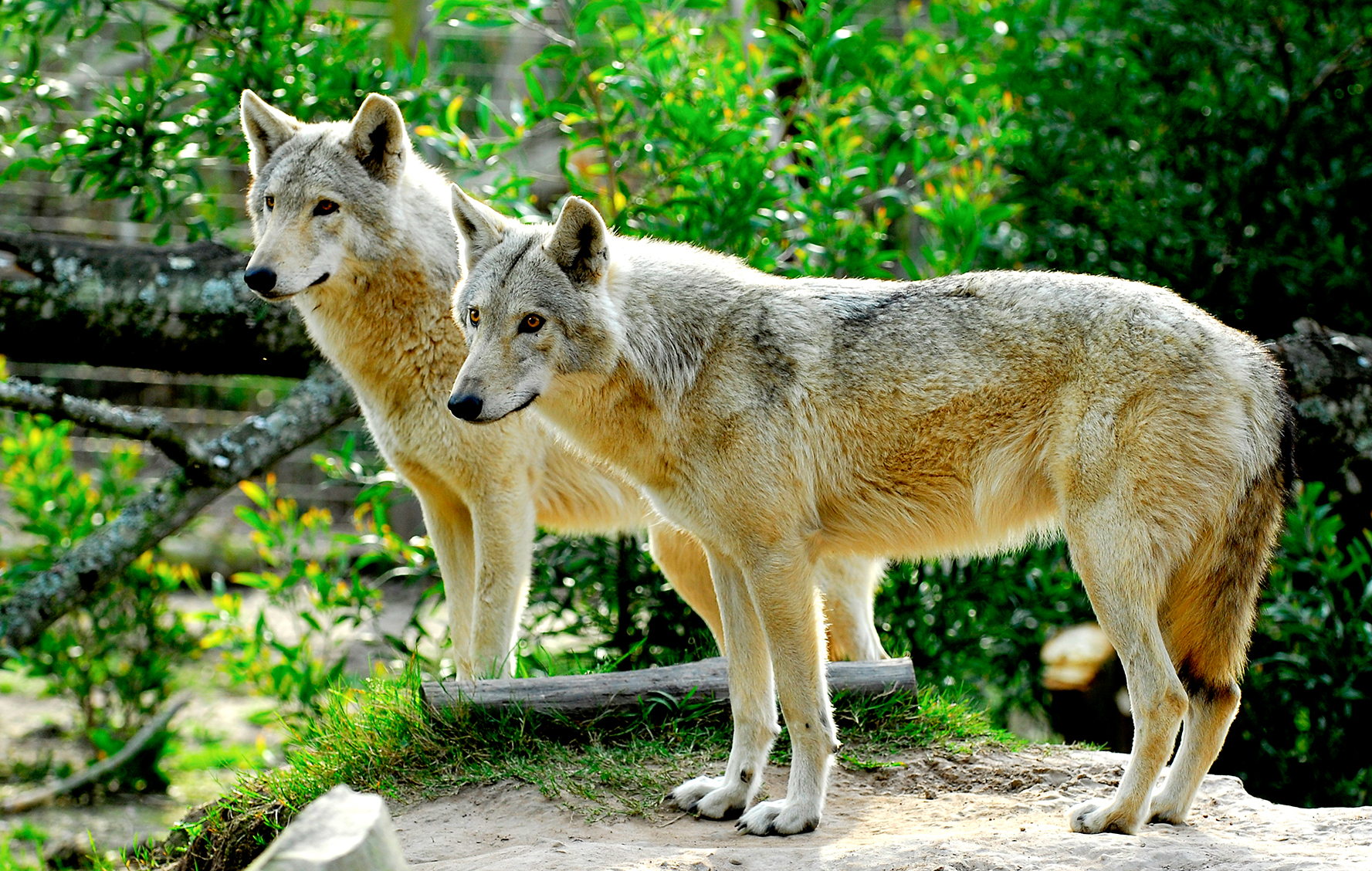
 Wolves are, by proportion, less damaging to stock that ranchers would have you believe. (Photo: Don Pinnock)
 The first story involves a problem-animal specialist named Thuys de Wet and took place more than a decade ago. We were sharing a Windhoek Lager at his house in the Venetia Limpopo Nature Reserve and talking about jackals.
/file/dailymaverick/wp-content/uploads/2025/08/If-you-kill-an-alpha-jackal-breeding-goes-through-the-roof-Don-Pinnock.jpg "If you kill an alpha male jackal, the predator’s breeding goes through the roof. (Photo: Don Pinnock)")
“Farmers don’t understand jackals. Most don’t kill sheep,” he said. “But if a sheep is killed, they go crazy and throw everything at the problem. So maybe they kill the alpha male. Then the real trouble starts.”
Jackals are territorial, he explained, and work in pairs. By dominating breeding cycles, alpha females can keep whole territories unproductive. But interlopers will generally chase her away once her mate is killed, and without her, younger females will begin to breed. There will soon be more pups around and lots of dumb sheep to feed them on. This means a higher survival rate, which means more jackals.
Fair game
Without the alpha male, the territory is fair game, and there are plenty of sub-males around – roaming Samurai warriors ready to exploit the gap. Being less established, they may have had to become inventive in their hunting. Maybe they have learnt to kill sheep. They’ll take over the range, teach other youngsters their skills.
Pretty soon, the farmer’s losing sizeable chunks of his flock. From where he sits, it looks like a vendetta. Each generation is harder to trap, harder to poison, harder to fence out, harder to fool and harder to kill. And every one is genetically hard-wired to learn from the top predator – the farmer himself – to outwit him.
“There was a farmer who managed to kill 37 jackals in a virtual war of fury at the death of a ewe. Within a year or two, there were so many smart, sheep-hungry jackals around that his entire farming operation was in jeopardy.
“I’ve been in this business for 24 years,” he commented, “and I can tell you the blunderbuss approach achieves little and kills many of the wrong creatures. Most jackals aren’t stock catchers. I can’t imagine how many jackals we’ve executed for offences they didn’t commit.”
Wolves
/file/dailymaverick/wp-content/uploads/2025/08/Wolves-are-by-proportion-less-damaging-to-stock-that-ranchers-would-have-you-believe-Don-Pinnock-2.jpg "Wolves are, by proportion, less damaging to stock than ranchers would have you believe. (Photo: Don Pinnock)")
The second story is research into another predator – wolves.
In the rugged rangelands of the northwestern United States, wolves have made an extraordinary comeback. Driven nearly to extinction by the mid-20th century, these predators are once again prowling their old haunts, sparking both admiration and anger.
For ranchers, their return often means fresh worries – a cow or a sheep found dead in the morning, the carcasses bearing the tell-tale signs of a wolf kill. For wildlife agencies, it means navigating an increasingly bitter conflict over how best to manage a species that is both protected symbol and livestock predator. But just how serious is it?
Public wolf hunting is being tried as a possible solution. The idea is simple enough: allow hunters and trappers to reduce wolf numbers, which in turn should cut livestock losses and spare governments the costly task of killing wolves themselves. Is it working?
In an attempt to answer that question, a team of environmental scientists from the US and Germany assessed 16 years of data from Idaho, Montana, Oregon and Washington. It’s just been published in Science Advances. They discovered the answer is far less straightforward than many assume.
/file/dailymaverick/wp-content/uploads/2025/08/In-the-US-wolves-are-back-and-ranchers-have-to-learn-to-live-with-that-2-Don-Pinnock.jpg "Wolves provide unexpected services. By reducing deer populations, they lower the frequency of deer-vehicle collisions, which carry heavy financial and human costs. They also restore rivers overgrazed by deer by reducing their numbers. (Photo: Don Pinnock)")
The research analysed records from 2005 to 2021 and found that while hunting wolves can slightly reduce livestock predation, the effect is surprisingly small. It had no measurable impact, even when government agencies later stepped in to kill wolves themselves.
Uncomfortable questions
The findings raise uncomfortable questions about whether wolf hunts, already among the most divisive wildlife management policies in the United States, actually deliver on their promises.
Few animals spark such polarised views as the grey wolf. Conservationists see their return as a triumph of environmental policy, restoring balance to ecosystems where wolves once reigned.
Many ranchers, by contrast, view them as dangerous predators whose protection comes at the expense of rural livelihoods. Public hunting has been promoted as a middle ground – satisfying calls for control while allowing regulated harvests rather than wholesale eradication.
Idaho and Montana legalised wolf hunting after federal protections were lifted in 2009, though legal challenges meant seasons were interrupted until 2012. By contrast, Washington and Oregon never permitted wolf hunting on nontribal lands, even as wolf populations expanded.
Comparing outcomes
This mix of approaches created a natural experiment. Some counties saw regular wolf harvests; others did not. By comparing outcomes across time and geography, researchers could test whether hunting actually shifted the dynamics of human-wolf conflict.
The finding? On average, livestock depredation in the studied counties was relatively low – about three confirmed or probable cases per county a year. In some places, losses climbed higher, but averaged only about seven animals annually. Against this backdrop, the study examined how changes in wolf hunting – whether a county allowed it and how many wolves were killed – correlated with livestock losses.
The results showed a small effect. Killing one additional wolf in a given year was associated with a 2.3% decrease in livestock losses, or about 0.07 animals spared in an average county. In high-loss counties, the benefit was slightly larger: about 0.17 fewer animals lost per wolf killed.
Why would hunting, which undeniably removes wolves from the landscape, fail to consistently reduce conflicts? A reason is that the effects are simply too small to matter at the scale most ranchers care about. To see meaningful reductions in the small livestock losses, a very high proportion of wolves would need to be killed – an approach that collides with conservation policies and public resistance.
Another factor may be the complex social structures of wolf packs.
Disrupting packs by killing the alpha pair can sometimes make matters worse, as with jackals, leaving inexperienced wolves more likely to turn to livestock. Hunting might also selectively remove cautious individuals, leaving behind bolder wolves more prone to predation. These dynamics create a web of consequences, making outcomes unpredictable.
The study’s findings highlight the narrow benefits of wolf hunting, but also point toward broader considerations. Hunting near popular wildlife tourism destinations can have unintended costs.
Yellowstone, for instance, has drawn millions of visitors eager to see wolves in the wild, but when heavily hunted just outside park boundaries, the viewing opportunities – and associated tourism revenue – can shrink dramatically.
Unexpected benefits
At the same time, wolves provide unexpected services. By reducing deer populations, they lower the frequency of deer-vehicle collisions, which carry heavy financial and human costs. They also restore rivers overgrazed by deer by reducing their numbers.
Balancing such benefits against the losses from livestock predation, say the researchers, requires a broader accounting than simply tallying kills.
Are there alternatives? Nonlethal deterrents such as range riders, guard dogs and fencing are effective in some contexts. Changes in husbandry practices, such as calving in protected areas or promptly removing livestock carcasses, can reduce risks. Insurance or compensation schemes can help offset inevitable losses, though rancher satisfaction with these programmes has been mixed.
/file/dailymaverick/wp-content/uploads/2025/08/In-the-US-wolves-are-back-and-ranchers-have-to-learn-to-live-with-that-Don-Pinnock-1.jpg "In the US, wolves are back and ranchers have to learn to live with that. (Photo: Don Pinnock)")
Ultimately, the study underscores that living with wolves means accepting some level of conflict. Eliminating all predation is unrealistic so long as wolves share the landscape with livestock. So ranchers must learn to live with them.
The hard reality that the research points to is that wolves are back to stay, and managing their presence will require more than rifles and traps. And for the public, the debate over wolves is a reminder that the solutions are seldom as simple as they seem. Thuys, the jackal man, could have told them that 10 years ago. DM
Addendum
Anatolian Shepherds have been used in the US to defend livestock, including sheep, from predators like wolves. In particular, a groundbreaking project by R and L Coppinger introduced Anatolian Shepherd Dogs on US farms where wolves had previously caused up to 200 sheep losses per year. Remarkably, once the dogs were deployed, not a single sheep was lost, and no predators were harmed – the dogs simply prevented approaching wolves from getting near the flock.
In South Africa, Cheetah Outreach Anatolian Shepherd Programme (started 2005) has placed about 380-390 Anatolian dogs on South African farms since inception. Farms report livestock survival rates going from severe losses to minimal or none.
The Endangered Wildlife Trust’s Livestock Guardian Dog Project (since 2008) deployed around 240+ Anatolians and Maluti Shepherds to 200+ farms. More than 80% of these dogs matured successfully as working guardians.
Together, these two programmes account for more than 600 dogs deployed across South Africa, protecting sheep and goats against jackals, caracals and other predators. While that’s a small fraction of all sheep farmers nationally, the practice is well established and steadily growing, particularly among conservation-minded and commercial operations tired of losing flocks to jackals.