




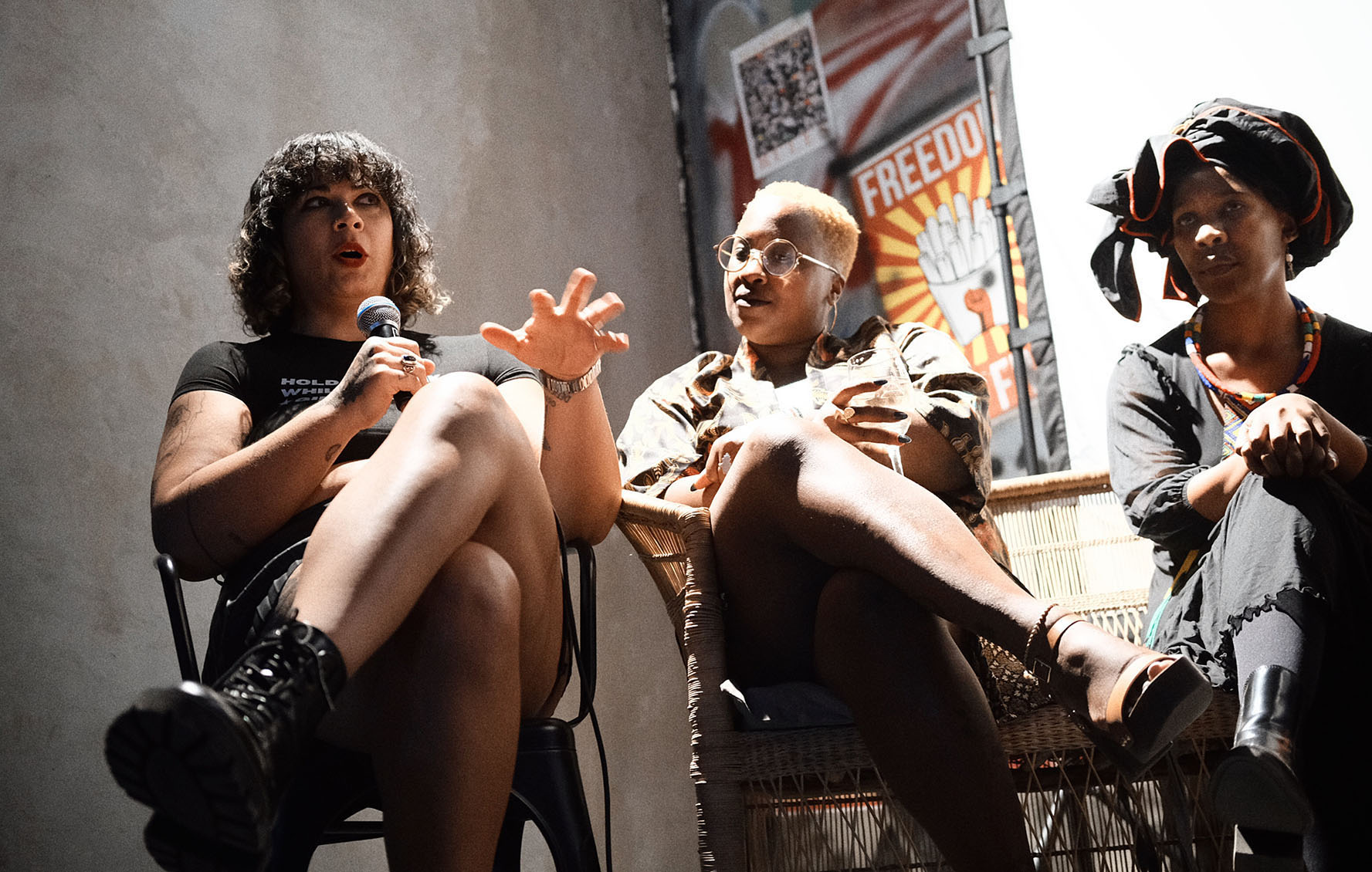
 Panellists at the Sex of the Nation Address at the Democracy Bar in Johannesburg on 24 August. (Photo: Troye Alexander)
 Getting ready to work on what I think was my third consecutive Sunday, and staring down at the laundry and personal admin still waiting, it dawned on me as I left to attend South Africa’s first Sex of the Nation Address (Sona) that sex work isn’t all that unlike journalism; you often work on the clock of others, it’s a highly competitive industry and none of us get paid enough.
The Democracy Bar is tucked away in the upmarket Johannesburg suburb of Illovo. My ticket is scanned (thanks, Daily Maverick), and I’m given a choice of two complimentary stickers.
I picked one of a handheld camera stamped “Sex work is work”, the other of a woman in lingerie wielding a sword and dagger with the legend: “Rights, not rescue”.
Full disclosure: before I wrote for a living, I shot news pictures. Before that, at university, I took photographs for escorts advertising in an online directory. The community and its nuances aren’t unfamiliar.
The Democracy Bar contained about 60 people. There were tattoos and expressive aesthetics; care with pronouns and presentation; and notably but not unexpectedly, very few white, straight-seeming men (I counted three but didn’t ask their preferences).
No one cared that I arrived on my motorbike, or in jeans, a black T-shirt and combat boots, just how I behaved — and that I think, is the point.
Sona is the brainchild of Jessica van der Berg, a South African sex-positive marketer and organiser now living in Amsterdam. She noticed the paucity of sex-positive events in her adopted hometown and began the initiative there.
When she visited South Africa, she thought that similar value could be offered by hosting such an event here, particularly given where we are as a country, both historically and presently, in our transactional relationship to sex and sex work.
Thus was born this Sona, organised in a very short four weeks, with Van der Berg collaborating with the likes of Yonela Sinqu, a journalist and representative of the sex worker rights organisation Sisonke, and Leah Jazz, radio presenter, sex educator and founder of Eden, which promotes sex-positive education.
It was also a fundraiser for the Sex Workers Education and Advocacy Taskforce (Sweat) and Sisonke in Johannesburg — organisations that have championed sex worker rights and safety for years.
An industry on the rise
As the team sorted out the audiovisual presentation (IT challenges are universal), I ran the numbers on the research I had carried out on the industry before the event.
Just looking at the largest few online listing directories of “escorts”, there are around 3,000 independent listings across South Africa — but that’s the formal, informal industry — the one that has access to escort directories, photographers, a modicum of verification and, hopefully, protection.
Including the entirety of the industry — and bearing in mind research that involves asking questions such as “Are you a sex worker?” may not yield a positive response — it is estimated that about 150,000 people are involved nationwide. If you run with this, almost certainly dwarven estimate, that’s about the same as the coal value chain in South Africa. Or the clothing, textile, footwear and leather industry.
We argue about the importance of other value chains all the time, but guess which industry hosts events with a code of conduct taped to the door?
Oh, and that estimate — it’s from a decade ago — the last reliable one I could find. The numbers are likely to be much higher now.
The first film at Sona — an interestingly narrative-driven piece about a person transitioning from male to female and wanting to preserve their sperm, fantasising about their partners while in the cubicle — was the only one I watched, but I’m sure the others were compelling.
/file/dailymaverick/wp-content/uploads/2025/08/DSCF6388.jpeg "Attendees at the Sex of the Nation Address view a film. (Photo: Troye Alexander)")
I found myself wandering away to smoke and speak with other attendees, and what I found, particularly from the panel discussions, is that politics and sex follow the same threads, but the rope is applied very differently.
The talks spanned bondage and discipline, dominance and submission, sadism and masochism (BDSM) and consent culture; content creation and sex work; queerness and embodied healing; pleasure and care as activism. There was an exhibition on boundaries, aftercare, emotional literacy and touch.
The house rules were blunter than most boardrooms’ and worked a lot better: consent is everything; a soft no, a maybe, or silence also means no; wristbands show who doesn’t want to be photographed; arousal is welcome, action is not; dignity isn’t optional.
If you’ve been living with any awareness in South Africa at any period in time, you’ll know that mandated dignity is not the norm.
Which brings me to my reason for attending the event — the current state of our legislation.
Legal missteps
South Africa still criminalises the sale and purchase of sex. In late 2022, the Cabinet published a Criminal Law (Sexual Offences and Related Matters) Amendment Bill to decriminalise adult sex work. Public comment followed, and support from rights groups was strong. The process slowed, then stalled in redrafting.
The Bill in its current form does nothing to regulate the industry — no implications for zoning, health registrations and licensing — just that a sex worker and a client won’t be able to be rolled over by cops for a bribe if they get caught.
Arguments against the legalisation and legislation of sex work that I’ve heard tend to come from two distinct camps — the liberal one, where sex workers are in theory recognised as workers, and their rights are respected, but also brackish in such a way that further discussion or advocacy is ignored — and the conservative, which tends to be moralistic and against legalisation because it somehow encourages “immoral” behaviour.
Both of these are, to me, distasteful: the liberal take is much like many others, all talk and no action other than the self-moralising pat on the back, and as for the conservative take, well, there’s a reason Sun City was built in Bophuthatswana.
Like our first time
So here’s an unoriginal argument to be made from pragmatism, which is what advocacy groups such as Sisonke and Sweat have pushed for, and is often cited by healthcare professionals and the legal bodies who researched and provided comment on the Criminal Law Amendment Bill.
Sex is closer to food or breathing than, say, woodwork or accounting. It’s something pretty much everyone participates in at some point. If they’re not able to do so with the exchange of their personality or time, they may do so with money.
Sex work isn’t going anywhere, it’s really a matter of how we do it, and as a country, we really are doing it like it’s our first time: no education, no protection, no thought of the consequences that are going to land in the metaphorical five minutes it’s going to take for them to land when we are of clear mind.
Read more: Activists offer to help Justice Department redraft long-delayed Bill to decriminalise sex work
Much like the Sex of the Nation Address, where news of the event was spread by word of mouth, the newsflash is that so do STDs and STIs — and in a country with our history and Thabo Mbeki-legacy HIV rate, those will spread too without decriminalisation and legislation, whether it’s from your they/them polycule partner in Melville or your C-Suite husband/wife/mistress in Menlo Park.
Another reason is the fiscus itself. Having attended multiple insert-word-here Budget dysfunctions, it’s apparent that South Africa is desperately cash-strapped. Decriminalisation and regulation means tax and revenue — one contact in the industry, admittedly at the higher end of the pricing in the industry, makes around R70,000 a month.
Lastly, but certainly most importantly, legislation that decriminalises and regulates sex work will protect the workers themselves, who are essentially currently performing a criminal act that leaves them vulnerable to violence, extortion and abuse perpetrated by law enforcement and clients — at rates that are orders of magnitude higher than those of our already risky-life-in-SA population.
Read more: 2024 elections — where the major political parties stand on legality of sex work
/file/dailymaverick/wp-content/uploads/2025/08/DSCF6297.jpeg "An exhibitor selling sex toys at the event. (Photo: Troye Alexander)")
I’m not a fan of the word intersectional, because it tends to be overused by a certain kind of liberal who is a fan of a respectable moral position without action — and I am not a liberal — but if anything, this event did highlight, albeit briefly, how the sex work industry and sex itself is a dovetail of so many aspects of both the human condition and the South African condition.
This Sona asks us to speak about sex and self without shame, and then act like we mean it in policy. The code of conduct is so basic as to be mundane, but in the best way: how to be with other people.
It’s also the only Sona I’ve attended of many that ran close to time, left me with respect and sent me home early enough to do the laundry. Consent all round.
Soon, we’ll have yet another litmus test — in September, the Western Cape Division of the High Court will hear a challenge to strike down the offences that criminalise consensual adult sex — even if it’s paid for. The case, brought by an anonymous sex worker, with Sweat as a co-applicant, may yet determine which direction we take.
Perhaps it’s time we start treating the industry with a margin of the respect we give the other Sona. I think we’ll be better off for it. And in the kind of space that events like this create, if anyone gets screwed, at least it’s consensual, and not the entire country. DM