



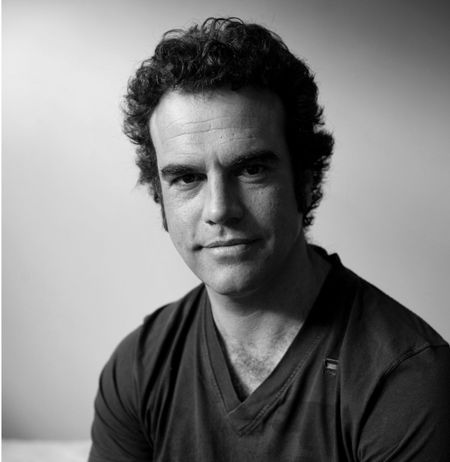
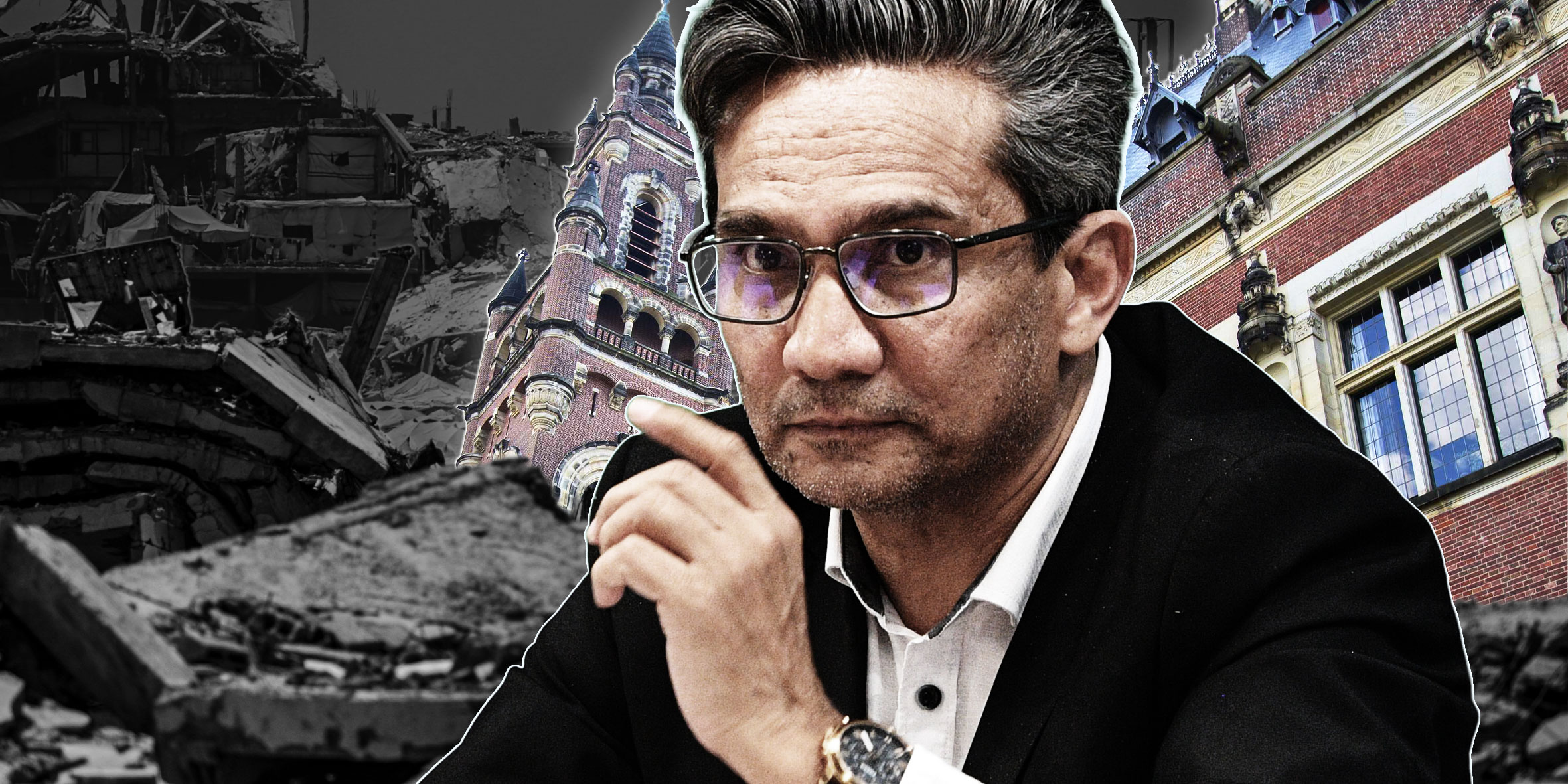
 Illustrative image: Zane Dangor (Photo: Gallo Images / Lefty Shivambu) | The northern Gaza Strip on 8 August 2025. (Photo: EPA / Mohammed Saber) | Permanent Court of Arbitration at the Vredespaleis (Peace Palace), in The Hague, the Netherlands. (Photo: EPA / Guus Shoonewille)
 “Today, Israel’s hindrances to the import of food and essential items have brought Gaza to the brink of famine,”
Blinne Ní Ghrálaigh testified back in January of 2024, “with adults — mothers, fathers, grandparents — regularly foregoing food for the day so that children can eat at least something.”
Ghrálaigh, an Irish barrister acting as an adviser to the South African legal team in its case against Israel at the International Court of Justice, was at the time hoping to steer the Genocide Convention of 1948 into an era of greater relevance. Just a month after its 75th anniversary, there was an expectation in the South African camp that the convention would do what it had been designed to do — that is, prevent the further intensification of genocidal acts.
“Israel continues to deny that it is responsible for the humanitarian crisis it has created,” Ghrálaigh continued, “even as Gaza starves.”
More than 19 months later, on Friday, 22 August 2025, the world’s most credible food monitoring institution officially declared a famine in the enclave, with more than half a million people affected. The next day, on cue, Prime Minister Benjamin Netanyahu dismissed the Gazan famine declaration as a “modern blood libel”.
With Netanyahu’s plans to reoccupy the enclave and depopulate Gaza City going ahead, billions of human beings were now asking the same deceitfully simple question — if the ICJ could not enforce the obligations of its signatory states, when and how would the atrocities stop?
Shortly before the famine declaration, we put this and other related questions to Zane Dangor, director-general of South Africa’s Department of International Relations and Cooperation, or Dirco. As the chief architect of our country’s case at the ICJ, a man with extensive on-the-ground knowledge of the forces at play in the Middle East, the insights that Dangor had to offer were at once shocking, revelatory and, yes, even slightly hopeful.
It may have taken way too long, but it seemed, to him at least, that the route to a ceasefire was in sight.
The interview, which took place in mid-August 2025, has been edited for length and clarity.
Kevin Bloom: Before we go back into the history of Dirco’s submissions to the ICJ, let’s start with the way more urgent issue of where we find ourselves now. In the first weeks of 2024 already, South Africa approached the court with the allegation that Israel was using starvation as a weapon of war against Palestinian civilians in Gaza. This was more than 18 months before world-renowned famine expert Alex de Waal said that, in his decades of experience, he had never seen such a clear-cut case of “precisely designed mass starvation”. Could you please comment on the sources you used to arrive at your conclusion — and to effectively warn the world — way before the seriousness of the situation became obvious.
Zane Dangor: So the sources we used, both in our application in January 2024 but more substantively in our application in March 2024, were UNRWA [United Nations Relief and Works Agency for Palestine Refugees in the Near East], the FAO [Food and Agriculture Organisation of the United Nations] and the World Food Programme, which generally form what is considered to be a network that reports on food security crises globally. And their figures then were quite accurate. In January already, I remember the famine levels being described as “level three”, you know, just two levels below catastrophe. So we mentioned that in our oral representation. Immediately after that, there was a meeting in Switzerland, where we were still doing the Ukraine peace negotiations, and I mentioned this again — because the evidence was already beginning to mount.
So it was credible UN sources. Also, the Red Crescent and Red Cross, who were working on the ground. But OCHA [the United Nations Office for the Coordination of Humanitarian Affairs] provided a lot of the detail. OCHA has been active up until now, by the way, but has just been barred from operating.
KB: Unfortunately, we find ourselves in a situation now where — despite all evidence to the contrary — the Israeli leadership continues to deny the starvation in the besieged enclave. More important, however, the international community has failed to act. Could you comment on the levels of frustration among South Africa’s legal team at this criminally egregious (and perhaps unprecedented) dereliction of duty in the face of its ICJ submission.
ZD: I think there is a sense of frustration, a deep one, but also a huge sense of loss, because, you know, if one reads the Genocide Convention, its major premise is not to punish, it’s to prevent. And it was on that focus of prevention that we made our submissions, to prevent further intensification of genocidal acts. That includes the military action, but also other means “to destroy a people in part or in whole”, which extends to the destruction of hospitals, clinics, schools and of course, as we are seeing now, the denial of access to food.
We made these warnings with the intent that people would act, that the most powerful amongst us would act. The ICJ, we thought, would have the ability to provide the kind of instructions that others would feel obligated to implement. But we were faced with the institutional impunity that Israel and some of the other big powers have been enjoying for many decades. It has given rise to a sense that, you know, these laws are meant to hold smaller powers to account. Some international legal scholars call them “the international legal subalterns,” as in, you are the subjects of these laws, but you cannot enforce them against others.
One of our legal experts, the Irish advocate, Blinne Ní Ghrálaigh, actually mentioned this in her oral argument in January 2024 — when she said that it’s not just Israel on trial, “it’s this very court”. And she mentioned the court not because of the court itself, but essentially because of the enforcement gap. The court is meant to ensure that obligations which are enforceable are indeed enforced, and the UN Security Council and the most powerful states among us are supposed to help with that.
So the legal team is frustrated, yes, but we also feel that as much as we know the weaknesses of the international legal system, it’s the only system we have. We have to reform it, but it’s the only protection that middle powers and smaller powers have.
KB: Going back, then, to the very early days — on 16 October 2023, just over a week into its assault, Raz Segal, an Israeli expert on modern genocide, warned that what Israel was doing in Gaza was a textbook case of “intent to commit genocide”. At around the same time, journalists like Mehdi Hassan and Owen Jones were saying the same thing. You no doubt would have been paying close attention to such observations. Could you perhaps give us an insight into the behind-the-scenes process that motivated Dirco to put together the legal team to make the first submission to the ICJ in December of that year.
ZD: Yes, so many years before the post-October 7th military attacks, we had the Russell Tribunal, some of it set in South Africa, which started to make the case that there was systemic genocide within the Palestinian territories. In that context, Raz Segal’s comments were ones that I followed immediately, although he wasn’t the only expert who was saying those things in the very early days. The notion of a textbook case of genocide — a former British diplomat and former UN staffer, as I remember, also raised their hands on that at more or less the same time.
We were getting lots of emails, petitions, from people across the world. I think they were reaching out to many, many countries. They said, you’ve got to invoke the Genocide Convention. I remember speaking to a couple of international lawyers and asking, what’s the best route? Isn’t the ICC [International Criminal Court] a better route, you know, where you have individual criminal accountability? And we knew that the ICJ process, having just looked at the Gambia case and other cases, could take forever. If our objective was prevention, we thought, maybe the ICC could get to the issues quite quickly, and you would then find that there would be some pressure on the attacks to stop.
But as it escalated, and once our leaders in government started saying it’s a genocide, then we were obligated, under the Genocide Convention, to act either to prevent or to punish. So the process behind the scenes was engagement with experts, international legal scholars around the world, in the UK, South Africa, Switzerland, as to what would be the best route. We had discussions, for example, about whether we should take what is called the “Article VIII” route, where you just ask a competent organ of the United Nations to act on its own recourse. But because our focus was on prevention, we went with “Article IX” — sorry for all the technical jargon, but it’s important — because that allowed us to ask for provisional orders. To ask for exactly the types of things you alluded to in your first question; can we ensure that aid gets in unhindered, can we ensure that the attacks on hospitals stop. And these provisional orders are binding, they’re not advisory. “Article VIII” would have been advisory; this is binding.
So when we started to put the team together, we were thinking about what would be the best team from the international legal community, people who had worked on these issues before. We chose barristers from Ireland and the UK, not because they’re from those areas, but because they’ve worked extensively on ICJ matters and understand the processes of the court. Then we looked for domestic advocates who would be able to make the kinds of arguments that we thought needed to be made on the international stage. It was ultimately a combination of the best we had domestically with the necessary foreign expertise to navigate the demands of the court.
KB: The allegation that Iran instigated and funded the ICJ submission, by bailing out the ANC from bankruptcy, has not gone away. In fact, just recently, the allegation gained fresh steam off General Rudzani Maphwanya’s comments about the “common goals” of the South African National Defence Force and the Iranian military. How would you respond to the critics who insist on Dirco’s sinister agenda in this regard?
ZD: The sinister agenda one is puzzling, and I’ll come to the general’s comments in due course. So this originally became an issue after the first provisional orders were issued, on 26 January 2024. And as much as we came out to explain that we hadn’t been influenced by Iran or anybody else to do what we were doing — you know, people have also asked me whether anybody tried to dissuade us — it didn’t seem to help. There was even one senior US official who asked us to please give them a chance to engage the peace process rather than go this route, and we made the link that it’s not justice or peace, it’s justice and peace. And that very same person — I’ve sworn anonymity — has since apologised and said, “we should have listened”.
Again, the attacks came in the media after the first provisional orders, and yet the very same countries who launched those attacks now can’t move away from the term “genocide”. We in fact stated in the very first paragraphs of our application that we understood the weight of the term when it came to Israel. We of course know that the Genocide Convention had its origins in many ways in the Holocaust, and we made that point, because it’s not an easy one to deal with. Also, we engage quite significantly with Israeli organisations. Yesh Din, for example, who did the first legal paper on Israel as an apartheid state, using the Apartheid Convention. Then there is B’Tselem, and when you engage with the people of B’Tselem you realise that the conclusion in their “Our Genocide” report was a very difficult conclusion for them to reach, but it was one based on evidence.
So what has transpired since the Iranian issue just gives one a sense that the allegation was meant to deflect. It was meant to tarnish the work that South Africa had done. It was, you know, almost this “axis of evil” approach. But I can say categorically, as a person who played a leading role in drafting the Cabinet memo, in asking the members of Cabinet to consider going to the ICJ under the Genocide Convention, that there was not one instance of engaging with any foreign government, including and especially Iran.
The allegations were also linked, perhaps, to the fact that South Africa has diplomatic relations with Iran, but that diplomatic relationship is not one that is uncritical. On the JCPOA [Joint Comprehensive Plan of Action], for example, the nuclear agreement that we felt was an incredibly good agreement that the Obama administration had signed, South Africa worked very carefully to ensure that Iran stuck to it — because, you know, we’re a TPNW [Treaty on the Prohibition of Nuclear Weapons] state, which means we believe that no state should have access to nuclear weapons. We also believe that the non-proliferation treaty is a key tool in that, and so this has been a major subject in our diplomatic engagements with Iran.
As for the general of the SANDF going there and making political statements, we were very clear in our media release that the office of the President and Dirco are the only institutions that can make such statements about relations between states. He had no role or authority to make those comments. But of course it would feed into this frenzy that, you know, Iran played a major role in the ICJ case. And yet there are still no facts to back up these allegations. We are wondering what more we must do to dispel the rumours; we have put out media statements before and discussions like this are important, but it’s got legs and so it’s difficult to undo what certain people have mobilised their bias around.
KB: Sure, there’s no doubt that international diplomacy is a tough gig. On that point, then, given where Israel finds itself today, facing the condemnation and rage of an ever-growing number of governments and ordinary citizens, how do you think it should have responded to the Hamas assault of 7 October?
ZD: Look, I remember a few days after the attack of 7th October, I was with [British-Israeli analyst, author and former adviser to the Israeli government] Daniel Levy; both of us were on a TV show together. And we both said that the attack of 7th October should be a shock to our collective humanity, all of us, any time that civilians are attacked in that manner. But we also said that the occupying power has the ability to use its normal policing responses to engage with whoever perpetrated the attack.
The year before that, in 2022, I was in the West Bank and also in Jerusalem, and I met with a range of actors, including the former head of foreign affairs for Israel, Alon Liel. They were starting to make the prediction that the [religious Zionist] Bezalel Smotrich component of the current Israeli government was spoiling for the “final war”. They were saying that the kinds of provocations they were seeing on a day-to-day basis in the West Bank and in Gaza could give rise to an event like October 7th. To be clear, nothing justifies that attack, but the predictions were there.
So we believe that the occupying power should have used whatever means it had under its policing structures. Of course, what we saw was that the attack became the vehicle for longstanding plans of depopulating Gaza. You know, we used the term “depopulation” in January 2024, and some of our diplomatic colleagues said we were overstating the case. Many of them have now realised that it wasn’t an overstatement.
KB: What do you have to say, then, to the mainstream Jewish community of South Africa, whose institutions — including the South African Jewish Board of Deputies, the Zionist Federation and the office of the chief rabbi — have accused Dirco and the South African government of betrayal and anti-Semitism?
ZD: So the South African Jewish community is diverse, as are the Muslim and Christian communities. You know, you find that within the Muslim communities, you have Zionists as well. And you have Christian Zionism. I often explain to people that the basis of Zionism, having studied this for obvious reasons over the years, is not in Judaism; it’s actually in evangelical Christianity, in a certain component of that sect.
In that sense, I think that the Jewish Board of Deputies needs to reflect on what it represents at the moment. You know, it still talks, as many of us do, about a two-state solution. But it has not gone far enough at all in dealing with the absolute horrors that we see on a day-to-day basis. A critique of Israel is not a critique of the Jewish people; it’s not a critique of the Jewish community in South Africa, or globally.
You know, one of the most touching conferences I have attended in the last two years was organised by Jewish Currents in New York. The meeting was supposed to be held at one of the universities, but a few days before it was due to take place, Jewish Currents was deplatformed. The conference then took place in the oldest synagogue in the city. Just talking to a range of people in that grouping, and 95% were Jewish, they were reflecting on — and I don’t want to speak on behalf of Jewish people — but they were reflecting on how Jewish tradition is completely opposite to what the Israeli government is perpetrating. They were telling Daniel Levy and myself that we were too diplomatic in our descriptions of the atrocities.
So the voices that you get from South African Jews for a Free Palestine, but also Jewish Voice for Peace globally, these are voices that are more in touch — as far as I am concerned — with a human rights tradition that runs across religions, across ethnicities. The accusation that we are betraying the Jewish community of South Africa is therefore not only inaccurate, it rings hollow. We ask the Jewish Board of Deputies to look at what is happening genuinely and objectively and then, you know, to start calling out the Israeli government for what it is doing today.
KB: In closing, as we have already discussed, Dirco has at this stage been largely vindicated on the ICJ case, with most of the world’s genocide scholars and top-tier human rights organisations — including two of the major rights organisations in Israel — accusing the Jewish state of the “crime of crimes”. But vindication aside, it appears, on the back of Netanyahu’s plan to reoccupy Gaza, that the situation is about to get a lot worse. In the face of this horrific scenario, what is the strategy of Dirco and the ICJ legal team going forward?
ZD: Yes, so the case has brought to the fore in a very sharp way that what we have is an unfolding genocide. You know, in many of its other cases, the ICJ was looking at genocides of the past; this is one that is unfolding in the present. So the legal processes amplify the political processes. You had the two-state solution conference at the UN in July, many people were quite dismissive of it, but we were saying that this is a step in the right direction — because now, at the very least, countries that have always been almost uncritically supportive of Israel are taking a different stance. This lays the basis for change; it lays the basis for the kinds of pressures that will lead to change. When Germany says, for example, that they are not going to be sending arms, it’s an important step.
We will be working with a range of states like those up until September, when the discussion that took place last month will continue. For us, it’s about creating the momentum to hold Israel accountable in a manner that lays the basis for a complete ceasefire. We need to ensure that there will be counter-measures in place as the plan to reoccupy Gaza goes ahead. It may not be easy because, you know, you still have one powerful state that is not coming out clearly in terms of what they are going to do. But everybody else, the entire European Union, is now beginning to speak with one voice.
The Middle East is also coming across. It was always said that the difference between South Africa and Palestine was that in the former, the frontline states were very supportive; in Palestine, the frontline states are not as supportive. You know, you don’t have in those states the levels of democratisation that you had in a decolonising southern Africa. But still, we are seeing a change in tone coming from that part of the world too, which is an important signal for the kinds of pressures that are necessary for the emergence of a just peace for Israelis and for Palestinians. DM