



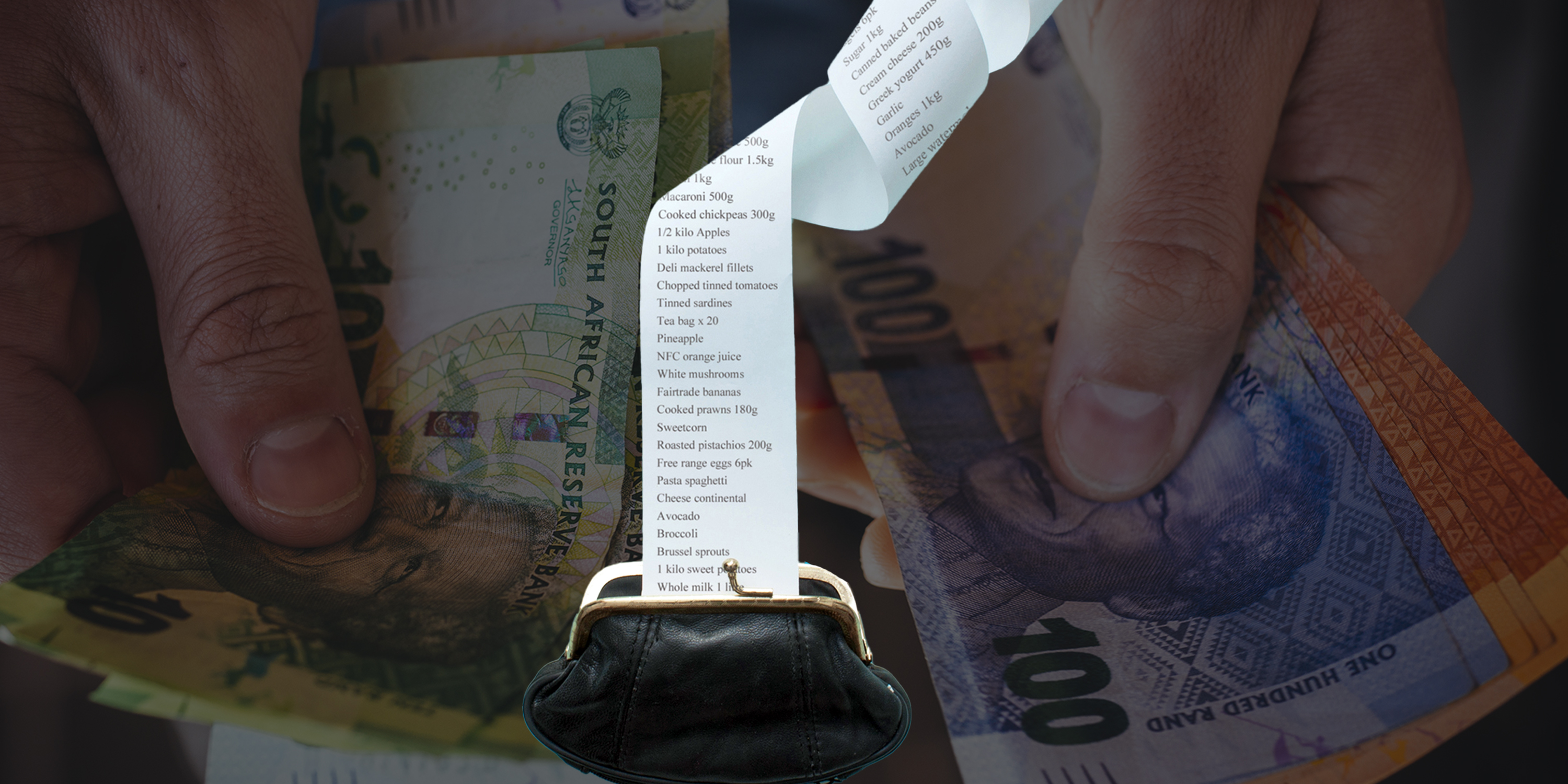
 Illustrative image | South African banknotes. (Photo: Waldo Swiegers / Bloomberg via Getty Images) | The cost of things like electricity, water, food and transport is going up at a much higher rate than official inflation. (Photo: iStock)
 So, I’m guessing here, but unless you happen to have owned land in Cape Town over the past 15 years, you’re probably feeling poorer than you did back when we hosted the World Cup.
As it turns out, that year in particular was probably a turning point in your finances. Up until then, at roughly the point Jacob Zuma and Sepp Blatter walked onto the pitch at FNB Stadium in 2010, things had been getting better in South Africa.
Now, in this country, I completely understand why we don’t discuss the plight of the middle class very often. It’s because so many people in so many other parts of our society are suffering so deeply.
But, if you belong to our middle class, however you define it, you are absolutely allowed (somehow a safer word than “entitled”) a bit of grumbling.
In fact, quite a bit of grumbling. A lot of grumbling, really.
As Moneyweb explained in what I thought was a really important and thoughtful piece on Monday, the evidence backs it up. You probably have a lot less money to spend than you did back then.
You’re allowed to ask at this point: “But hold on, inflation is finally down, we didn’t suffer what other people did during the pandemic (when places like Hungary suffered food inflation of 45%). Why does it still feel so bad?”
I think it must feel bad because, actually, it’s pretty bad. It’s just taken us a long time to get here.
It’s not just about the numbers, it’s about what Stanlib chief economist Kevin Lings described quite wonderfully as “lived inflation”.
As he explains it, the basket of goods used by Stats SA to measure consumer price inflation includes many things you don’t buy often. Appliance inflation is -3.6% (which is why it really is a good idea to put off buying that new fridge or vacuum cleaner until next month).
But, the price of things like electricity, water, food and transport – things you use every day – is going up at a much higher rate than official inflation.
And these are costs you just can’t avoid.
Lings put it rather neatly on The Money Show last night: “The main problem is a lack of prospect, a lack of progression in your career. If you go to other countries, there are many, many more job opportunities. As you gain experience in your business, you are looking to move up the corporate ladder. You’re looking to prosper, looking for a better-paying job. Those jobs are available, so you find yourself moving to another business, a much better-paying job. That can increase your salary in one go by 20 or 30%.”
Read more: July CPI surges to 10-month high of 3.5%, sailing above the Reserve Bank’s de facto target
And in the US, he says, that is a massive component of “how to increase your income”.
To look at it this way, you – yes, you in the middle class – are also a victim of our non-growing economy.
Or, to quote Lings again (sorry, Kevin!): “We’re not investing, we’re not growing, we’re not employing, we’re not expanding.”
That one sentence probably sums up our entire situation.
I do think there are other things that might well explain our current state of grumbling though.
It’s not just that we are paying an absolute fortune for electricity and other council services. It’s that we get virtually nothing in return.
It may be different where you bought land 15 years ago, but I think in most other places, you probably feel that you are just giving the council money for nothing.
And that means you’ve had to put buckets of money you can’t really raise easily into the solar panels on your roof. Or sink money you don’t have into a borehole.
I suspect that in many parts of Joburg, Tshwane and eThekwini on a Sunday afternoon you might hear the complaint that you have to over-invest in your property just to live.
And that, in turn, is money you won’t get back either.
And, as bad as it is for you, I fear it may be worse for our children. And I do mean all of the children in our nation.
It seems much harder now to get into the formal economy than it was when I was oversupplied with hair and attitude.
And this is possibly of absolutely no comfort to you whatsoever, but I think that is the case for younger people in most places.
The economies of the EU and the bigger, uppity island off its coast are also struggling.
Youth unemployment in Spain is more than 20%. I have no idea what is going to happen in the US, and even China, an economy that has been growing at a staggering rate for so long, is so worried about its youth unemployment figures that it stopped publishing them for a while.
So life is tough. And getting financially tougher. And there is not much we can do about it.
But we can grumble.
And grumble we should. DM