



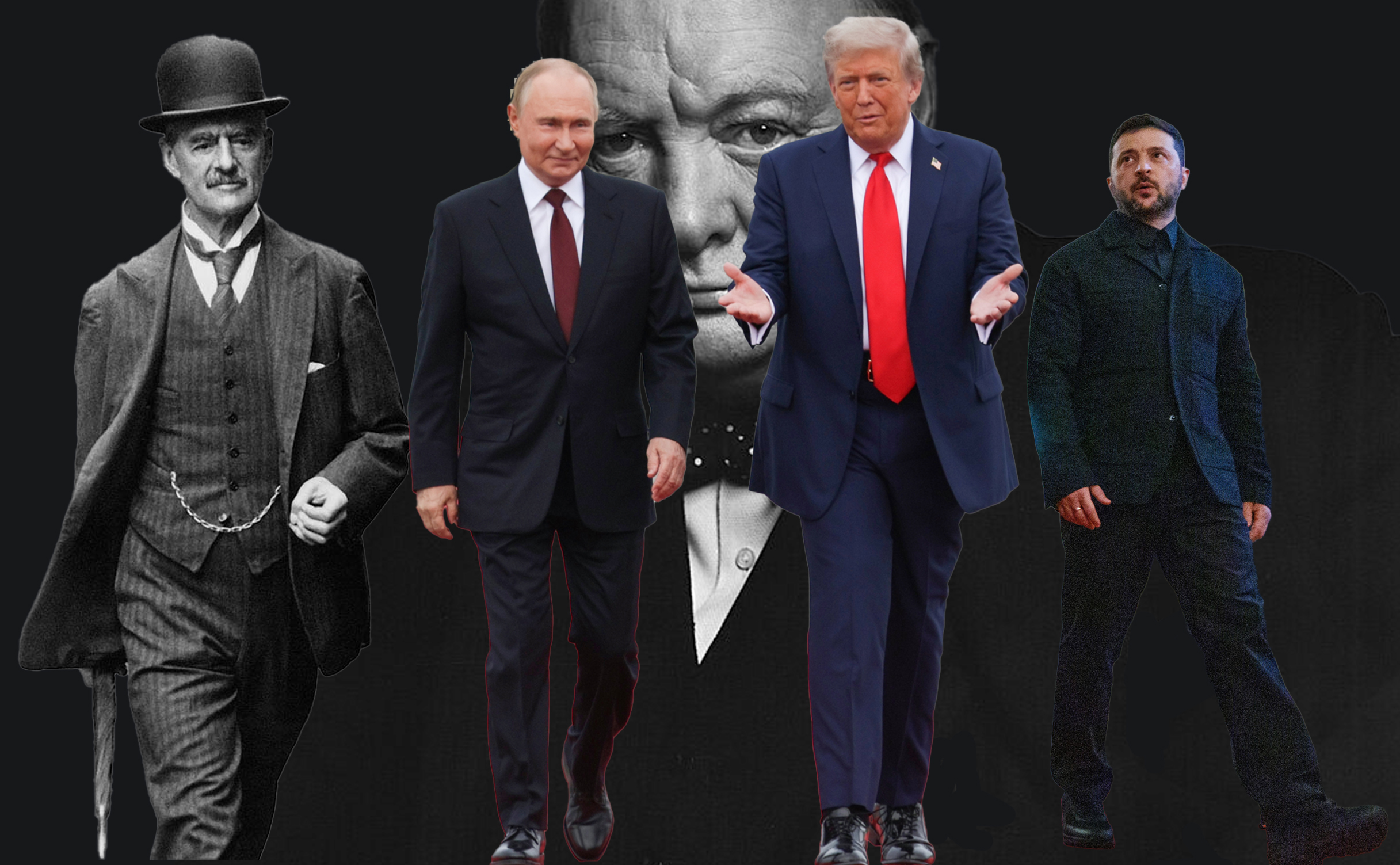
 Illustrative image | Sir Winston Churchill. (Photo: Wikipedia) | Neville Chamberlain. (Photo: Wikipedia) | US President Donald Trump (right) and Russian President Vladimir Putin. (Photo: Gavriil Grigorov / Sputnik / Kremlin Pool / EPA) | Ukrainian President Volodymyr Zelensky. (Photo: Aaron Schwartz / EPA / Pool)
 At the risk of repeating it yet again, history offers the flawed promise uttered by then British Prime Minister Neville Chamberlain on his return from the infamous 1938 Munich Conference.
Now it is the elusive promise of peace in the wake of the Russian invasion of Ukraine.
History doesn’t exactly repeat itself, nor does it necessarily repeat as farce, despite Karl Marx’s admonition. Instead, sometimes it is simply another iteration of tragedy.
That 1938 meeting in southern Germany brought together German leader Adolf Hitler on the one hand and French Prime Minister Édouard Daladier and Chamberlain on the other, where the three leaders reached an agreement granting Germany control over the Sudetenland district near the Czech-German border.
This region was significantly populated by ethnic Germans, but became part of Czechoslovakia as a result of the collapse of the Austro-Hungarian Empire after World War 1. The Czechs, however, were not invited to participate in Munich for the carving up of their nation.
Bordered on three sides by German territory once Austria was added to Nazi Germany, the Czechs had heavily fortified their border region and were quite prepared to defend their territory against an invasion. But, pressured by France and Britain, they gave way in the face of a lack of any support by the West for what Chamberlain called “peace in our time”.
Despite that agreement, though, within less than a year, Germany had forcibly absorbed the remaining parts of Bohemia and Moravia, granted portions of what was left to Hungary and Poland, and created a quasi-independent nation out of the remnant of Slovakia.
‘All is over’
Upon learning of the outcome of the Munich meeting, Winston Churchill — not yet in the British Cabinet, let alone prime minister, but still a member of parliament — said in a speech, “All is over. Silent, mournful, abandoned, broke, Czechoslovakia recedes into the darkness. She has suffered in every respect by her association with the Western democracies and with the League of Nations, of which she has always been an obedient servant.
“It must now be accepted that all the countries of Central and Eastern Europe will make the best terms they can with the triumphant Nazi power. The system of alliances in Central Europe upon which France has relied for her safety has been swept away, and I can see no means by which they can be reconstituted.
“And do not suppose that this is the end. This is only the beginning of the reckoning. This is only the first sip, the first foretaste of a bitter cup which will be proffered to us year by year unless by a supreme recovery of moral health and martial vigour, we arise again and take our stand for freedom as in the olden time.”
To an old friend, he then wrote, prophetically, “We seem to be very near the bleak choice between War and Shame. My feeling is that we shall choose Shame, and then have War thrown in a little later on even more adverse terms than at present.”
Lessons unlearned
One has to wonder if Donald Trump and his inexperienced servitors have read anything whatsoever about this bleak period of history.
Watching the US president’s recent public performances at the Alaska summit and the subsequent White House gathering, we must conclude he and his aides simply have not done their homework.
Or perhaps they skipped the classes when the history of the 1930s was being taught — or at a minimum, they attended but absorbed all the wrong lessons from the events.
In any case, far too many experienced diplomats and analysts have now been summarily fired from government service on the grounds of insufficient slavish loyalty to the president, so that the depth of knowledge available has been sorely diminished.
Trump continues to speak about the need for peace; that Russia’s Vladimir Putin has told him that he wants peace; and that the US leader’s primary goal is to end the bloodshed.
Nevertheless, he seems unable to pronounce any of the words spelling out the obvious: one certain avenue towards peace could come from Russia ending its invasion, together with its cessation of missile and drone attacks on Ukrainian civilian targets.
Similarly, the president has meandered across the policy landscape regarding his support for at least a temporary ceasefire to end the civilian and military carnage, while negotiations for more lasting arrangements for a peaceful outcome can begin. Instead, after publicly endorsing the idea of a ceasefire, he followed it with his almost shameless adoration of Putin at their Alaska meeting, complete with a red carpet, US Air Force flyovers, and a ride in the US presidential limo.
This happened even as Putin is under indictment for the kidnapping of some 20,000 Ukrainian children, among other actions. Trump abruptly reversed course and suddenly opted to promote full-on negotiations for a comprehensive peace agreement instead of an immediate, albeit temporary, end to the bloodshed and destruction.
/file/dailymaverick/wp-content/uploads/2025/08/13270742.jpg "(Left to right) EU Commission President Ursula von der Leyen, British Prime Minister Keir Starmer, Finland's President Alexander Stubb, Ukraine's President Volodymyr Zelensky, US President Donald Trump, French President Emmanuel Macron, Italian Prime Minister Giorgia Meloni, German Chancellor Friedrich Merz and Nato Secretary-General Mark Rutte pose for a family photo in the Cross Hall of the White House in Washington, DC, on 18 August. (Photo: Aaron Schwartz /Pool / EPA)")
Cart before the horse
To most analysts, this changed position means that if such a negotiation were to begin, the Russian military could continue its attacks while Putin’s diplomats slow-walked negotiations to gain more advantageous military positioning on the ground.
To those analysts — as well as the Ukrainian officials who have commented on this — this is putting the cart before the horse. Even a temporary ceasefire ahead of negotiations for an end to the fighting might give Russia time to regroup, re-equip and refresh, especially if they then chose to break off negotiations and resume the attack.
But a ceasefire could be a reasonable risk for peace. In other conflicts, a ceasefire is the usual way of doing things, so as to generate confidence in building towards a more overarching landscape for a peaceful resolution of a conflict.
But the problematic elements of how it played out in Alaska and then Washington were, according to a comment to us from a retired US ambassador, that: “Mr Trump deserves the title of ‘Conceder-in-Chief.’ In less than a week, he has reversed himself time and again. For starters, he said Putin must either agree to a ceasefire in Ukraine or face tougher economic sanctions.
“After meeting with the Russian tyrant, he meekly demurred on this demand. Suggesting the US was open to providing troops with Europe as part of a future security guarantee to Ukraine, he timidly backtracked, conceding a bargaining chip to Russia with nothing in return.
“As for his claim Russia conceded to him on a Putin-Zelensky summit, expect Trump to fold again when it doesn’t happen. What we see is pathetic weakness and lack of resolve by this so-called leader of the free world.”
By now, we might also add that even the presumed trilateral meeting between Putin, Zelensky and Trump, let alone the bilateral one between the leaders of the two nations at war, appears to be far from being confirmed, despite Trump’s cheery assumption that it will happen because he has spoken.
Fatal misunderstanding
The larger problem, of course, is that Trump has fatally misunderstood the nature of Putin’s policies and intentions, as well as the larger implications of preemptively giving way on so many points even before negotiations begin.
There should be no expectation that the Russian leader actually wants a win-win peace, given his frequent assertions that Ukraine is not a real nation, but instead should return to being part of the larger Slavic Russian world.
Putin’s minimum goals are to gain the full extent of the Donbas region with its industrial and mining base, and a subservient regime in Kyiv — one that does not include anyone in Ukraine’s current leadership — as well as all of the territory it has already gained by force of arms. To these points, there must be promises that Ukraine will not apply for membership of either the European Union or Nato.
But peace by itself should not be the final goal, especially if it means a dismembered or seriously subservient Ukraine, as opposed to a restoration of Ukraine to operate as an independent nation able to exercise its sovereignty and domestic policies without interference by its larger neighbour.
Mired in confusion
As historian Max Boot wrote in The Washington Post recently, “This whole exercise began with, and remains mired in, confusion. [Trump’s negotiator, the real estate developer Steve] Witkoff came away from his Aug. 6 meeting suggesting that Putin was willing to make significant concessions. That, in turn, led Trump to write on his social media site, Truth Social, that ‘Great progress was made!’
“He postponed his threatened sanctions on Russia (though maintained tariffs on India [for purchasing Russian oil]) and rushed to schedule a summit with Putin. But, on closer examination, it became obvious that any concessions Putin was willing to make were minimal.
“When Russian and Ukrainian representatives met in Istanbul on June 2, the Russians presented a long list of demands that, if accepted, would turn Ukraine into a virtual Russian colony. The Russians offered a ceasefire only after the complete withdrawal of the Ukrainian army from four partially occupied regions: Donetsk, Luhansk, Kherson and Zaporizhzhia. The Russians also demanded a halt to all Western arms supply to Ukraine and caps on the size of its armed forces. These were the same maximalist demands that Putin has been pursuing since the conflict’s beginning.”
Boot went on to say, “The European leaders hurried to the White House on Monday to try to dissuade Trump from falling for Putin’s cynical ruses. They insisted that Trump stick to his original ceasefire demand and that the United States offer security guarantees to Ukraine as part of any peace settlement.
“Trump now seems willing to offer some kind of security guarantee, which is progress of a sort, but what Trump is saying is so vague as to be meaningless. After meeting with the Europeans, Trump wrote: ‘We discussed Security Guarantees for Ukraine, which Guarantees would be provided by the various European Countries, with a coordination with the United States of America’.”
To some, the similarities are entirely too close to the peace that France and Britain obtained in Munich in 1938, which collapsed within a year.
It is observations such as those that led New York Times columnist Thomas Friedman to despair, “I am trying to balance President Trump’s commendable desire to end the murderous war in Ukraine with the utterly personalized, seat-of-the-pants, often farcical way he is going about it — including the energy that everyone involved has to expend feeding his ego and avoiding his wrath, before they even get to the hellish compromises needed to make peace.
“When our allies have to devote this much energy just to keep the peace with our president, before they even begin to figure out how to make peace with Vladimir Putin; when they have to constantly look over their shoulder to make sure that Trump is not shooting them in the back with a social media post, before Putin shoots them in the front with a missile; and when our president doesn’t understand that when Putin says to Ukraine, in effect ‘Marry me or I’ll kill you,’ Zelensky needs more than just an American marriage counselor, it all leads me to ask: How is this ever going to work?”
Crux of the matter
And that, of course, is the real crux of the matter.
A simple “I want peace”, as if this is a matter of a handshake over a new property development in downtown Manhattan, will almost certainly not lead to a lasting solution.
Instead, hard, skilled negotiating, resolute behaviour on the part of the West and assiduous attention to the fine detail of difficult compromises may — ultimately — lead to an end of the fighting.
But in the meantime, absent a ceasefire, soldiers of both sides will continue to perish. The drones and rockets will still be launched at Ukrainian hospitals, schools and apartment blocks — because the Russian military can do so, now largely without consequences directed at Russia from the West.
The hard men in the Kremlin will continue to tell their population that their sacrifices for this war of conquest are really in the service of reconstituting a pan-Slavic Russia to bring together those parts that had been unfairly ripped from the country in the disintegration of the old Soviet Union.
Instead, expect the worst. DM