



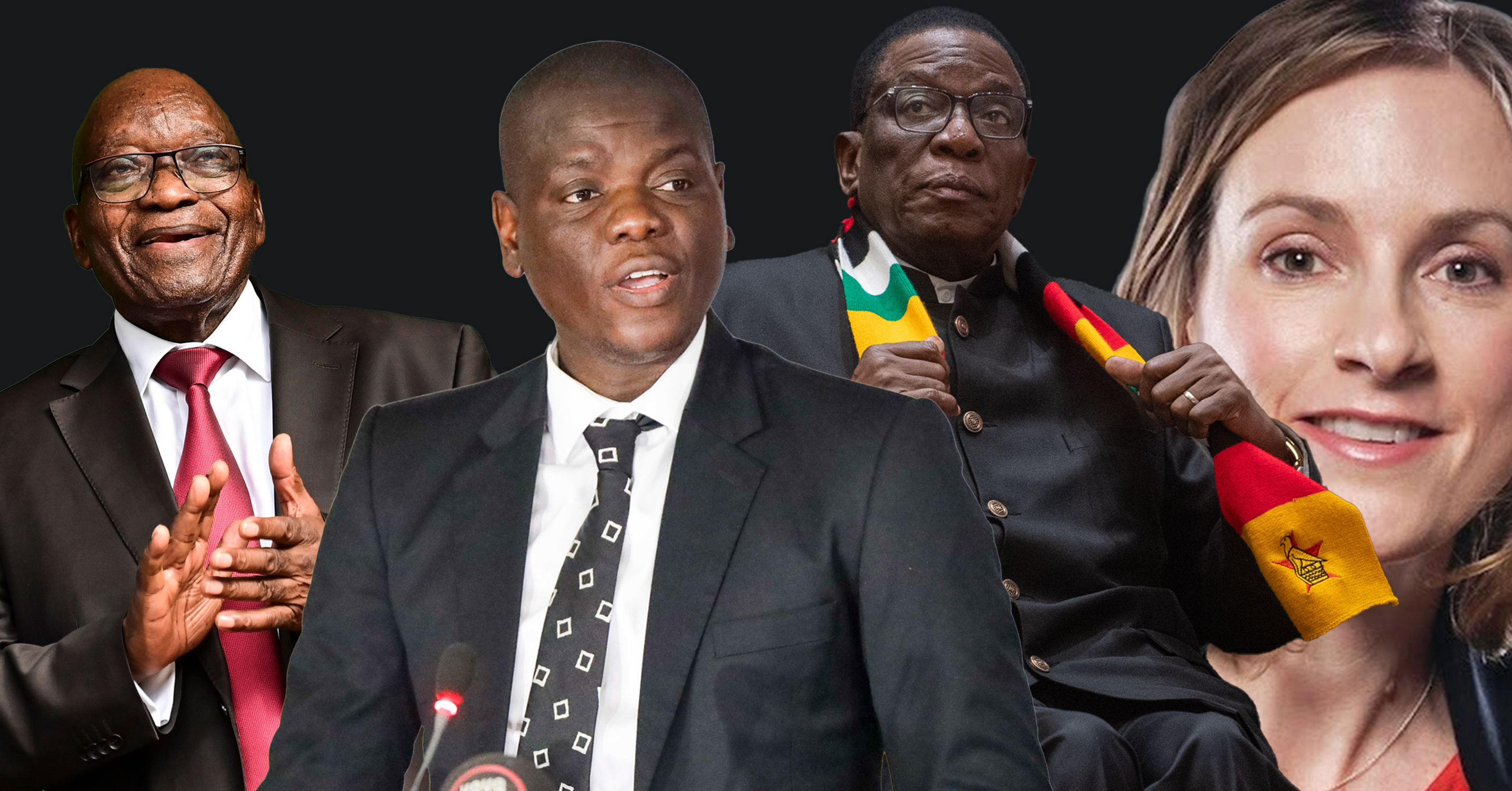
 Illustrative image | Former president Jacob Zuma. (Photo: Darren Stewart / Gallo Images) | Dirco Minister Ronald Lamola. (Photo: OJ Koloti / Gallo Images) | Zimbabwean President Emmerson Mnangagwa. (Photo: Munashe Chokodza / EPA) | Nicole Fritz. (Photo: Supplied)
 SADC seems to be trying to revive its Tribunal, which was suspended by member states in 2011 after it had ruled that Zimbabwean President Robert Mugabe’s seizure of white farms was illegal.
This move by the 16-nation Southern African Development Community, many years after the dramatic demise of the region’s court, has raised many questions.
Will the Tribunal be revived at all, or is this effort just political expediency — perhaps designed to appease important constituencies? And if it is restored, will it be to its original potent form, or just as a toothless tiger?
At least one organisation, the Southern African Agri Initiative (Saai) — an influential agricultural interest network of regional farmers — is optimistic.
“Saai welcomes the news that the Southern African Development Community (SADC) has committed itself to the long-awaited revival of the SADC Tribunal,” said the organisation, responding to an article in Zimbabwe’s Herald Online newspaper in June.
The paper said at the time that the Committee of Ministers of Justice and Attorneys General of SADC would meet virtually on 11 July to consider, among other things, the said “long-awaited revival of the SADC Tribunal”.
That report, and other previous indications, created expectations that the justice ministers and attorneys-general would recommend the revival of the Tribunal in its original form, with the power to hear human rights cases brought by individuals in SADC states against their governments. And that the full SADC summit, which took place on Sunday, 17 August, in Madagascar, would accept that recommendation.
But that did not happen. Neither the committee nor the summit mentioned the Tribunal in their public statements. However, Daily Maverick learned that the justice ministers had discussed the Tribunal, though the summit had not.
Meeting of legal experts
“The SADC Tribunal’s re-operationalisation was not brought before the Summit or any of its preparatory meetings,” said Chrispin Phiri, the spokesperson for International Relations and Cooperation Minister Ronald Lamola.
“At its July meeting, the Committee of Ministers of Justice reiterated its call for the Secretariat to take two steps: mobilise the necessary resources for a physical meeting of legal experts, and ensure this meeting is held no later than October 31, 2025,” he said.
“The primary reason for a physical meeting is the sensitive nature of the topic, which, according to most member states, demands a face-to-face discussion to fully consider their respective positions.
“Following the meeting, its outcomes will be presented to the Committee of Ministers of Justice. From there, recommendations will be made to the Council of Ministers and ultimately to the Summit.
“Updates on this internal matter will be provided as the process moves forward. For its part, South Africa is dedicated to upholding the constitutional values of the rule of law and human rights.”
It is not clear how the SADC Secretariat responded to the call from the justice ministers to convene a meeting of legal experts by 31 October to discuss the revival of the Tribunal.
Daily Maverick asked SADC Secretariat spokesperson Barbara Lopi for comment on this, but she had not responded by the time of publication.
Amendments to the Protocol
Lamola himself had contributed to the expectations about the revival of the Tribunal last October when DA MP Emma Powell asked him a parliamentary question about what steps he had taken to initiate the re-operationalisation of the Tribunal.
He replied: “The SADC Secretariat is preparing amendments to the Protocol on the SADC Tribunal, which will be presented to the Committee of Ministers of Justice/Attorneys-General for consideration. The committee will report to the SADC Summit in August 2025. The re-operationalisation of the Tribunal will take effect once a sufficient number of member states have ratified the amendments to the Protocol.”
It is not clear if the SADC Secretariat did in fact prepare amendments to the Protocol on the SADC Tribunal, and if so, why the committee of justice ministers did not consider them.
It might have been because, as Phiri suggested, the justice ministers felt that legal experts should first be consulted and that the issue should be discussed in a face-to-face meeting.
The big question is: If the Tribunal were indeed to be revived, would it be restored to its original pre-2011 form — including the authority to hear human rights disputes by SADC citizens against their governments?
Or would it be revived in some diluted form, enjoying only the power to adjudicate disputes between member states? This is what the heads of state reduced it to in 2014 when they passed a new Protocol defining its role, although it never played that role and was allowed to fade into disuse, in large part because no new judges were appointed.
One legal expert, who wished to remain anonymous, thought the latter was more likely. He found it suspicious that the Herald — known to be a mouthpiece of Zimbabwe’s ruling Zanu-PF party — seemed to be welcoming the revival of the Tribunal, since it was Zanu-PF that led the lynch mob which had originally killed it.
Sceptical
Nicole Fritz, executive director of the Campaign for Free Expression (and founder of the Southern Africa Litigation Centre, which joined the legal efforts to try to save the Tribunal back in 2011), said she was not sure what SADC had in mind for the Tribunal now. But she was sceptical that it would be resurrected in its original form.
“I would imagine that it is probably an easy route by which to make and appear to make common cause with the agriculture lobby and other interest groups who have the ear of the Trump administration,” she said.
“But SA’s say-so alone won’t make it happen. And while [Zimbabwean President Emmerson] Mnangagwa might be willing to be seen to be providing redress to Zim farmers, I imagine that among SADC leaders the objections will be as sharp as ever to the idea that a supranational institution gets to supervise ‘domestic’ matters.”
Indeed.
The SADC Tribunal was created in 2005, based in Windhoek. Its protocol allowed it to adjudicate employment disputes brought by SADC employees against the SADC Secretariat; commercial disputes between companies and national governments of SADC member states; and most importantly, human rights disputes between individuals and governments of SADC member states.
Most of its cases were brought by individuals against the Zimbabwe government, and the government lost all of them.
In November 2008, the Tribunal issued its landmark ruling in the case brought by Mike Campbell and other Zimbabwean farmers against Mugabe’s government.
The Tribunal held that the Zimbabwean government had violated SADC’s treaty by denying access to the courts and engaging in racial discrimination against white farmers whose lands had been confiscated under the land reform programme in Zimbabwe.
Mugabe’s government ignored the ruling and took up the issue with his fellow SADC leaders — including SA President Jacob Zuma — who suspended the Tribunal in 2011, and in 2014 amended its Protocol to allow it only to hear disputes between SADC states, and not between SADC individuals and their governments.
In 2018, the Gauteng High Court in Pretoria ruled that Zuma had breached South Africa’s Constitution by suspending the SADC Tribunal and changing its protocol. The Constitutional Court later upheld this judgment. DM