



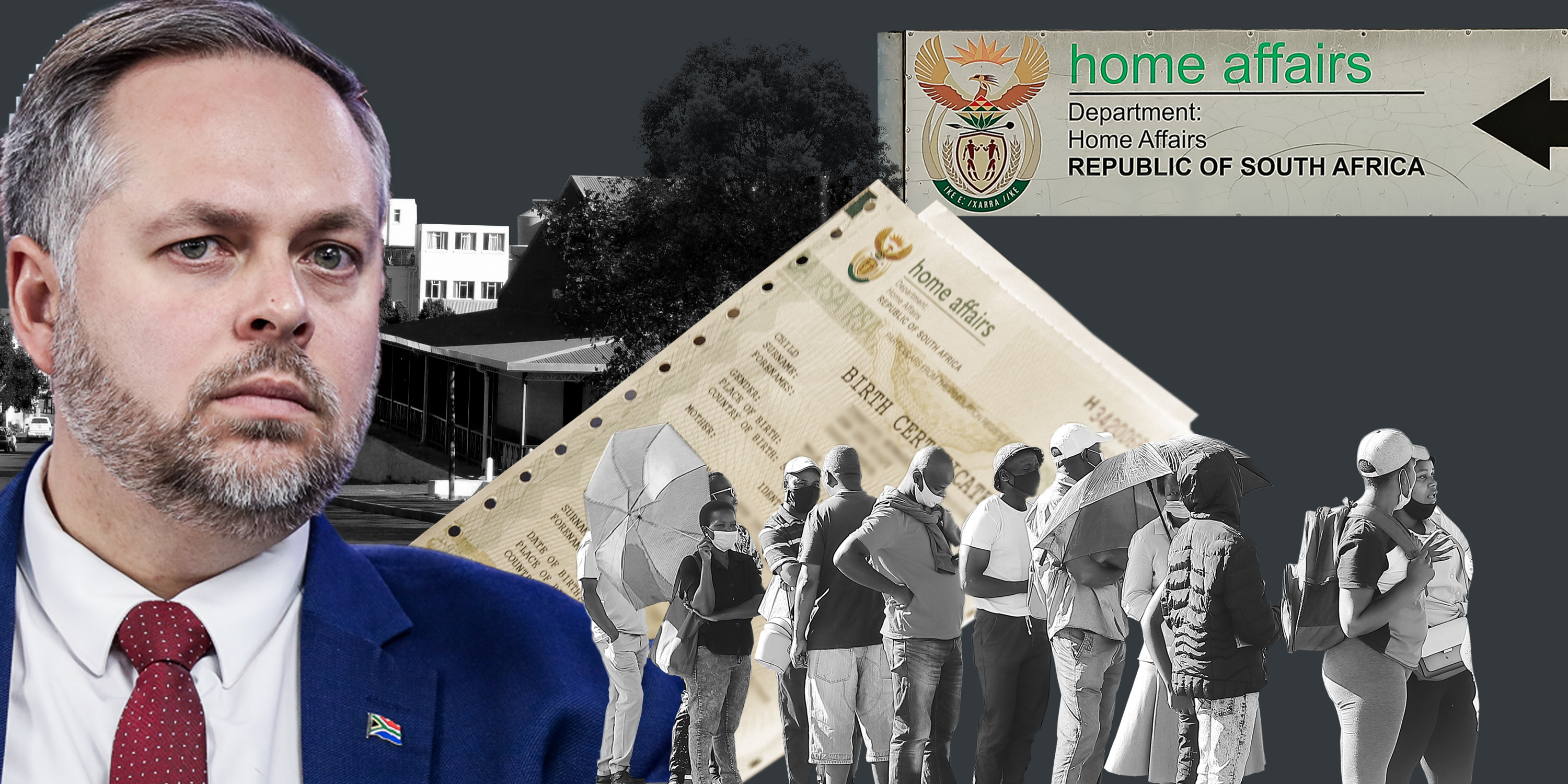
 Illustrative image | Sources: Leon Schreiber, Minister of Home Affairs. (Photo: Gallo Images / Fani Mahuntsi) | People wait in long queues at Soweto Regional Home Affairs Office. (Photo: Gallo Images / Fani Mahuntsi)
When Andrew Tate told UK property investor Samuel Leeds that “every revolution in history began with the assassination of a tax man”
style="font-weight: 400;">during a YouTube interview, he was dismissing the preachings of inequality activist and former Citibank trader Gary Stevenson. It was the same energy then TymeBank CEO Coenraad Jonker channelled when he complained about the 6,500% spike in real-time identity verification prices.
Read more: Home Affairs’ Leon Schreiber stands by identity verification price hike
Minister of Home Affairs Leon Schreiber arrived at Capitec Bank’s Stellenbosch head office this week with the confidence of a man who had spent a year dismantling South Africa’s fragile identity verification system and rebuilding it from the ground up.
“Today, we launch the most transforming of reforms that Home Affairs has ever seen,” Schreiber told the audience, unveiling the next chapter of his department’s “apex priority”, the Home Affairs @ home vision to revolutionise civic services.
A fix before the future
When Schreiber took office in mid-2024, the Online Verification Service (OVS) was in crisis. More than half of verification attempts failed, and response times could stretch to 24 hours, a national security risk that made banks reluctant to expand Home Affairs services.
“None of us would be standing here today if we had not had the courage to make this change,” Schreiber said. “If we did not fix the Online Verification Service, banks would not have been willing to expand the service to many more locations.”
The 1 July system upgrade cut the failure rate to below 1% and now returns results in less than a second, using modern biometrics such as fingerprints and facial recognition.
Years of under-pricing at 15c per transaction had starved the system of maintenance funding. The new tiered fee, R10 for real-time and R1 for off-peak batch verifications for private sector users, created a sustainable model, even as it drew criticism.
What this means for you
- More access, less travel: Services will expand from 30 branches to hundreds nationwide, with Capitec and FNB leading the rollout.
- Digital-first convenience: Future plans include applying for smart IDs and passports via banking apps, with home delivery.
- Security boost: Faster, more reliable verification and replacement of vulnerable green ID books with secure smart IDs.
- Free at point of service: Partner banks say they won’t charge extra for Home Affairs transactions.
Banking on digital apps
The old model, limited to 30 branches across five banks, relied on costly duplication of staff and hardware inside branches. The new model integrates directly with banks’ secure networks, extending Home Affairs’ IT platform “across the length and breadth of South Africa and onto smartphone apps”, Schreiber said.
Capitec will equip 100 branches with Home Affairs functionality by early 2026, expanding to 300 by mid-2026. The target is 1,000 branches by 2029, but Schreiber believes it can be reached sooner.
Beyond the branch
Schreiber’s roadmap goes further.
“Once this service is stable, we will work together to enable South Africans to apply through the digital banking apps they use every day. We will add the ability to apply for a passport, and we will introduce home delivery.”
He calls it the “holy grail” of governance: a future where “South Africans will soon be able to apply for a new document and have it delivered directly to their doorstep without ever leaving their house”.
Capitec CEO Graham Lee said: “This partnership is the first proof point of our commitment to work closely with the government and the public sector to solve real problems, remove friction for South Africans and help our country grow. By combining our technology, branch network and client-first approach with the Department of Home Affairs’ mandate, we are making essential services faster, simpler and more accessible for millions from suburbs to rural areas.”
Fighting fraud, enabling lives
With 18 million green ID books still in circulation, “the most defrauded document in Africa”, the minister sees the partnership as key to eliminating costly fraud.
“By working together, we can urgently replace all those green IDs with smart IDs,” he said.
For Capitec, the benefits go beyond goodwill.
“Identity is crucial to the ability to provide solid, secure and scalable financial services,” said Lee, who confirmed to Daily Maverick that there would be no extra charges for the service.
Standard Bank signed up on Tuesday, joining Capitec and FNB. Schreiber urged all banks to “move with the same urgency… to roll out app access and home deliveries as soon as possible”.
“We are proud to be part of this forward-thinking collaboration that will save our clients time and make it easier to access essential identity services,” said Standard Bank Personal and Private Banking CEO, Funeka Montjane.
How it works for Capitec users
- Photo capture: If the Department of Home Affairs does not have a suitable ID photo on file, you can visit a special smart ID terminal in select Capitec branches.
- Biometric verification: You enter your ID number, and have your photo taken, at which point the system verifies your identity against the department’s database in real time.
- Collection: Your smart ID will be ready for collection at the same branch within weeks.
- Future expansion: For even greater convenience, functionality through the Capitec app and home delivery will be introduced later. Passport renewal will be added soon.
Freeing up Home Affairs
Digital integration will allow officials to focus on unresolved challenges including late birth registrations, the documentation of families and even whole communities whose identities have never been recorded.
“Without these documents, people literally cannot operate in society. You can’t get a social grant, a pension, a bank account or a job,” Schreiber said.
Read more: Estonia showed that Leon Schreiber is the minister of good intentions
The vision includes modernising birth, marriage and death registrations, and amendments, “to digitise, automate and enable remote access for all the services we provide”.
For Schreiber, the mission remains unchanged: “To transform South Africa into a cutting-edge digital state and society where the days of exclusion, of suffering, of fraud and identity theft become things of the past.” It’s the first meaningful step toward fighting inequality. DM