




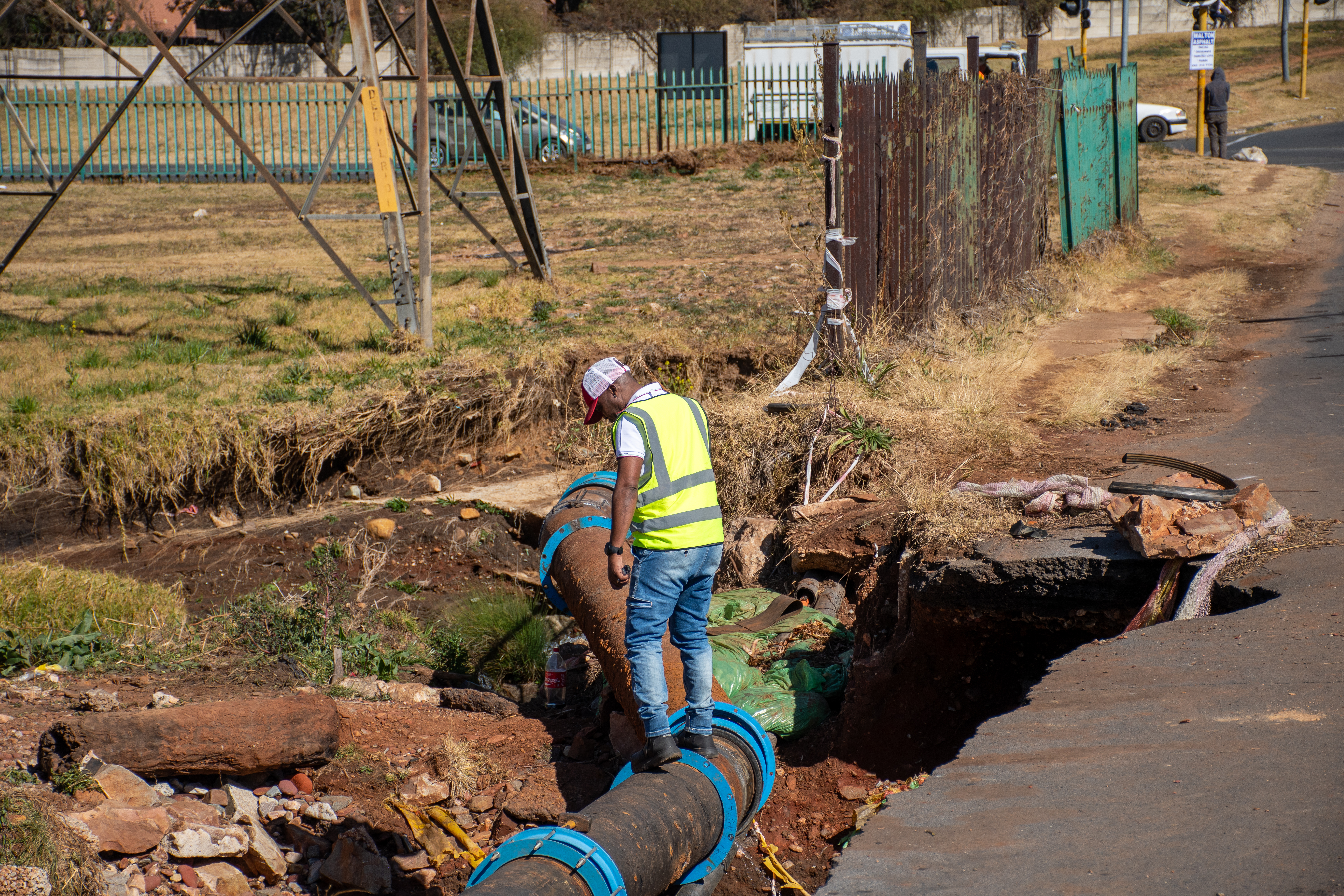
 A Johannesburg Water technician at the damaged 375mm bulk water pipe at the corner of Milner Avenue and John Adamson Drive in Montgomery Park, Randburg after flooding was stopped on 5 August 2025. (Photo: Julia Evans)
 On Sunday night, 3 August, a massive 375mm bulk water pipe burst on Milner Avenue in Montgomery Park, Randburg, sending thousands of litres of water into the air and leaving parts of Northcliff without supply for days.
“This is the fourth time this pipe has burst in the past two years. It’s eaten up the road,” said Ward 88 councillor Nicolene Jonker, who reported the incident to Johannesburg Water shortly after it was logged on the official councillor escalation platform.
Joburg is battling bursts like this all over the city. While crews work to repair them, little will change until the city finds the billions needed to replace ageing pipes and overhaul water infrastructure. A quarter of all the treated water Johannesburg Water buys from Rand Water is lost through leaks and burst pipes, and the losses show no sign of slowing.
/file/dailymaverick/wp-content/uploads/2025/08/Julia-JhbLeaksBudget.jpg "Water shoots into the air after a 375mm bulk water pipe burst on 3 August 2025 at the corner of Milner Avenue and John Adamson Drive in Montgomery Park, Randburg. (Photo: Julia Evans)")
By 10am the next day, Monday, 4 August, the Montgomery Park pipe was still flooding at high pressure, Jonker said.
“Water was gushing out in megalitres,” she said. “I arrived on site and contacted Ntshavheni Mukwevho, the managing director of Johannesburg Water. Teams began arriving within 20 to 40 minutes after my escalation. I remained on site until the water was eventually shut off.”
After the water was turned off, the pipe was repaired – but it burst again the following day. Johannesburg Water said the pipe, which supplies the Northcliff Reservoir, failed because of “aged and worn-out infrastructure. Steel is susceptible to wear and tear.”
The repeated failure led to the Northcliff reservoir and tower running dry, meaning parts of Northcliff, Waterval Estate and surrounding areas were without water for nearly three days.
“The impact on residents has been significant,” Jonker said. “Water outages, damaged infrastructure and traffic risks from road damage have been ongoing concerns. The road surface in Montgomery Park is now severely compromised and poses safety hazards.”
/file/dailymaverick/wp-content/uploads/2025/08/DSC_3321.jpg "Joburg is battling bursts like this all over the city.(Photo: Julia Evans)")
She said that community frustration was deep because of repeated failures and the lack of a lasting fix.
“While the water supply has been restored, infrastructure recovery and permanent pipe replacement remain urgent.”
Why does this keep happening?
Joburg battles leaks like this all over the city. Often, a few days after a leak is repaired, another will pop up on the same pipe a few metres down the road. The entity said that it received about 100 reported leaks a day on average, and the issue does not seem to be getting better.
Johannesburg Water said leaks and bursts were caused by:
- Age of infrastructure;
- Type of material (for example, asbestos cement pipes are susceptible to leaks and bursts, especially during winter);
- High water pressure;
- Air in the line, especially if not recharged correctly; and
- Quality of material and workmanship.
Jonker said that pressure-reducing valves were scheduled for maintenance on the Montgomery pipe two days after the burst. These valves lower and control water pressure to prevent bursts and reduce leaks – but tools like these are not enough for an ageing system.
In the 2023/2024 financial year, 46.2% of the water supplied was non-revenue water, which refers to the portion of water supplied but never billed. Physical losses, such as pipe bursts and leaks, alone accounted for about 24%.
Johannesburg Water’s unaudited figures for the end of May 2025 put non-revenue water at 48.4%, and physical losses at 26.3%, up from 24%.
Adesola Ilemobade, professor of water and infrastructure at Wits University’s School of Civil and Environmental Engineering, previously explained to Daily Maverick that infrastructure failed in different ways.
“If a pipe is old and compromised, repairing one section won’t stop another part from failing,” he said.
Recurring burst pipes and leaks where new ones sometimes appear just 2m from a recent repair are not uncommon in Johannesburg.
Many of Johannesburg’s water pipes, particularly within 20km of the city centre, are made of galvanised iron, which rusts over time. Some pipes have been in the ground for 50 years.
The combination of ageing pipes, pressure fluctuations caused by water shedding, and soil interactions contributed to pipe failures, said Ilemobade.
Cash-strapped
A long-term, sustainable solution would be to replace pipelines. However, as Ilembade pointed out, this was no small task.
“Joburg Water manages a network of 12,500km of water pipelines,” he said. “My suspicion is that they would rather repair, because it is a short-term, cheaper solution.”
Replacing pipes costs money. And there is a lot of infrastructure that needs to be upgraded in the city.
At the end of last year, Johannesburg Water reported that there was a R27-billion backlog in upgrading and replacing essential infrastructure, with a significant portion of assets – those with a remaining lifespan of between zero and two years – requiring immediate attention.
Of that, the cost of urgent water mains replacements is R3.3-billion.
According to the utility’s Asset Management Plan, 2% of this value should be renewed each year to maintain system functionality. Due to a lack of funding, however, only 0.9% is being renewed annually.
Read more: With a R27bn infrastructure upgrades backlog, Joburg Water takes financial reins back from city
https://public.flourish.studio/visualisation/20701568/
Joburg Water estimates that the annual budget needed to address infrastructure backlog and upgrades over 10 years is R3-billion.
Traditionally, Joburg Water’s finances were controlled by the Johannesburg City Council, and the R1.1-billion budget for capital expenditure was given by the city, which includes grant funding from the national government.
Read more: Joburg Water’s turnaround strategy: Can it secure the R3bn needed to address the crisis?
To address the water crisis, at the end of 2024, the Johannesburg City Council approved a comprehensive turnaround strategy for Johannesburg Water, including ring-fencing revenue for the water service.
Instead of the revenue generated for water services going into the pool of the city’s general budget as has historically been the case, Joburg Water can reinvest revenue, profits and cash generated from water and sanitation services back into the water business, specifically targeting infrastructure.
Following the city’s turnaround strategy to address the water crisis, that budget is now at R1.7-billion. While this is an improvement, it remains far short of the R3-billion target.
More than promises needed
Environmental activist and executive director of WaterCAN, Dr Ferrial Adam, warned that without serious investment, the city’s water system will continue to deteriorate.
“Johannesburg Water’s non-revenue water figure of 48.4% is not surprising. We’ve known for years that nearly half of the city’s water is being lost, with a significant portion through leaks and burst pipes.
“The real concern is that the meagre increase in Joburg Water’s budget will not be enough to even make a dent in this crisis. It’s like putting a plaster on a compound fracture.”
She said, “Without urgent and sustained investment, the water crisis will only worsen. Announcements of turnaround plans and performance-based contracts mean little without transparency, clear milestones and independent oversight.
“Communities across the city are already paying the price through persistent water outages, unsafe water quality and collapsing infrastructure. We need more than promises. We need a concrete timeline, public accountability and real consequences for continued failure.”
What’s the plan?
Johannesburg Water said its key focus areas for the next 10 years would be the upgrading and renewal of infrastructure, and investing in treatment plants, which it said would help to address the infrastructure failure rate.
In terms of getting the money to do so, the water utility said that it had requested support from the Government Technical Advisory Centre (GTAC) to procure and manage professional service providers for the planning and implementation of the Non-Revenue Water Performance-Based Contract.
“This project will attract private sector participation into activities or projects that will reduce non-revenue water on a win-win basis,” Nombuso Shabalala, spokesperson for Johannesburg Water, told Daily Maverick.
Johannesburg Water said it was also exploring alternative funding models, including performance-based contracts for reducing non-revenue water, public-private partnerships for key projects and borrowing as part of its capital programme.
“The borrowings have been part of the funding sources for the current and previous capital programmes,” it said.
But Adam was sceptical – funding challenges might hinder any meaningful progress. She referred to discussions in the Presidential Working Groups, established after the Presidency stepped in to help resolve Joburg’s crises.
WaterCAN is party to the discussions, which Adams said have shown that there are “a lot of things” that still need to be put in place: “What I have figured out from the Presidential Working Groups is that the city is cash-strapped.” DM