




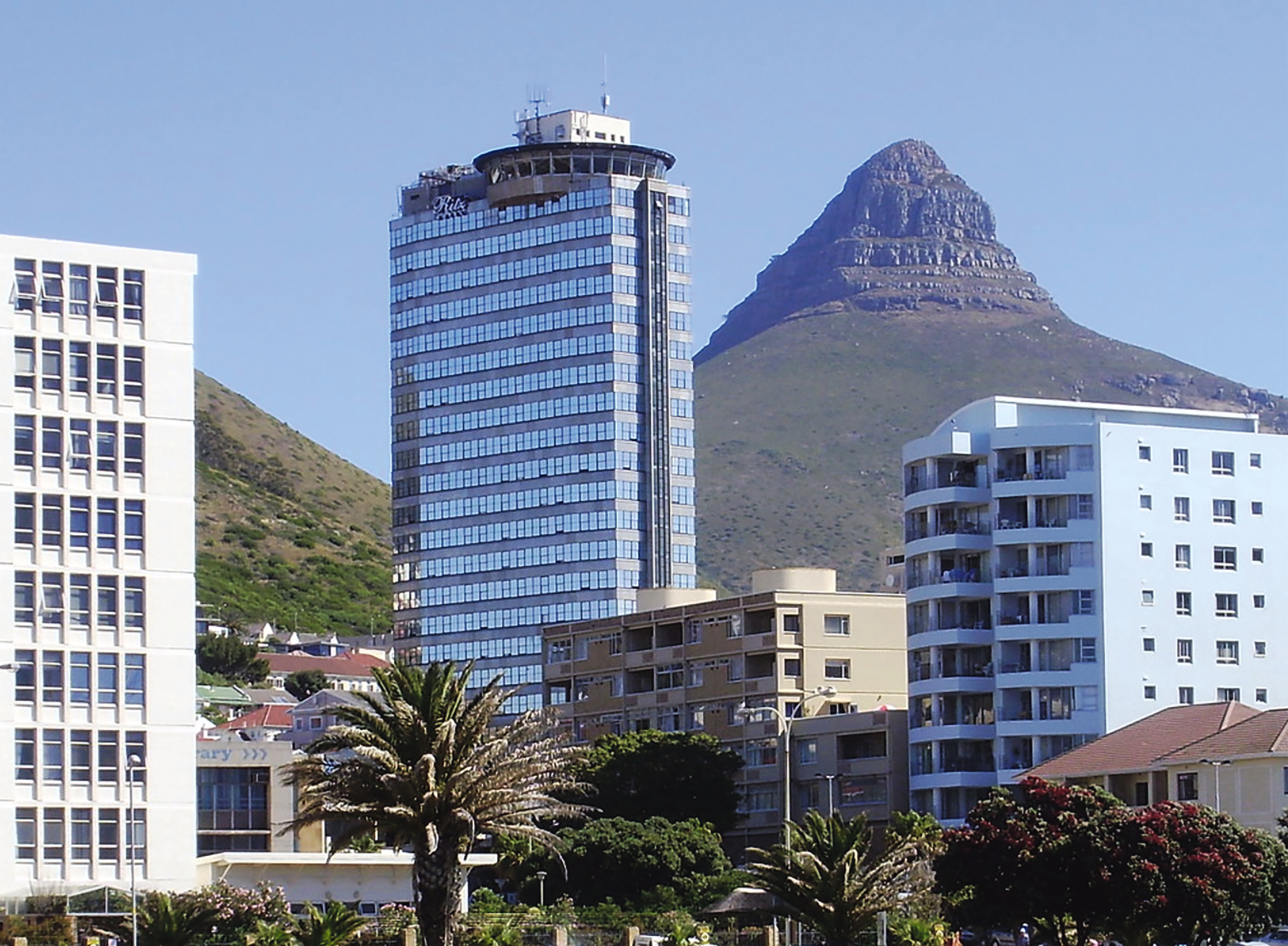
 The Ritz Hotel in Sea Point. (Photo: Supplied)
 I was a young boy growing up in a modest Sea Point of the 1970s. It was a fringe foodie haven before the Waterfront’s arrival, not nouvelle cuisine, refined or fancy, but honest, everyday fare that brimmed with genuine flavour.
Although the mood and grub were multi-ethnic, more so than the Boerewors Curtain, it was as we called it, kômmin cosmopolitan. Toasted cheese-and-tomato sandwiches and Five Roses Tea were de rigueur at the drive-in restaurant at the Doll House. Also, pink or green milkshakes and hamburgers, with slap tjips and the foghorn as background music.
Then there was the pavilion, the beaches, hotels and movie houses. It was the height of apartheid, and black people couldn’t even rest on the benches along the seafront or dip their toes in the pavilion’s waters. My recollections of carefree walks and sunny days are white memories, shaped by a divided past I now strive to understand and be mindful of.
No movies on Sundays. To get around that, the movie houses would screen a movie at one minute past midnight on a Sunday. I’m not kidding, the Dutch Reformed Church and apartheid prime minister John Vorster with his red nose were large and in charge.
No alcohol on Sundays, except if you ordered food from one of the hotels. A carvery with oversalted gravy and depressed grandparents staring into their semi-sweet Bellingham Johannesberger. Supermarkets closed at 1pm on Saturdays.
Cars still looked like cars. People drove Ford Cortinas, Datsun 1600 SSSs, VW Beetles, Chevrolets and Valiants. Sculptures on wheels. Television had not yet arrived in South Africa — it was Springbok Radio or Radio Good Hope. Locally we listened to singers Four Jacks and a Jill, Clout and Miriam Makeba, but on vinyl.
And then, while all of the above was happening in a sort of suburban hum, The Ritz with its snazzy name opened on Saturday, 23 September 1972, a hotel that would give the suburb a futuristic twist. It had 21 storeys and added on top was a revolving restaurant of shiny steel rising above the grit and salt.
UFO
Cape Town had never seen anything like The Ritz before. I was still a child and remember clearly how fascinated I was with the architecture: this gleaming silver building with its UFO on top.
I asked Graham Jacobs, conservation and heritage architect, to explain the design: “Stylistically, I would call this a modernist high-rise building. However, what makes it stand out among the others of its generation is that its construction involved a substantial amount of modular building components,” he says.
“This was probably the first building of its type in Cape Town using modular prefabricated rooms, maybe even one of the first in the country. All the bedrooms and bathrooms were prefabricated off-site before being installed, presumably attached to a reinforced concrete sliding shutter-core.”
What about its look?
“Its sheer, metallic appearance would have been no accident. Remember that this was a time when the space age was all the rage. You are talking about a building constructed not long after the first moon landing and the release of Stanley Kubrick’s 2001: A Space Odyssey.
“This also coincided with the release of the US government’s Project Blue Book on the possible existence of UFOs, which saw a resurgence in the subject in the late 1960s and early 1970s. I suspect that the resemblance of the revolving restaurant to a UFO is not accidental,” Jacobs says.
I was lucky to have a father who, when he won money on the horses, loved eating out. My first visit to the Top of the Ritz restaurant was shortly after the opening.
/file/dailymaverick/wp-content/uploads/2025/08/Ritz-3.jpg "Circa 1972 with my dad, Sam, and his wife, Linda. (Photo: Supplied)")
It was a grand affair: men had to wear suits, women evening dresses. A porter dressed in a black suit with a matching black top hat would welcome you. There would be a bellhop and concierge hovering around the foyer, all frightfully grand.
The carpets were thick, and the décor can only be described as theatrical but not vulgar: tasteful early-1970s chic, shimmering chandeliers hanging from the ceilings and a huge staircase leading to a swish cocktail lounge next to the swimming pool area.
You would walk past all this grandeur to the lifts. Once inside, it would shoot at high speed right to the 21st floor. From there you would enter a bar with a view of the city and sea, at night all twinkly lights and fancy. Soft background music such as Nat King Cole’s Ramblin’ Rose would set the mood for pre-dinner drinks or after-dinner cigars and cognac, preferably Rémy Martin.
Another staircase led up to the revolving restaurant, which completed a full 360°-rotation every hour. The lights were dimmed. There were purple-upholstered chairs, dark wooden counters and a grand piano. There was always someone playing, softly, to add a hint of opulence.
The food? It ushered in a new beginning. The menu was pure theatre, a glossy postcard from another era.
These are the fine memories of a little boy. I went there with my dad and his wife from the age of eight until 16.
The grand finale and a false start
The Ritz Hotel closed in March 2015. Then a new chapter began in 2016 with the arrival of a celebrity power couple: restaurateur Nicky van der Walt and model Lee-Ann Liebenberg, whose vision was as ambitious as it was expensive. Through Van der Walt’s company, Shimmy Luxury Collection, a R120-million refurbishment commenced in late 2017.
The plan? To return the Ritz to its rightful place in the constellation of South African high society. There were promises of sleek interiors, rooftop glamour, and of course the slow-turning restaurant in the sky.
But Sea Point’s star-crossed icon would not revive so easily. In 2018, after a soft launch and much whispered excitement, the relaunch fizzled. Van der Walt’s company vacated the premises. By mid-year, the building was shuttered. And there it remained: silent, scandal-shadowed and slowly crumbling.
In late June 2025, a new deal was sealed. The Hurwitz and Roffey families, long-time custodians of the building, handed over the keys to OKU Hotels, an international group known for its minimalist Mediterranean sanctuaries. Think Ibizan calm meets Japanese wabi-sabi. Its ethos is slow living, inner space, understated splendour. Sea Point, with its salt-stained air and restless property sharks, hardly saw it coming.
The other good news is that the hotel will be renovated, not demolished. I tracked down their head of communications in London, Claire Morrissey, via email.
/file/dailymaverick/wp-content/uploads/2025/08/Ritz-2.jpg "The Seventies look. (Photo: Supplied)")
“Yes, we can confirm this [the sale and renovations],” she said.
She refused to touch the question of price, though the figures that have been bouncing around town are somewhere between R240-million and R300-million, depending on who you buy your gossip from.
But the sale is now fully completed and every last legal knot untangled.
The acquisition marks OKU Hotels’ first foray into South Africa, adding to its growing international portfolio of soulful, design-led properties. The restoration, not demolition, of the Ritz Hotel aligns with OKU’s broader brand philosophy, which values both place and memory.
More details about the renovation timeline and design direction are expected in the coming months, but one thing is certain: the Ritz, once the pinnacle of charm in Cape Town’s hospitality scene, is being reimagined for a new era with its legacy intact.
For a neighbourhood long caught between nostalgia and gentrification, the Ritz Hotel’s renaissance is more than just a property deal. It is a love letter to the past, delivered with the seductive promise of what is still to come. Cheers to that! DM
Herman Lategan is a Cape Town-based journalist and writer.
This story first appeared in our weekly Daily Maverick 168 newspaper, which is available countrywide for R35.
