




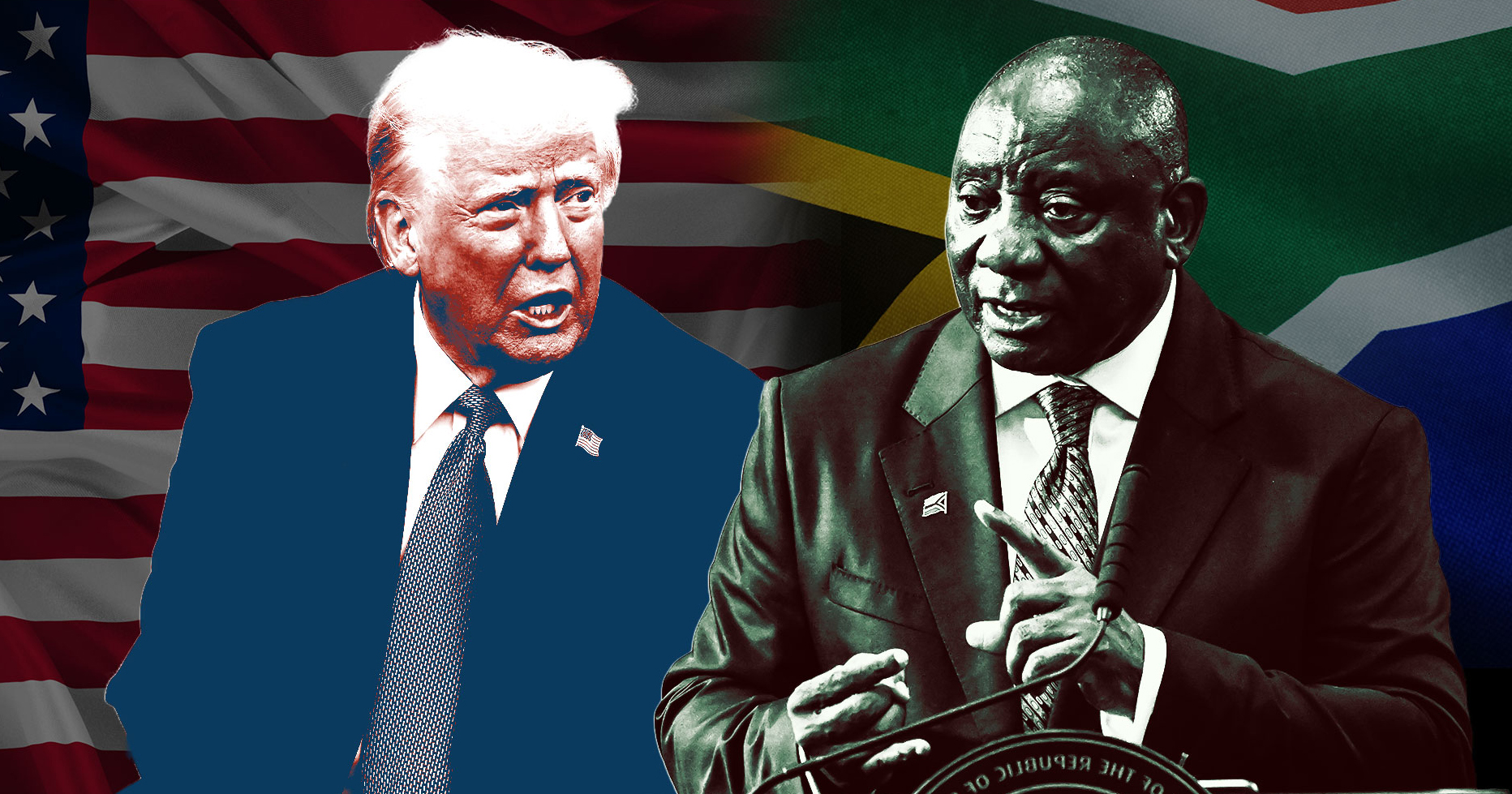
 Illustrative Image: US President Donald Trump. (Photo: Anna Moneymaker / Getty Images) | SA President Cyril Ramaphosa. (Photo: Jeffrey Abrahams / Gallo Images) | Flags. (Image: Freepik)
 President Cyril Ramaphosa had a telephone conversation with US President Donald Trump on Wednesday, 6 August 2025 – hours before Trump’s sweeping new tariffs came into effect at midnight on Thursday, 7 August.
In the call, the two leaders committed to continued engagement, acknowledging the number of trade negotiations the US is involved in, according to a brief statement from President Ramaphosa’s office.
Read more: Private sector mobilises as government falters in US tariff fallout
“President Cyril Ramaphosa held a telephone discussion during the morning of 6 August 2025, with US President Donald Trump on bilateral trade matters.
“The two leaders undertook to continue with further engagements recognising the various trade negotiations the US is currently involved in. Respective trade negotiating teams will take forward more detailed discussions,” Ramaphosa’s spokesperson, Vincent Magwenya, said in the statement.
PRESIDENT RAMAPHOSA SPEAKS TO PRESIDENT TRUMP
President @CyrilRamaphosa held a telephone discussion during the morning of 6 August 2025, with US President Donald Trump on bilateral trade matters. The two leaders undertook to continue with further engagements recognising the… pic.twitter.com/M69euVSiN4
— The Presidency 🇿🇦 (@PresidencyZA) August 7, 2025
At a press conference on Thursday morning, Minister in the Presidency Khumbudzo Ntshavheni said Ramaphosa’s call with Trump was “part of supporting our negotiation effort”.
“As communicated through the Presidency, President Ramaphosa has reached out to through a phone call to President Trump yesterday morning as part of bolstering South Africa’s negotiation efforts on the trade agreements,” she said.
Ntshavheni said that during Ramaphosa’s working visit to the White House in May, where he met with Trump, “there was an assurance that as soon as we reach a deal, then there will be a [review] of the tariffs”.
“If there was no prospect for a review, there would not be a need for continuous engagement,” she said. “So we continue to engage because there’s always prospect for review, and we’re not the only country that is in that position.”
She added: “We would not be putting effort [into] the negotiations if we were not hopeful... that there is room to reach an agreement.”
Trump’s higher tariff rates came into effect for dozens of countries on Thursday, after he announced the new rates in an executive order signed last week.
In a post to his Truth Social account just after midnight, Trump said: “IT’S MIDNIGHT!!! BILLIONS OF DOLLARS IN TARIFFS ARE NOW FLOWING INTO THE UNITED STATES OF AMERICA!”
Some countries received modified tariff rates, while South Africa’s remained at the 30% previously proposed by the US. The higher duty imports of 30% apply to all South African goods — excluding a range of mining exports.
Last week, Ramaphosa announced that Pretoria was preparing a package to support vulnerable companies affected by the tariffs, which included the establishment of an Export Support Desk to support South African exporters.
According to the Department of Trade, Industry and Competition, at least 30,000 jobs are at risk due to the tariff increases.
Read more: Department of Trade, Industry and Competition says 30,000 jobs at risk from Trump tariffs
‘Targeted interventions’
Ntshavheni said the Cabinet had received an update on Pretoria’s proposed framework deal with the US, in light of the 30% tariffs that came into effect on Thursday, “with the provision that the tariffs will be reviewed as soon as the two countries reach a deal.
“Cabinet affirmed the government’s commitment to finding constructive and sustainable solutions through continued engagements with the United States of America, including at a presidential level,” she said.
According to Ntshavheni, Department of Trade, Industry and Competition Minister Parks Tau and Agriculture Minister John Steenhuisen would brief the media on the details of measures in response to the tariffs.
Ntshavheni announced a series of interventions that the Cabinet had approved, which she said were part of an attempt to “mitigate against” those roughly 30,000 job losses.
“Specific to industries impacted by the tariff increase, government is focusing on demand side interventions in the impacted industries and targeted interventions to ensure industry stability and safeguard employment,” she said.
According to Ntshavheni, these interventions included:
- The establishment of an Export Support Desk, which will serve as a direct point of contact for affected companies.
- Measures to help companies to absorb the tariff and facilitate long-term resilience and growth strategies to protect jobs and productive capacity in South Africa.
- A Localisation Support Fund for affected companies to contribute to the national effort.
- The Export and Competitiveness Support Programme, which will include a working capital facility and plant and equipment facility to address short- to medium-term needs across all industries.
- Working with the Department of Employment and Labour on measures to mitigate potential job losses, using existing instruments within its entities that can be adjusted to respond to the current challenges.
- Following consultations with the Competition Commission, a Block Exemption for Exporters had been introduced to enable collaboration and coordination by competitors. A draft Block Exemption would be published by the end of the week so that the process could be concluded expeditiously. DM