




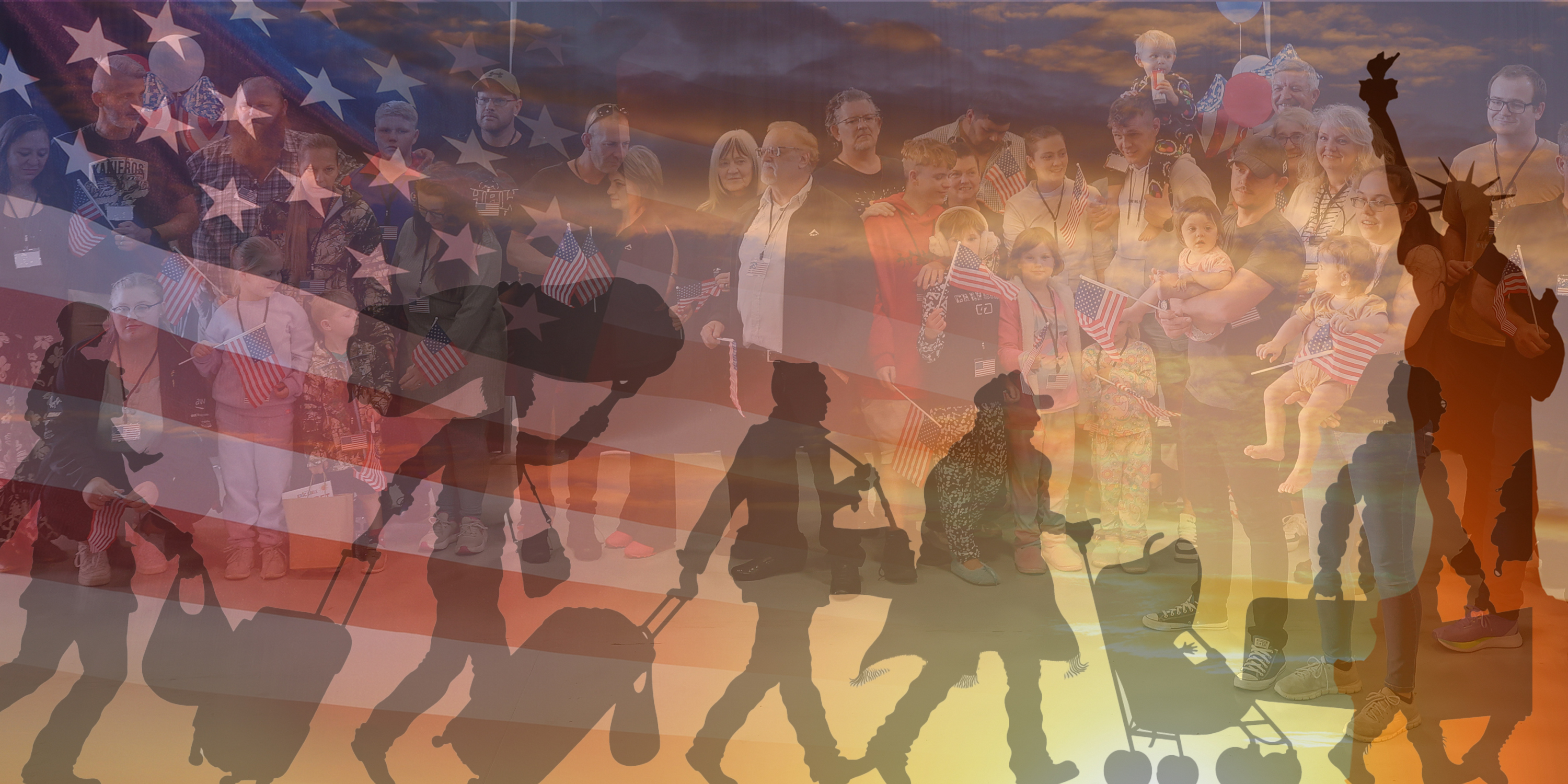
 Illustrative image | Newly arrived Afrikaner 'refugees' in the US. (Photo: Chip Somodevilla / Getty Images) | Statue of Liberty silhouette and US flag. (Photo: iStock) | Asylum seekers. (Photo: iStock)
“In the US, I had to face this painful truth: I don’t know where I fit in anymore. Can I work for someone else? Will I ever feel ‘capable’ again in this new place?”
This anonymous comment from one of the Afrikaner “refugees” in the US was shared by the @amerikaners2025 X account — the closest thing to an official mouthpiece for the group — on 4 August.
The account has repeatedly advised the Afrikaners, brought over in at least two groups on 11 and 31 May, to avoid sharing much about their lives due to media interest: hence the anonymity of the post.
/file/dailymaverick/wp-content/uploads/2025/05/Tori-Afrikaners-touchdown1.jpg "Newly arrived South Africans wait to hear welcome statements from U.S. government officials in a hangar at Atlantic Aviation Dulles near Washington Dulles International Airport on May 12, 2025 in Dulles, Virginia. (Photo by Chip Somodevilla/Getty Images)")
The author, identified only as a mother of five in her “late fifties — emphasis on very”, writes that she came to the US with qualifications including “courses in Psychology, English, Geography” and “Trained CADD [computer-aided design and drafting] & surveyor draughtsman”.
In South Africa, she had “owned businesses in sales, publishing, estate sales; revived an arts festival, designed logos and ads; trained marketers, did admin, managed charity projects” and more.
In the US, she described getting “rejected for entry-level hotel jobs for being ‘overqualified’”.
She writes, however, that she has been hired by a care agency to “care for a few select seniors”, while also being shortlisted for an interview with a business consulting agency.
Much speculation about lives of ‘refugees’
A great deal of speculation — and lashings of schadenfreude from some quarters — has been attached to how the lives of the Afrikaner “refugees” are playing out stateside since US President Donald Trump made his controversial decision to prioritise them for resettlement in the US, while official channels seem to have gone entirely silent on the topic.
In the absence of much formal communication, a whole community has sprung up online, with would-be “refugees” — often attaching “MAGA” or American flags to their X bios in the apparent belief that this could aid their chances — swapping information about what to expect from the process.
Several online figures have emerged as beacons — some of whom are Afrikaners based in the US who are happy to offer advice.
One is Sonell van Niekerk, a Biblical content creator based in North Dakota, who gives candid warnings to would-be “refugees” about the challenges of the uprooting — such as “the constant missing of your friends and family that you need to live with”.
Says Van Niekerk in one recent video: “It’s almost like there’s a limb on your body that’s missing… You go through stages of grief. You get angry, you get depressed, you get sad.”
Van Niekerk has also warned followers that upon arriving in the US she had to work three jobs to survive, one of which was cleaning houses. She advises that the support of a church is indispensable.
Another online guide has emerged as fellow expat Andrea Shea, who recently published “a guide to help you build your refugee case”, covering “how to present a well-founded fear of future persecution using both personal experiences and objective evidence”.
However, the towering figure in this community is Chris Wyatt, a former US military YouTuber whose following has almost doubled over the last few months as his content has increasingly focused on offering advice to would-be Afrikaner “refugees”.
Farmer sent to NY flees to South Dakota
Wyatt has, in the last two months, posted video interviews with two of the “refugees”, the first being farmer Charl Kleinhaus.
/file/dailymaverick/wp-content/uploads/2025/08/Becs-amerikaners1.jpg "Charl Kleinhaus, one of the original 59 refugees, captured in a video conversation with Chris Wyatt. (Screengrab/YouTube)")
Kleinhaus told Wyatt in late July that the refugee programme sent him to Buffalo, New York, somewhat to his horror: “I thought I’d go to Texas, Montana, somewhere like that where there’s farming, but it didn’t happen like that.”
As a result, he chose to leave the assistance programme after eight days and make his own way, having made contact with a farmer in South Dakota through another South African who had worked on the same farm.
The farmer bought plane tickets for Kleinhaus and his family to South Dakota and supplied them with a fully furnished house.
Kleinhaus said: “The biggest challenge is here you work, hey. There’s no kitchen lady you call to sweep the house, or clean the house, or stuff like that. You do the work yourself.”
He said that even farm owners worked from “morning till 11pm at night” with no farm labourers to call for help.
“You guys work,” Kleinhaus told Wyatt. “You play, but you work much harder.”
Kleinhaus also expressed apprehension about the upcoming winter in South Dakota, in which temperatures will drop to -30°C.
Because the original group of refugees is spread across a vast country, there seems to be little contact among them. Kleinhaus told Wyatt that the “59ers”, as the original group call themselves, have a WhatsApp group but “don’t chat much any more”.
Alabama ‘refugee’ had three jobs
In late June, Wyatt interviewed another 59er, Errol Langton, whose family group accounted for nine of the original 59, and whose stepdaughter — back home in South Africa — has accused him of rank opportunism, including not being an Afrikaner.
Langton now calls home Alabama, which he says he requested.
He told Wyatt that he had a gig selling life insurance, which kept him busy driving all over the state — but clarified that he hadn’t earned anything yet, as it was commission only.
Langton said he was interviewing for another job and starting a third job.
“You’re not given a job, you’re not given anything,” warned Langton. “This is the last month we have [state-sponsored] accommodation.”
In a subsequent interview with Wyatt in July, Langton said he had secured a job at a car wash.
/file/dailymaverick/wp-content/uploads/2025/08/Becs-amerikaners2.jpg "Errol Langton, captured in a video conversation with Chris Wyatt. ( Screengrab/YouTube)")
An anonymous refugee X account, @AfrikanerPOV, posted a video on July 12 of “the accommodation that we were placed in from our arrival in the USA”, showing a basic two-bedroom apartment.
This is the accommodation that we were placed in from our arrival in the USA. It was a 2 bedroom 1 Bathroom apartment. We had basic furniture (some of which we could have taken with us when we moved) that was provided as well as linens,towels,kitchen utensils. #afrikanerrefugee pic.twitter.com/Q7JPj0ZQy4
— AfrikanerPov (@AfrikanerPov) July 12, 2025
The same account has posted: “We are working and staying on a farm at the moment”, and advises that “refugees” do not need to inform employers about their refugee status, “if you do not want to”.
The account also informed one would-be “refugee” that it is possible to return to visit South Africa: “Your case worker will discuss it with you as well when you get like the initial rundown as well after you arrive — you will just need to apply for a travel document and you will need to inform them why you want to go back.”
However, he or she strongly advised against this: “Why would you want to visit a country you fled for your safety but I know for some people it is a make or break subject but I will definitely not be going back for any reason whatsoever.”
Despite the work and cultural challenges of their new lives, all the accounts mentioned have stressed the transformative nature of the feeling of safety in the US.
“More important than anything money can buy?” posted the 50-something woman on the Amerikaners account.
“Peace. Safety. Walking freely without fear. That’s priceless.” DM
Comments
Scroll down to load comments...