




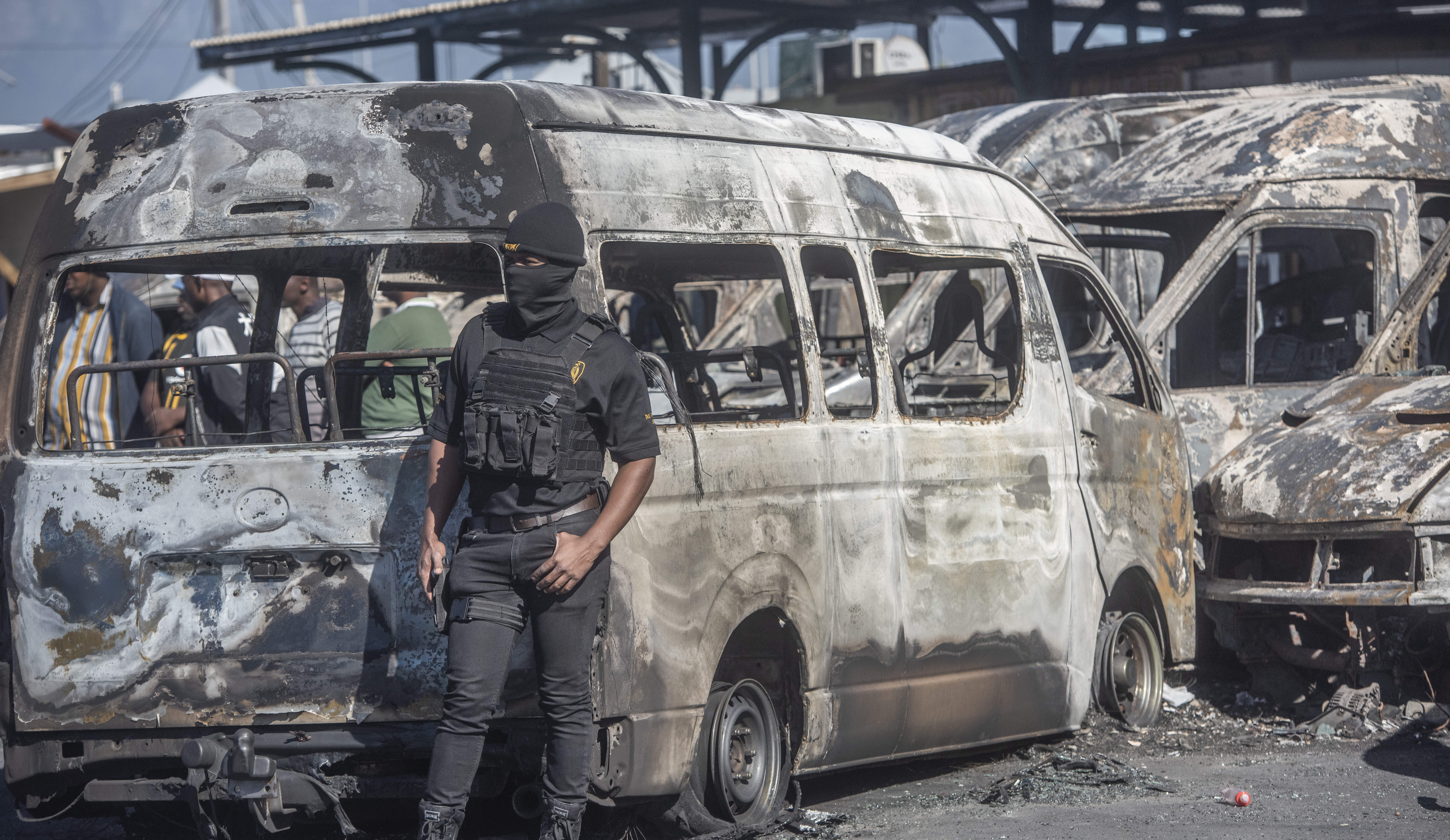
 A recent taxi peace summit aims to end scenes like this, when 16 minibus taxis were torched at Nyanga taxi rank in Cape Town on 10 February. (Photo: Brenton Geach / Gallo Images)
 The minibus taxi sector in Cape Town has long been marred by issues of violence, extortion and illegality as operators vie for a slice of the industry, estimated to be worth R5-billion to R7-billion in the Western Cape.
Taxi violence started in the region during the 1990s, with taxi operators targeting the Golden Arrow Bus Service. Since then, the bodies have continued to pile up.
On Monday, 4 August, South African National Taxi Council (Santaco) Western Cape chairperson Mandla Hermanus stated: “We need to write a new chapter and it cannot be written in blood.”
He was speaking at Santaco’s Peace Summit in Cape Town, which brought together stakeholders to address the challenges undermining the taxi industry.
/file/dailymaverick/wp-content/uploads/2025/08/IMG_20250804_103407.jpg "Mandla Hermanus, chairperson of Santaco Western Cape, said a cashless system would reduce criminal activity in the taxi industry. (Photo: Vincent Cruywagen)")
One message that came through strongly from taxi operators and owners, religious leaders, the City of Cape Town and the Western Cape mobility MEC, Isaac Sileku, was that the killings, extortion and assassinations must end.
Conflict resolution
At the heart of violence — and the impact it has on commuters who rely on the services — are disputes over routes.
Dr Siyabulela Fobosi, a senior researcher at the University of Fort Hare, believes that the violence can be curbed through the introduction of route-based conflict management mechanisms.
Fobosi told Daily Maverick: “Where these problems are happening, the routes are identified to say, ‘Look, let’s implement this conflict management there, that mechanism will be made up of a multitude of stakeholders.
“The issues are then identified. The conflict is identified in its early stages. The people are advised to practise mediation before it escalates into something that kills people.”
He said the issue of route duplication must be addressed urgently, as licences are often issued without proper adherence to the law.
“We end up with too many operators on a single route. While competition is expected, it should be fair, not as cut-throat and hostile as it currently is.”
Mobility MEC Sileku said his department had a five-year strategic plan to compel taxi owners and associations to register with municipalities, which would help prevent route invasions. He said there was a focus on establishing stakeholder engagement forums.
/file/dailymaverick/wp-content/uploads/2025/08/IMG_20250804_104658.jpg "Santaco national spokesperson Rebecca Phala and Western Cape Mobility MEC Isaac Mbulelo at the Taxi Peace Summit. (Photo: Vincent Cruywagen)")
The taxi industry has often been at odds with the City of Cape Town and Western Cape government, particularly over issues such as by-laws.
Governments across South Africa have attempted to register and formalise the taxi industry, with Fobosi writing, “Post-apartheid governments have failed to formalise or regulate the sector effectively, leaving it trapped in a liminal space: too essential to ignore, too unruly to reform.”
Fobosi added, however, that formalising the industry was possible.
Read more: Alleged taxi hitman accused of wreaking havoc in Cape Town a flight risk — prosecutor
A template
Speakers at the Peace Summit pointed to a recent example of how conflict between operators was resolved through dialogue.
In June, an agreement was reached between the Cape Amalgamated Taxi Association and the Cape Organisation for the Democratic Taxi Association to resolve route disputes and operational challenges on the Mfuleni-Somerset and Khayelitsha-Somerset West routes.
Seven people were killed and five others injured in the conflict, but through dialogue, the associations resolved their disputes and came to a mutually beneficial agreement.
/file/dailymaverick/wp-content/uploads/2025/08/IMG_20250804_100902.jpg "Taxi owners, religious groups and other role-players attended the Western Cape Taxi Peace Summit on Monday at the Waterfront in Cape Town. (Photo: Vincent Cruywagen)")
Sileku said this agreement was a testament to what is possible when collective leadership and dialogue are prioritised and people, rather than taxi owners, are put first.
Speaking about the Peace Summit, he said, “This summit is long overdue. We have always dealt with taxi violence as it occurred. So now we have decided to sit down. Let’s talk about it.”
He highlighted how taxi violence affected commuters: “A mother waits by the roadside for transport that never comes. A child loses a day of learning because a route is closed. A father does not return home because of a conflict he never chose. A community is left afraid. A family is left grieving.
“When mobility stops, life stops; there is no work, no school and no growth. That’s why this summit is so important. A moment where we move from crisis to collaboration, from confrontation to partnership, from fear to a future we can all believe in.”
He called on the taxi industry to rise above conflict and fear, and reiterated that the Western Cape government was not there to control or to dictate, but rather to build with the taxi industry.
Read more: ‘Private militias’ warning after Cape Town taxi shootout
Tackling criminality
Security strategist and former Interpol ambassador Andy Mashaile stressed the importance of protecting the taxi industry from infiltration by cartels, syndicates and criminal elements.
“Those are the people who are involved in money laundering, racketeering … those with the money of cash-in-transit heists.”
“Because those individuals want to clean their money, they will, for example, say: ‘Here is your gift of R10-million; go and buy yourself some taxis.’ That money that came in filthy has now been cleaned because the source of the money cannot now be identified,” said Mashaile.
He added that with such vast sums of money involved, the industry was bound to attract organised crime. He called for the implementation of an integrity pact that all taxi associations must sign, which would trigger lifestyle audits on owners.
/file/dailymaverick/wp-content/uploads/2025/08/IMG_20250804_123834.jpg "Security strategist and former Interpol ambassador Andy Mashaile. (Photo: Vincent Cruywagen)")
Read more: It’s time to rewrite the taxi industry rule book — the taxi barons must be co-authors
Santaco’s Hermanus proposed introducing a cashless system to help the industry deal with extortion.
“There is also the infiltration of the minibus industry by criminal elements, the issue of extortion by gangsters, and also instances of criminal elements within the industry itself extorting members from their own associations. This leads to violence.
“This is why we are discussing a cashless system, because we believe that if we remove cash from the taxi ranks, we will be able to deal with the issue where committee members or executives of associations want to take money from the association and use it for their own ends while eliminating anyone who tries to stop them from doing so,” he said.
Hermanus emphasised the importance of vetting minibus taxi operators and drivers. The government, he said, already had those mechanisms in place.
“It is simply a matter of working with us to ensure criminal elements are eliminated,” he said.
“The only thing to do is to deregister that driver from our system — when the registration and vetting kicks you out, then you automatically become deregistered… If you have a criminal record, it is important to look at how long ago it occurred. Rehabilitation will play a critical role.” DM