




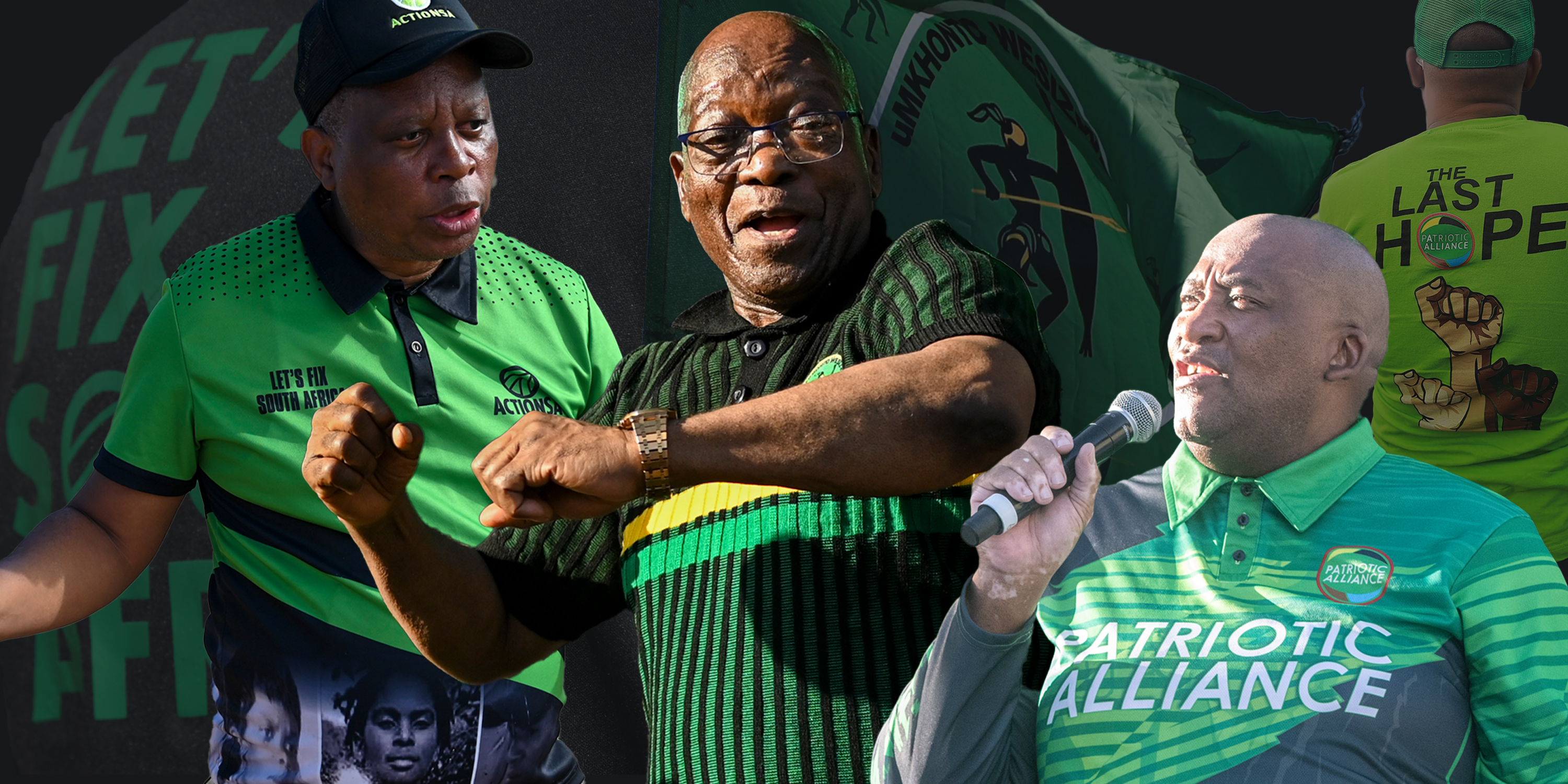
 Illustrative image | ActionSA president Herman Mashaba. (Photo: Darren Stewart / Gallo Images) | MK president Jacob Zuma. (Photo: Darren Stewart / Gallo Images) | PA leader Gayton McKenzie. (Photo: Brenton Geach / Gallo Images)
 “No electoral congress is on the cards for MK.”
uMkhonto Wesizwe (MK) party spokesperson Nhlamulo Ndhlela was perfectly straightforward when asked by Daily Maverick this week whether the party had any plans to allow members to elect party leaders.
MK has never made any pretence of this: all its leaders have been “appointed” by former president Jacob Zuma, who leads the party’s “high command” — all of whose members were hand-picked by Zuma.
Most recently, MK urged its members to be patient while Zuma decides who MK’s next secretary-general will be, with the party’s head of presidency, Magasela Mzobe, quoted as telling members: “The president will soon call the national leadership and announce who will take over the SG position. He is still assessing; he asked that he not be rushed.”
The MK party, in other words, is not a democracy. Democratic political parties periodically hold electoral conferences, at which delegates, acting on behalf of broader constituencies, cast votes for their leaders.
But MK is not the only South African party being run like a fiefdom.
Read more: Former MK party secretaries did many ‘wrong things’, says Zuma after Shivambu’s axing
Where is ActionSA’s electoral congress?
ActionSA, the party founded by former DA Johannesburg mayor Herman Mashaba, adopted its interim constitution in January.
That constitution states that the party will hold a “People’s Convention” every five years, at which the party president and other office-bearers will be elected.
It states that this electoral conference must be held “within 9 (nine) months after the 2024 national government elections” — yet almost 15 months after the elections, this has not happened.
Significantly, the ActionSA constitution also states: “The People’s Convention may not be held 18 (eighteen) months prior to an election of a general nature.”
It’s unclear whether this description would encompass the 2026 local government elections, which have been pencilled in for between 2 November 2026 and 1 February 2027. If it does, the party could have missed the window in which the conference should have been held.
Asked by Daily Maverick on Monday why ActionSA had not yet held an elective conference and when it intends to do so, party spokesperson Matthew George pointed to another clause of the constitution, which reads:
“A membership audit must confirm that branches have been established in 70% of the wards of the country before the People’s Convention can be called or upon the presentation of a resolution signed by 60% of the members of the Party.”
George said: “Following the 2024 National Elections, ActionSA embarked on an organisational review. One of the key outcomes was a mandate to overhaul our membership and branch structures and begin afresh.”
The party is “working hard to achieve” the branch target.
He said, “Importantly, in giving due effect to both constitutional provisions, we have sought not to elevate one above the other. As such, the matter of the People’s Convention currently resides with the Senate, ActionSA’s highest decision-making body in the absence of the Convention. The Senate will formally communicate the outcomes in due course, first to our internal structures and then to the media.”
Even when the People’s Convention is eventually held, the party’s constitution decrees that not all positions are voted on.
Of the top three ActionSA leadership positions — president, deputy president and chairperson — only the president is voted in at the elective conference. The constitution states that the chairperson and deputy president positions are “appointed for a 5 (five) year term linked to the term of the President, by the elected President”.
Patriotic Alliance is the playground of its ‘Founders’
The Patriotic Alliance (PA) did not respond to Daily Maverick’s questions on Monday, but in its 12 years of existence, it is unclear whether anyone has been able to challenge leader Gayton McKenzie in a vote.
Its constitution makes it clear that the supreme authorities in the party are the “Founders” — “one of the three individuals who originally established the Party”: Gayton McKenzie, businessman Kenny Kunene and former journalist Charles Cilliers.
The PA constitution says that party leaders are “selected” — not elected — “not based on popularity”, but on their ability to deliver results.
It openly states: “The Patriotic Alliance rejects the inefficiencies of traditional hierarchies and elective conference-driven systems.”
The closest the PA gets to participatory democracy is hosting an annual general meeting at which members are supposed to be able to “nominate candidates for consideration by the Founders to key Party positions”.
However, “The AGM does not have the authority to elect or confirm key Party positions unless the Founders neglect to approve or reject the nominations within 30 days of the AGM.”
McKenzie suspended Kunene as party deputy president last month after Kunene was found at the house of an accused hitman — but he presumably retains his status as a “Founder”.
Read more: ‘Continue Kenny’s good work’ — McKenzie appoints PA’s Liam Jacobs to replace Kunene
Other parties do practise democracy
In other local parties, there is genuine contestation for leadership positions. Historically, the most significant of these has been the ANC’s internal elections, since the winner of that contest has always gone on to be the president of South Africa. That may not be the case for the next victor, due to be elected in December 2027.
The DA’s Willie Aucamp confirmed to Daily Maverick that the DA’s next electoral congress will take place next year, on 11 and 12 April. The Freedom Front Plus, meanwhile, held its congress in February, at which Corné Mulder was voted in to replace Pieter Groenewald as leader.
The Economic Freedom Fighters (EFF) pay lip service to robust democratic structures, but its People’s Assembly was described by Zimbabwean journalist Hopewell Chin’ono in 2024 as an example of “guided democracy”: a system in which “democratic processes, such as political party leadership elections, are allowed to exist, but are heavily influenced or controlled by a central authority or dominant political force or individual” — in this case, Julius Malema.
As South Africa’s political landscape fragments into personality-driven outfits, the barely-there visibility of internal democracy in parties such as MK, EFF, ActionSA and the Patriotic Alliance hollows out the very idea of representative politics.
That only a handful of parties still hold genuinely competitive leadership elections underscores how rare true accountability has become. The genuine danger is also that it acclimatises South Africans to autocratic leadership — in a context where, to quote US President Franklin D Roosevelt, “People who are hungry and out of a job are the stuff of which dictatorships are made.” DM