




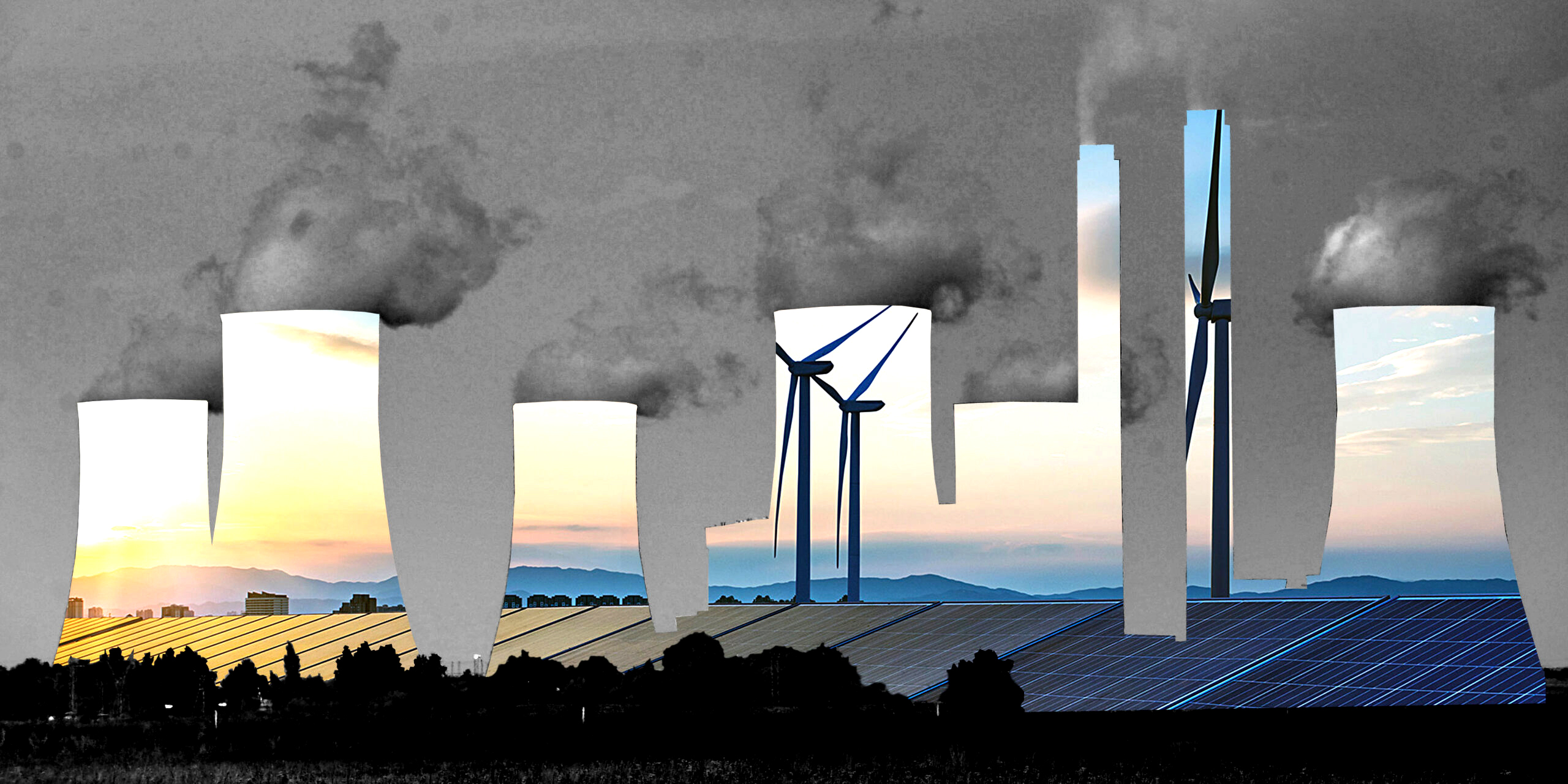
 Public consultation is now open for South Africa’s second draft of Nationally Determined Contributions, setting targets for net-zero carbon emissions by 2050. (Photo: Leon Sadiki / Bloomberg via Getty Images) / (Photo: iStock)
 South Africa has released its second draft of Nationally Determined Contributions (NDCs), outlining updated climate change mitigation targets and adaptation goals for 2026-35, with greenhouse gas emission reduction targets and strategies for a just transition to net-zero carbon emissions by 2050.
As a signatory to the Paris Agreement (a legally binding international treaty on climate change), South Africa is required to routinely update its NDCs to reflect the country’s “highest possible ambition”.
Environment Minister Dion George published the draft in the Government Gazette on 30 July 2025, inviting the public to submit comments within 30 days of that date.
The second draft of the NDCs arrives amid accelerating impacts in South Africa, with thousands displaced because of flooding incidents, a hard-hit agricultural sector, recurring droughts and rising food and water insecurity, all while the country faces intense international scrutiny with the 1.5°C climate safety threshold becoming ever more elusive to maintain.
“Climate change is one of the greatest challenges of our generation. Despite efforts in global mitigation, these fall short of what is needed to keep temperature increase below 1.5 °C above pre-industrial levels. Rising global emissions mean increasing impacts,” it states in the Gazette.
South Africa, struggling with the triple challenge of poverty, unemployment and inequality, recognised that climate action cannot be decoupled from these development imperatives.
The NDCs thus bring together mitigation (emissions reductions) and adaptation (building resilience against climate change impacts), with the goals of social inclusion, justice and economic transformation.
George said this draft reflects South Africa’s commitment to contribute fairly to the global efforts to limit temperature increase to well below 2°C, pursuing efforts to limit it to 1.5°C above pre-industrial levels.
South Africa is a significant emitter of greenhouse gases, especially in Africa, as seen in the graph below.
Addressing these emissions is critical not only for global climate goals but also for South Africa’s own sustainable development, given the pressing need to transition towards a low-carbon economy through renewable energy expansion and industrial transformation.
Unpacking the latest NDCs
The new NDCs are underpinned by the Climate Change Act, giving climate ambition the force and clarity of law. It assigns clearer responsibilities for every sphere of government and institutionalises the principle of a “just transition”, in an attempt to ensure that the pursuit of decarbonisation does not leave vulnerable communities behind.
Read more: ‘Doesn’t have teeth’ — experts voice concern about deferral of ‘key’ clauses in Climate Change Act
When it comes to mitigating greenhouse gases, the Gazette notes that annual greenhouse gas emissions should be in the range of 350 to 420 million tonnes of carbon dioxide equivalent (Mt CO₂-eq) by 2030. Then the range drops to 320-380 Mt CO₂-eq by 2035, hopefully en route to net zero carbon emissions by 2050.
These figures mean a continued decline from South Africa’s peak emissions, aligning with Paris Agreement ambitions. But achieving these targets will demand massive political will and investment, and much of it remains contingent on increased international climate finance.
“South Africa considers the mitigation target ranges in this NDC to be an ambitious and equitable contribution to the global mitigation effort, given South Africa’s current and historical emissions and its national circumstances (especially its development challenges),” states the Gazette.
In response to the Paris Agreement, South Africa, along with other nations, has been encouraged to create long-term strategies for a just transition to net zero emissions.
South Africa committed in its 2020 Long-Term Low Greenhouse Gas Emissions Development Strategy (LT-LEDS) to achieve net-zero CO2 emissions by 2050.
The path to achieving this goal, which will involve a fundamental shift away from a fossil fuel-dependent economy, will be further detailed in the country’s next LT-LEDS – which the Department of Forestry, Fisheries and the Environment (DFFE) is preparing.
Unlike mitigation, which is measured in tons of carbon, adaptation is about tangible and necessary improvements in water security, disaster readiness, infrastructure and social safety nets.
The updated NDCs introduce several adaptation goals for 2026-35, covering water and sanitation, disaster management, infrastructure, food security, climate services, biodiversity/ecosystem resilience and government capacity.
Each goal is mapped to concrete interventions such as updating municipal water plans, establishing rescue hubs in vulnerable settlements and expanding biodiversity protections, and paired with progress indicators.
This structure is designed to make adaptation measurable and monitorable, which is needed for South Africa’s biennial adaptation synthesis reports, improved data systems and transparency protocols – this is to evaluate what’s working and what needs rethinking.
Importantly, the NDCs do not gloss over risks. They lay out uncertainties, from international finance, to domestic capacity and political stability needed to meet these goals.
Without scaled support, the ambitions of the NDCs could remain aspirational. The document recognises the risk of inequitable impacts, the need for capacity and finance at every level of government and the challenge of translating strategy into action.
In the 2021 update of the first NDCs, major uncertainties were highlighted, particularly concerning the impacts of Covid-19, including issues related to debt.
The environment surrounding the second NDCs is now marked by significant geopolitical instability, particularly involving economic conflicts about tariffs and trade, ongoing military tensions in a number of countries with the potential for escalation, growing divisions both within societies and among nations and the possibility of reverting to regional power blocs, among other challenges.
“Recommitment by all countries to the multilateral rules-based approach to climate action and support is essential to address uncertainties,” the Gazette states.
Call for stronger climate action
James Reeler, WWF’s senior technical specialist on climate action, urged all South Africans to raise their voices and call for stronger climate action and reduced greenhouse gas emissions at this critical stage.
“The impacts of climate change are devastating communities across the country, and failure to adequately address them will undermine economic development. We need to make it clear to both government and the international community that South Africa can and will step up to the challenge that climate change poses,” said Reeler.
Reeler added that, despite strong lobbying efforts from some heavy emitters, there was a growing voice of concerned businesses calling for more ambition, with 95% of business leaders surveyed supporting a transition away from fossil fuels.
As an example of this, Reeler said, the Alliance for Climate Action, a grouping of more than 50 South African companies and five major metropolitan municipalities, has issued a call for strong ambition in these NDCs.
Reeler said that as the new NDCs cover the period to at least 2035, these must demonstrate how the country plans to address the risks to which a changing climate exposes agriculture, infrastructure and health.
Journalist’s comment
This gazette isn’t a bureaucratic formality, it's a direct call to action for every citizen and how we can hold our government accountable for the commitments it makes.
We know that climate change disproportionately affects our most vulnerable communities and we’ve all seen the wreckage of seemingly increasing extreme weather events, water scarcity, and food insecurity on our friends and family. So scrutinise this plan, offer informed feedback, and ensure that the final document reflects the diverse needs and realities of all South Africans. Without active citizen engagement, this crucial blueprint for our future risks becoming just another document, rather than the living, breathing national commitment it needs to be.
The public is invited to submit comments on the new draft NDCs within 30 days from the date of publication of the notice in the Government Gazette.
Submissions can be emailed to Mkhuthazi Steleki, the DFFE director-general, at MSteleki@dffe.gov.za or Mnditwani@dffe.gov.za. DM