




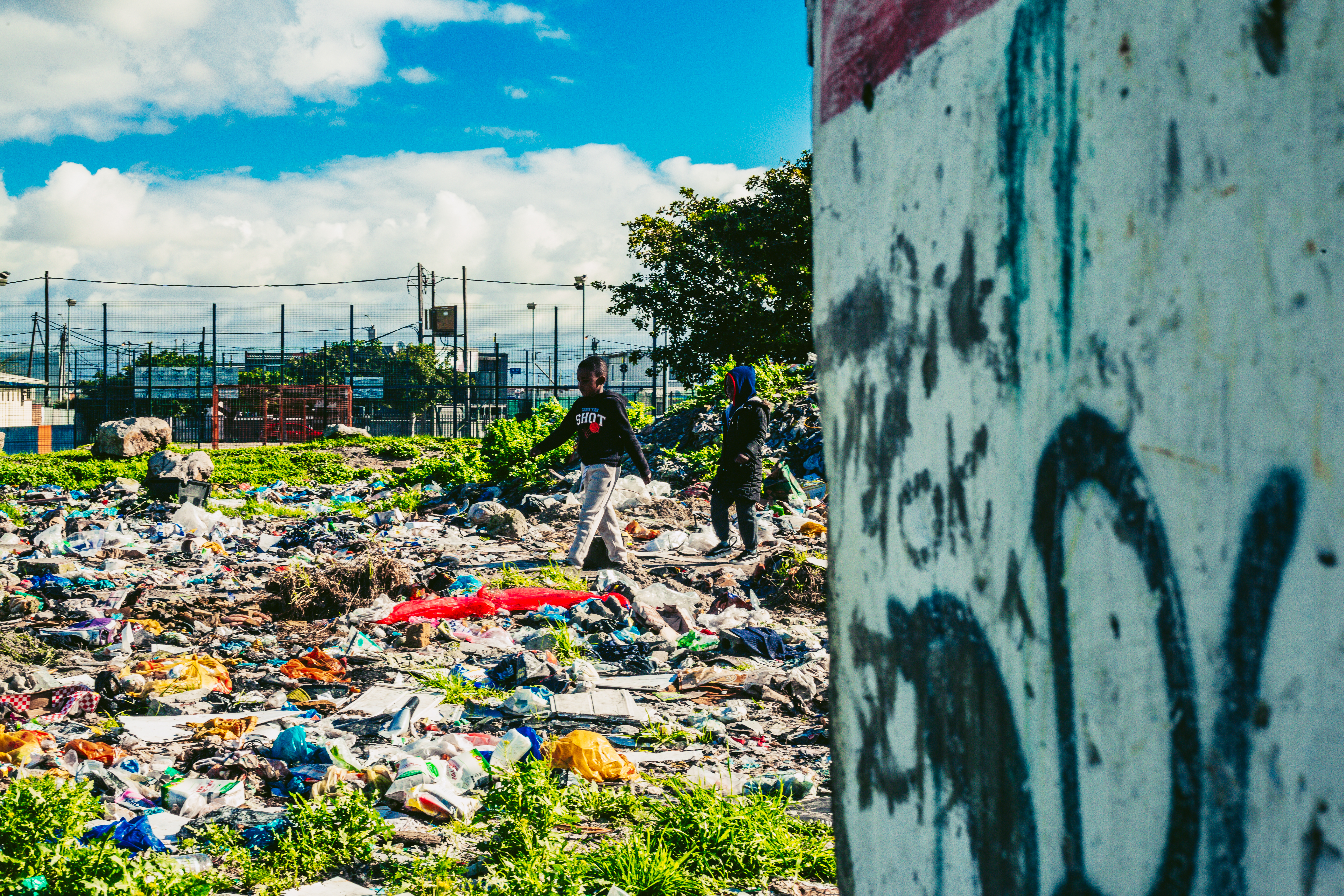
 The Right to Play Campaign, a project of the Movement for Collective Action and Racial Equity (Movement for Care), has called attention to the dire state of children’s play parks in Cape Town’s poor and working-class communities, including the waste-strewn Baba Park in the township of Mfuleni. (Photo: Supplied / Right to Play Campaign)
 The Right to Play Campaign, a project under the Movement for Collective Action and Racial Equity (Movement for Care), is spotlighting the dire state of some children’s play parks in Cape Town’s poor and working-class communities, including the waste-strewn Baba Park in the township of Mfuleni.
Mfuleni is about 32km from the city centre. On a visit to Baba Park in July, Daily Maverick observed young children playing in a space choked with rubbish such as used nappies, rusted mattress springs, animal carcasses and plastics. The playground equipment was damaged, with all the swings missing from the swing-set frame.
/file/dailymaverick/wp-content/uploads/2025/07/INSET-1-1.jpg "Since it was established about 10 years ago, conditions at Mfuleni’s Baba Park have deteriorated, with waste such as animal carcasses, nappies and kitchen scraps piled around the children’s play area. (Photo: Supplied / Right to Play Campaign)")
“For children, play is a right, not a luxury, and in many of these marginalised, poor and working-class communities, there aren’t safe spaces for kids to play,” said Nkosikhona Swartbooi, an organiser of the Right to Play Campaign and long-time housing rights activist.
“All governments must ensure that they implement [the right to play]. It cuts across a lot of things that kids should be exposed to, in terms of culture, art, recreation.”
The Movement for Care is a community-based organisation committed to addressing systemic and structural inequalities in the City of Cape Town, while the Right to Play Campaign highlights the “critical importance of safe, accessible and inclusive public play spaces for children, particularly those living in black and coloured working-class communities that are under-resourced and historically neglected”, said Swartbooi.
/file/dailymaverick/wp-content/uploads/2025/07/INSET-2.jpg "The frame of a swing set in Baba Park, Mfuleni, is missing all the swings. (Photo: Tamsin Metelerkamp)")
Concerns about Mfuleni’s parks
Dlamini Benya, a community leader from Mfuleni, said that when Baba Park was established about 10 years ago, it was a great resource for the community, providing space for picnics and outdoor activities.
However, he said it had since become dangerous for children due to the illegal dumping of rubbish and the presence of criminal elements who used the park for smoking and drinking.
“There’s no maintenance at all. The city just put the park here and then went away,” claimed Benya, adding that community leaders had asked city officials about the problems at the park, but had yet to see any action taken.
/file/dailymaverick/wp-content/uploads/2025/07/INSET-3-1.jpg "Dlamini Benya, a community leader in Mfuleni who lives near Baba Park, says he will no longer let his children play in the space as it has become too dangerous. (Photo: Tamsin Metelerkamp)")
Benya would like to see fencing and security measures for the park to improve access control and safety for the community’s children.
“We are trying… Up to today, we are still waiting for [change],” he said.
“For me, it’s a good idea [to campaign for safe parks]. If the park’s going to be restored… the kids are going to have a place to play, instead of playing on the road, which is dangerous.”
Cordelia Sigagayi, the head of an early childhood development (ECD) centre in Mfuleni, said that other parks in the area had also become high-risk sites. Her centre borders a smaller park on Tokwana Street where waste has accumulated.
“Sometimes, there are a lot of flies coming into our ECDs… The smell comes inside our ECDs, so we face challenges of unsafe and unhealthy [conditions]. We end up losing the children in our centres because… no parents want to bring their kids [there]. We’re struggling,” she said.
“In our ECD, we don’t have an outdoor play area, so we used the park. It doesn’t only affect the children in ECDs, but the whole community. Especially now, during the holidays, it’s difficult for the community children to play.”
/file/dailymaverick/wp-content/uploads/2025/07/INSET-4-1.jpg "The Right to Play Campaign says conditions at Baba Park in Mfuleni are a public health risk and a blatant violation of children’s rights. (Photo: Supplied / Right to Play Campaign)")
On 18 July, the Movement for Care released an open letter addressed to Councillor Francine Higham, Cape Town mayoral committee member for community services and health, requesting urgent action to address the issues at Baba Park and other public playgrounds in Mfuleni.
“The deteriorating condition of Baba Park and other play parks in Mfuleni exemplifies this ongoing neglect, denying children their fundamental right to safe and dignified spaces to play and thrive,” said the letter.
The campaign said it had tried to visit all 18 parks meant to exist in Mfuleni, but had been unable to locate some, suggesting problems with accessibility and proper management at the sites.
“This is not an isolated problem. We have noted similar neglect in many public parks across other black and coloured working-class communities in Cape Town. As part of our Right to Play Campaign, we would like to understand the city’s position and approach to public play spaces, especially in historically underserved areas,” it said.
Higham confirmed to Daily Maverick that her office had received the open letter from the Right to Play Campaign and would issue a formal response in due course.
/file/dailymaverick/wp-content/uploads/2025/07/INSET-5.jpg "The Right to Play Campaign has called on the City of Cape Town to provide the maintenance and cleaning schedule for parks in Mfuleni and across the city. (Photo: Supplied / Right to Play Campaign)")
From the City of Cape Town
The City of Cape Town Recreation and Parks Department is aware of the ongoing challenges at Baba Park and has implemented strategies in response, in collaboration with solid waste management, law enforcement, ward councillors and local stakeholders, according to Higham.
These measures included the deployment of Expanded Public Works Programme (EPWP) workers and “Park Buddies” (community members partnered with the department to manage parks), as well as scheduled maintenance by internal recreation and parks department staff, she said.
“However, the area continues to face severe and repeated illegal dumping – sometimes carried out by armed individuals – along with ongoing vandalism and theft of park infrastructure. These conditions significantly undermine efforts to sustain improvements. The department continues to engage with enforcement partners to strengthen safety measures and discourage antisocial behaviour in public parks,” said Higham.
The City of Cape Town has allocated about R159-million for park maintenance city-wide, which covers routine measures such as mowing, litter collection, infrastructure repairs and landscaping, according to Higham. This includes R5-million allocated to maintain the 18 parks in Mfuleni.
Higham noted that while there were still 18 parks in Mfuleni, some might appear inaccessible “due to ongoing issues of illegal dumping, infrastructure vandalism and encroachment”.
“These challenges affect the visibility and usability of certain parks, but do not reflect a lack of infrastructure investment,” she said.
When asked about the Right to Play Campaign’s statement that there were issues of neglect in many public parks across other black and coloured working-class communities in the city, Higham said the department “does not agree with this generalisation”.
“Parks across Cape Town, including in historically underserved communities, are maintained in line with the city’s recreation and parks maintenance standards. The key challenge is not neglect, but rather criminal activity such as dumping, theft and vandalism, which places additional pressure on available resources and staff. Ensuring our parks remain clean and safe for all residents is only possible when communities take ownership of these spaces and work with local government to care for and protect these shared places,” she said.
Defending the right to play
A lack of safe play spaces in communities poses a real threat to children’s lives and well-being, according to Swartbooi. He spoke about the loss of his nephew, two-year-old Imthande Swartbooi, who drowned after falling into an uncovered manhole while playing near his family’s home in Khayelitsha.
“Imthande is not the only child that has died as a result of trying to find a safe place to play,” he said.
Swartbooi said there was a need for the right to play to be explicitly encoded in South Africa’s legislation, including the Constitution and the Children’s Act.
“The Constitution talks about basic nutrition, shelter, basic healthcare services and social services… but where is the right to play? Because all of these are important, but if kids are deprived of the right to play, it’s more likely that… they will not grow well. It’s more likely that they will not be able to apprehend information, and learn and grow in terms of education,” he said.
He linked the shortage of safe recreational spaces to other social ills within communities, including higher rates of crime, gang activity and substance use among young people.
Among the objectives the Right to Play Campaign is pursuing concerning play parks are: a review of section 28 of Constitution to include explicit reference to right to play; a plan, with a timeline and budget, for communities who do not have play parks in Cape Town; and a review of the effectiveness of the cleaning and maintenance processes shaping local parks.
“This is important in terms of accountability… This is the conversation that we are starting – that there’s an obligation, and we can’t keep quiet when the state of these play parks is becoming unbecoming,” said Swartbooi.
He acknowledged that addressing the poor state of play parks was the responsibility of the community as well as the municipality.
“This is not just a problem that we are squarely putting at the door of the government… There’s a responsibility that the state has in terms of maintaining [and] ensuring that they meet their obligations in relation to these parks… but also, residents have an obligation to look after spaces where their kids are playing,” he said.
“You have a responsibility as a community member to ensure that you look after your community. Whether you have kids or not, that obligation still stands.” DM