




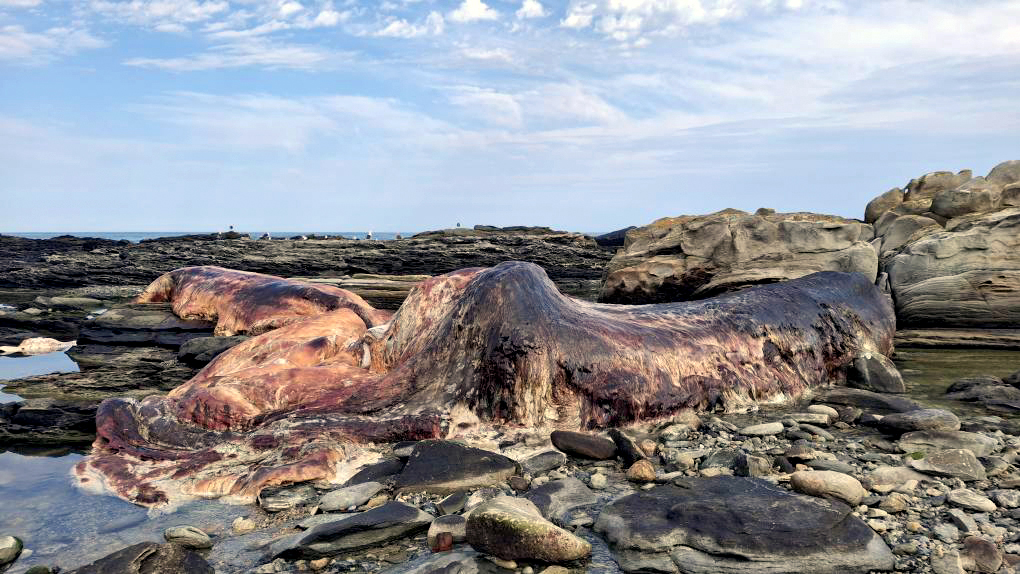
 The Nelson Mandela Bay Municipality and the Department of Forestry, Fisheries and the Environment cannot agree on whose job it is to remove a dead whale that washed up in Schoenmakerskop, Geberha, almost a month ago. (Picture: Melissa Riordan)
 While whale strandings, or the washing up of whale carcasses, are a frequent event during winter along the Algoa Bay coastline, the Nelson Mandela Bay Metro insists that it is not their job to remove rotting whale carcasses.
The Department of Forestry, Fisheries and the Environment says it is also not their job. Dr Greg Hofmeyr, the curator for marine mammals at the Port Elizabeth Museum at Bayworld agrees with the department, saying it is the municipality’s job.
“The municipality has removed whales before. They have asked us to remove the carcasses of marine mammals before, but it is not our job,” he said. “It is a very expensive thing to do.”
A whale carcass has been rotting in a rock pool at Schoenmakerskop for the past month.
Hofmeyr, a resident of Schoenmakerskop, said that whale carcasses frequently washed up along the Algo Bay coastline during winter when the whales migrated. But he added that there was probably no harm in leaving the whale carcass.
“Nobody is bothered by it here,” he said. “In another month or so most of it will be gone. It is not an ecological risk. But I would just advise people not to swim too close due to a bacterial risk and the oil released from it. We’ve had whale carcasses wash up at Schoenies before.”
Unlikely to wash up in summer
He said whale carcasses were unlikely to wash up in summer when the beaches were busy as the only species around all year were Bryde’s whales.
He said it was mostly whales that had died of old age or that had been injured that washed up on beaches.
“I’ve had a brief look at the carcass. [When it washed up] it was already too decayed for us to determine a cause of death or to collect many samples. Usually it is the land management authority that needs to remove the carcass. In this case it would be the Nelson Mandela Bay Municipality,” he said.
Hofmeyr added that in the past traditional healers had found a whale carcass on the beach at St George’s, and even though it was illegal to possess parts of a whale without the necessary permit, they had disposed of the carcass quickly.
“Previously we have seen the municipality hire a contractor to dispose of a whale carcass that washed up near Willows,” he said. He said the neighbouring municipality of Kouga removed whales that washed up along their part of the coast. “We also had a case at Colchester where a whale washed into the Sundays River. The land authority there was SANParks. They were keen to let it rot away, but due to several complaints they eventually disposed of the carcass,” he said.
Metro spokesperson Sithembiso Soyaya referred all queries to the Department of Forestry, Fisheries and the Environment.
‘Not our responsibility’
The department, however, said Soyaya was wrong — it could euthanise a stranded whale, it said, but if it was already dead it was not their responsibility.
“Once the whale strands alive, institutions permitted by the department under the National Strandings Network will attempt to refloat the animal if feasible and practical.
“Where it is not practical, an appropriately qualified expert assesses the whale and a decision is then made on humane euthanasia. If the animal is dead, then the first crucial action is the collection of samples for scientific purposes.
“Then the carcass is handed over to the municipality. The whale carcass disposal is a function of municipalities,” said Peter Mbelengwa from the department. Soyaya failed to respond to a request for clarification. DM