




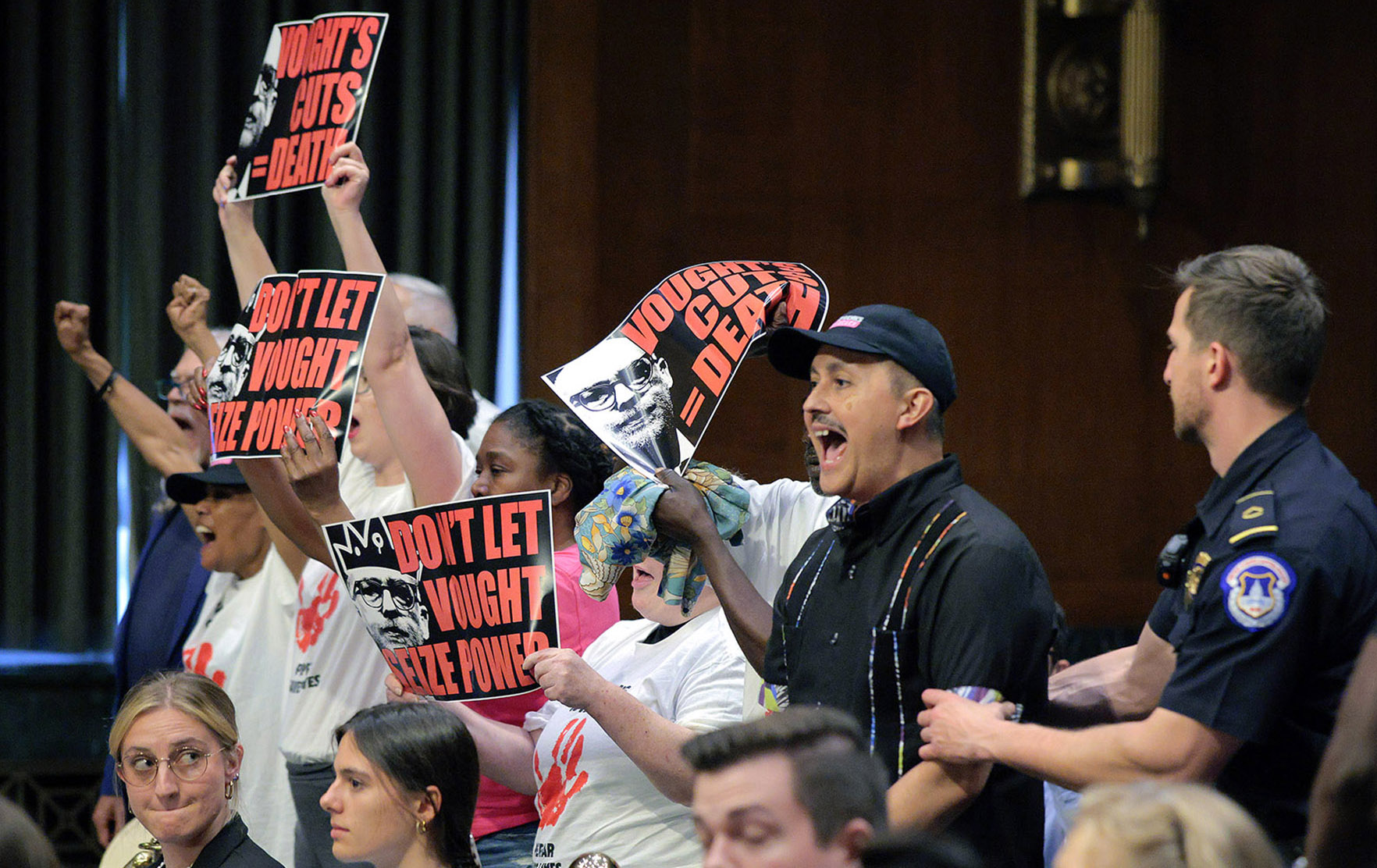
 Protesters at a hearing on 25 June 2025 in Washington, DC, as White House Office of Management and Budget Director Russell Vought testifies before the Senate Appropriations Committee on government spending cuts, including for the President’s Emergency Plan for Aids Relief. (Photo: Chip Somodevilla / Getty Images)
 The US President’s Emergency Plan for Aids Relief, or Pepfar, will reportedly be spared a $400-million funding cut that formed part of US President Donald Trump’s plan to slash billions in spending on foreign aid and public broadcasting.
The Trump administration’s “rescissions package” was seeking to cancel $9.4-billion in previously approved but unspent federal funds. However, Pepfar is being exempted from the cuts after objections from lawmakers in both the Republican and Democratic parties, bringing the size of the package to $9-billion, according to a Reuters report.
The South African National Department of Health had noted the decision in the US, said department spokesperson Foster Mohale, but did not believe it translated into an immediate decision to revive the Pepfar funding programme for countries who previously benefited from it.
“The department will continue with efforts for self-funding for health programmes for sustainability purposes,” said Mohale.
The US Senate voted to advance the Trump administration’s request for the mass funding cuts late on Tuesday, 15 July, with further votes expected later in the week. If Congress doesn’t pass the rescissions package by the deadline on Friday, 18 July, the request expires and the White House will be required to adhere to previously passed spending plans.
Read more: South Africa faces alarming drop in HIV testing rates linked to US funding withdrawal
Age of uncertainty
Pepfar, a global health programme started in 2003, constituted about 17% of South Africa’s R44.4-billion campaign for HIV counselling and testing. The programme’s funds were distributed to South African implementing partners by the United States Agency for International Development (USAid) and the Centers for Disease Control and Prevention, with about half of the Pepfar-supported initiatives in SA receiving funding through USAid.
Trump initially signed an executive order imposing a 90-day freeze on almost all foreign development assistance in January. Towards the end of February, the USAid issued notices to Pepfar-funded HIV organisations around the world terminating their funding for good.
The Treatment Action Campaign (TAC), an HIV/Aids activist organisation, welcomed the US Senate’s decision to preserve $400-million for Pepfar, as it showed that bipartisan support for the programme still existed, according to Sibongile Tshabalala, national chairperson of the TAC.
“However, the executive orders, restrictions and programmatic cuts are still in force – nothing has changed in terms of the current implementation. It does not mean that services will re-open, [nor that] implementing partners with terminated grants will return to clinics. We desperately await the return of all funding for the healthcare workers and services that was cut in January,” said Tshabalala.
Read more: Closing the funding gap — how SA can respond to US aid cuts
Dr Kate Rees, public health medicine specialist with the Anova Health Institute, said it was difficult to predict how the US Senate’s decision to preserve Pepfar funding would affect South Africa’s HIV programmes.
Anova lost its Pepfar funding during the Trump administration’s cuts, but continues to run its other programmes.
“There’s still a lot of work to do to decide how that [Pepfar] money is going to be dispersed and we can’t really say just yet what’s going to happen with it. It’s likely that some of it will come to South Africa. What we know for sure is that the programmes, as they were before, are not going to be reinstated,” said Rees.
“Even if Pepfar funding is restored to South Africa, it’s going to be in a different format, it’s going to be [at] different levels, it’s going to be implemented very differently to how it was before. There’s going to have to be a different relationship between the Department of Health and Pepfar, and the NGOs that were implementing some of the programmes.”
Prof Linda-Gail Bekker, CEO of the Desmond Tutu HIV Foundation and director of the Desmond Tutu HIV Centre at the University of Cape Town, echoed Rees’s sentiments, noting that it was “too soon to say” how the restoration of Pepfar funding would play out in South Africa.
“I think we all need to advocate for urgency. Pepfar isn’t yet through, as such, and so I think we still need to advocate for how, where and when [it’ll be reinstated],” she said.
Sustainable solutions
Bekker said that beyond establishing a “transitional, emergency bridge” to get South Africa back on the road to reaching the 2030 targets for ending the Aids epidemic, there was also a need to rethink priorities and increase efficiency in the response to HIV.
Rees told Daily Maverick, “Restoring the [HIV] projects, that’s not going to happen, so the question is what do we prioritise and what is Pepfar going to prioritise in order to make sure that we protect the most vulnerable and allow the health system to operate in the best possible way.
“One of the things that seems to be generally accepted is that key populations and community organisations really rely heavily on external funding, and need that external funding because if they’re pushed into the overall system, they can often get lost and missed. I would like to think that there will be Pepfar funding coming into South Africa for some of these programmes.”
Both Rees and Bekker said that a restoration of Pepfar funding would need to be accompanied by new measures that ensured South Africa’s HIV programmes were not vulnerable to potential shocks caused by future funding cuts.
Bekker advocated for “sustainable” solutions that took into consideration the need to bring more people on to anti-retroviral treatment, eliminate vertical transmission, prioritise primary prevention methods and incorporate innovations for HIV care and prevention.
“From across the country, within our district health system, we need to see that whatever funding does come in… shouldn’t be duplicative of the health system, [though] it should come through… the government health services,” said Rees.
“We really need to focus on ensuring health system strengthening – information systems [and] health management really need a lot of work and support, [as well as] ensuring that the workforce is in place, supply chains, [and] all of these elements that need to be in place for a well-functioning health system.” DM