



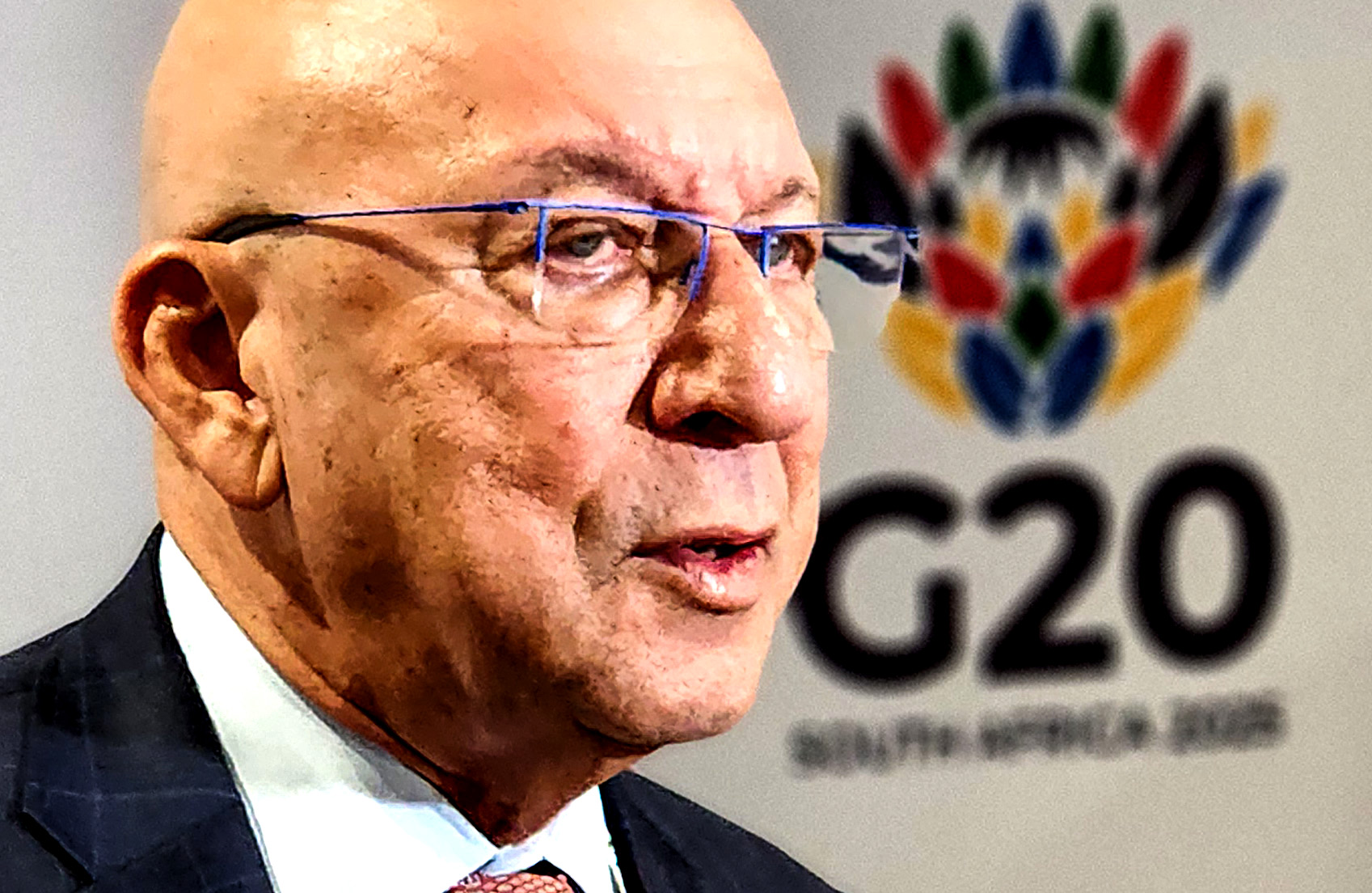
 Former finance minister and chair of an Africa Expert Panel, Trevor Manuel at the G20 Finance Ministers Summit at the lush Zimbali resort in Durban. (Photo: Neesa Moodley)
 Former finance minister and chair of an Africa Expert Panel, Trevor Manuel, told journalists yesterday that three elements need to be considered on the subject of debt, noting that Africa’s interest rate burden has increased very rapidly.
African Development Bank vice president and chief economist, Kevin Urama, said last month: “African countries pay about 500% more in loan interests when they borrow from the global capital markets compared to when they borrow from Multilateral Development Banks (MDBs) such as the African Development Bank Group or the World Bank. Debt service costs in Africa could reach $89-billion in 2025, diverting resources away from investments in education, health and other productive sectors.”
“Debt squeezes out development, it impoverishes countries. There are elements of the cost of capital that need particular attention. Included in that is the credit ratings. When countries borrow, and the interest rates are very high and they increase with time – there’s a bigger problem going forward,” Manuel said yesterday.
The third aspect he noted was the importance of working with Africa to ensure the development of domestic capital markets. “If countries could borrow in their own currencies, they don’t carry the exchange rate burden. When you have fluctuation – many countries borrow in dollars or euros and when their own currencies depreciate against those hard currencies, then the interest rate burden becomes more unsustainable,” he said.
Despite being the region with the least default rate for long-term infrastructure projects globally, Africa loses about $74.5-billion annually due to sovereign risk mispricing.
The Africa Expert Panel has made 11 recommendations to reshape global financial architecture
- Reduce Africa’s cost of capital: Advocate for reforms in global finance (rating agencies, Basel III framework) to lower risk premiums and bring down borrowing costs by engaging multilaterals and credit-rating bodies.
- Enhance debt sustainability frameworks: Improve and expand implementation of the G20 Common Framework and mobilise development banks’ resources to restructure sovereign debt more effectively.
- Build deep local-currency bond markets: Support countries in developing domestic debt markets, enhancing fiscal space and reducing dependence on costly external borrowing.
- Mobilise climate finance for a just transition: Create funding mechanisms to support Africa’s shift to green energy, ensuring social equity and inclusive growth.
- Improve data transparency for credit agencies: Call for more granular financial data from African governments to correct risk mispricing by rating agencies.
- Tackle systemic credit rating bias: Engage global rating agencies in reform processes to eliminate embedded biases against African economies.
- Expand and reform MDB support: Increase African nations’ access to financing via the World Bank, AfDB, and other MDBs, with scalable support tailored to development needs.
- Use G20 leverage to influence global financial rules: Harness South Africa’s G20 presidency to push for reforms that amplify Africa’s voice in setting standards, metrics and rules.
- Prioritise human development spending over debt servicing: Encourage rebalancing of budgets to invest in education, health and infrastructure instead of interest payments.
- Strengthen intra-African economic integration: Support AfCFTA implementation, scale cross-border trade infrastructure, and address logistical and policy bottlenecks.
- Foster resilient multilateralism: Promote dependable global partnerships, predictable development assistance and stable trade policies to shield Africa from geopolitical shocks.
Addressing the elephant in the room, Manuel observed that when trade or tariffs affected any of South Africa’s neighbours – Botswana, Lesotho or Namibia – it affected us too. “(The tariffs) will have a massive impact on South African outflows as well, impoverishing us further,” he said, adding that it was “impossible to predict” anything when “you have a head of state getting up one day and saying the tariff on this country will be (50%) and tomorrow he changes his mind, then the following day it’s back”. DM