




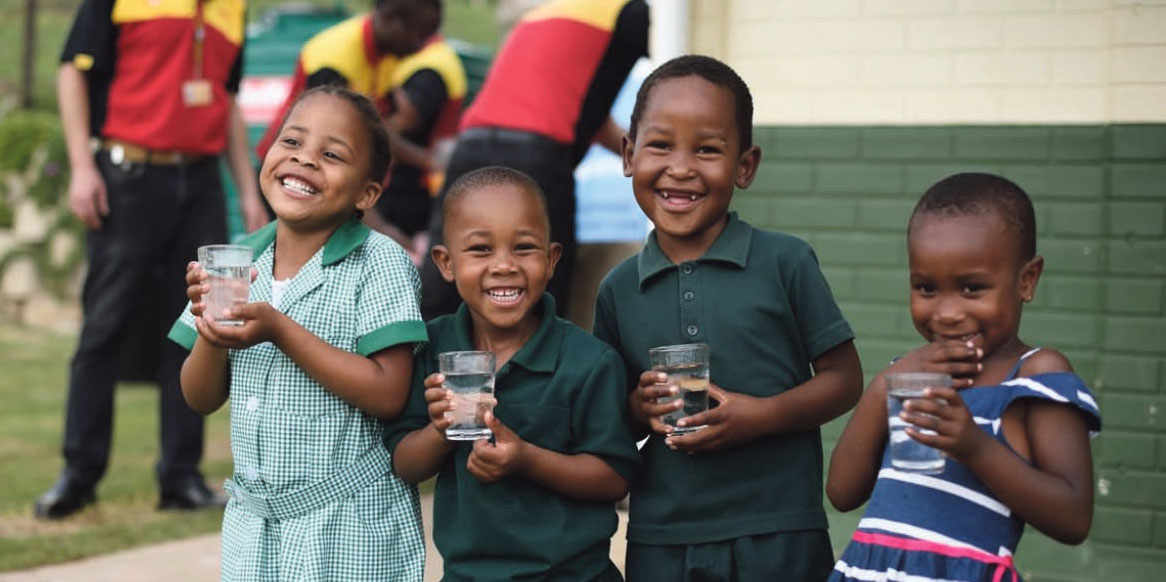
 Children drinking safe, clean water. (Photo: Supplied)
 The school day begins like any other, but it doesn’t take long for the cracks to show. The English teacher is absent again, sick with a stomach bug that’s been spreading steadily among the staff. In maths, the numbers on the whiteboard blur slightly, harder to focus on, as the heat builds and dehydration sets in.
A few desks are empty because some girls are at home, their absence explained only by a quiet, shared understanding. After soccer practice, the team collapses into the shade, sweat drying on their skin, mouths parched. There’s no water to drink, not even a sip.
For hundreds of thousands of pupils all over South Africa, this is an everyday reality. With more than 11 million people lacking access to safe, clean water, and one in three schools with inadequate water and sanitation, the ripple effects on health, attendance and academic performance are profound.
It’s a daily struggle that often goes unseen, but for Murendeni Mafumo it’s deeply personal. Raised in the rural villages of what was then known as Venda, Mafumo lived South Africa’s water crisis from the inside and remembers water as a daily uncertainty.
“Growing up, water has always been a topic of conversation. It’s always been a struggle – always collecting water, waiting for water, asking whether we’ve got enough water,” he recalled.
This experience shaped his path. Years later, after studying chemistry and working in water and sanitation for the City of Cape Town and Rand Water in Johannesburg, Mafumo began to realise that his story and his skills could converge.
“Everywhere I went, water was a challenge and I thought that maybe there was an opportunity for me to use my skills to solve this problem,” he said.
Today, Mafumo is the founder and CEO of Kusini Water, a South African social enterprise bringing clean, affordable drinking water to underserved communities, starting with the places that need it most: schools.
Kusini’s innovative filtration process
At the core of Kusini’s approach is a portable filtration unit that removes bacteria, parasites and other contaminants from unsafe water sources.
The process begins with a sediment filter that traps visible debris such as sand, leaves and small stones.
The partially cleaned water then passes through a fine membrane that eliminates microscopic pathogens and harmful microorganisms. The filtered water passes through a bed of waste macadamia nutshells ground into granular pieces and incinerated to create a natural, carbon-rich filter.
The result? Clean, odourless, safe drinking water, powered by simple science and local materials.
Since launching in 2016, Kusini Water has established about 260 sites all around South Africa, spanning three main types of locations. The first is the village solution, designed for communities that have never had access to piped water or where infrastructure has been damaged.
The second type is schools, and the third is a water kiosk. This is a community water distribution point where people can fill their own containers for a fixed fee.
/file/dailymaverick/wp-content/uploads/2025/07/09-inside-kiosk-1.jpg "A purifier inside a container and one of Kusini’s kiosks where residents can fill their own containers. (Photos: Supplied)")
Kusini Water has reached 60 schools in the country so far, and to track the impact of its work, Mafumo said it closely monitors school attendance.
“We measure impact by attendance. We ask: how many days did the school have to close because of water? When we install a system, we want that number to drop to zero,” he said.
He added that water scarcity affects more than attendance because not only is a lack of water a hygiene and sanitation risk, it also costs schools time and money. In many schools, staff members spend hours coordinating water deliveries or walking long distances to fetch it themselves.
Clean water on school grounds also means schools can cook meals through government nutrition programmes, or grow vegetables in food gardens that nourish pupils and stretch limited budgets.
After a cholera outbreak in 2023 in Hammanskraal, Gauteng, Kusini Water installed clean water systems in 19 schools, supported by sponsors such as the Coca-Cola Foundation and Nedbank. Limpopo is the second-largest region it works in, followed by the Eastern Cape and Northern Cape.
Mafumo recalled two moments that had a lasting impact on him. In Westenburg, Limpopo, the community’s communal gardens were struggling to survive because the 10 boreholes that supplied their water were all out of commission.
/file/dailymaverick/wp-content/uploads/2025/07/09-Murendeni-Mafumo.jpg "Murendeni Mafumo. (Photo: Supplied)")
“When we restored water, elderly women came to us nearly in tears, saying: ‘At least now we have a chance to grow our crops.’ That was deeply meaningful to me,” he said.
Another unforgettable experience took place in Ramotse, Hammanskraal, where a local school faced frequent closures because of the lack of water. The day Kusini connected the school to a reliable water supply was a turning point.
“On the day we connected the water, the principal approached me and said: ‘Wait, does this mean we’ll finally have flushing toilets?’ She couldn’t believe it, as running water had never been a certainty before,” said Mafumo.
Partnerships with purpose
Lot Seloko, the principal of one of the schools that has benefited from Kusini Water, explained how the partnership began in 2016.
“At the time, our area had a serious problem with water quality and there was a rise in diarrhoea cases among learners,” he said.
With the help of Kusini Water, the school installed a water purification system, significantly improving pupils’ health and reducing absenteeism.
Beyond school boundaries, the clean water initiative had ripple effects on the local community. Kusini set up kiosks where people could get affordable clean water and even provided free water to those who couldn’t afford it.
The initiative also sparked important environmental education. “We taught learners about grey water and how to reuse it. We taught them to report leaking taps and never to leave them open.
“That mentality stuck. They now know that water is very scarce in our country and are doing their part,” Seloko said.
This awareness led to vegetable gardens being created at the school with the support of partnerships with organisations such as Food4Africa and Nestlé, which helped to feed disadvantaged pupils both at school and at home.
There are several ways people can get involved with Kusini Water. One is through corporate social investment (CSI). Companies can support the installation of water systems by using their CSI budgets, helping to provide clean water to schools and communities that need it most.
Mafumo added that skilled support is also essential. Volunteers, particularly from corporate partners, can help with finance, insurance, bookkeeping and logistics. Others contribute on-site by installing gardens or joining community clean-up efforts.
“One of the biggest things is that people come from places we can’t always reach. They know which areas are struggling, where there’s no water, where a school is in need. If they can introduce us to those communities, we’ll get the sponsors to help fill the gaps,” Mafumo said. DM
This story first appeared in our weekly Daily Maverick 168 newspaper, which is available countrywide for R35.
