




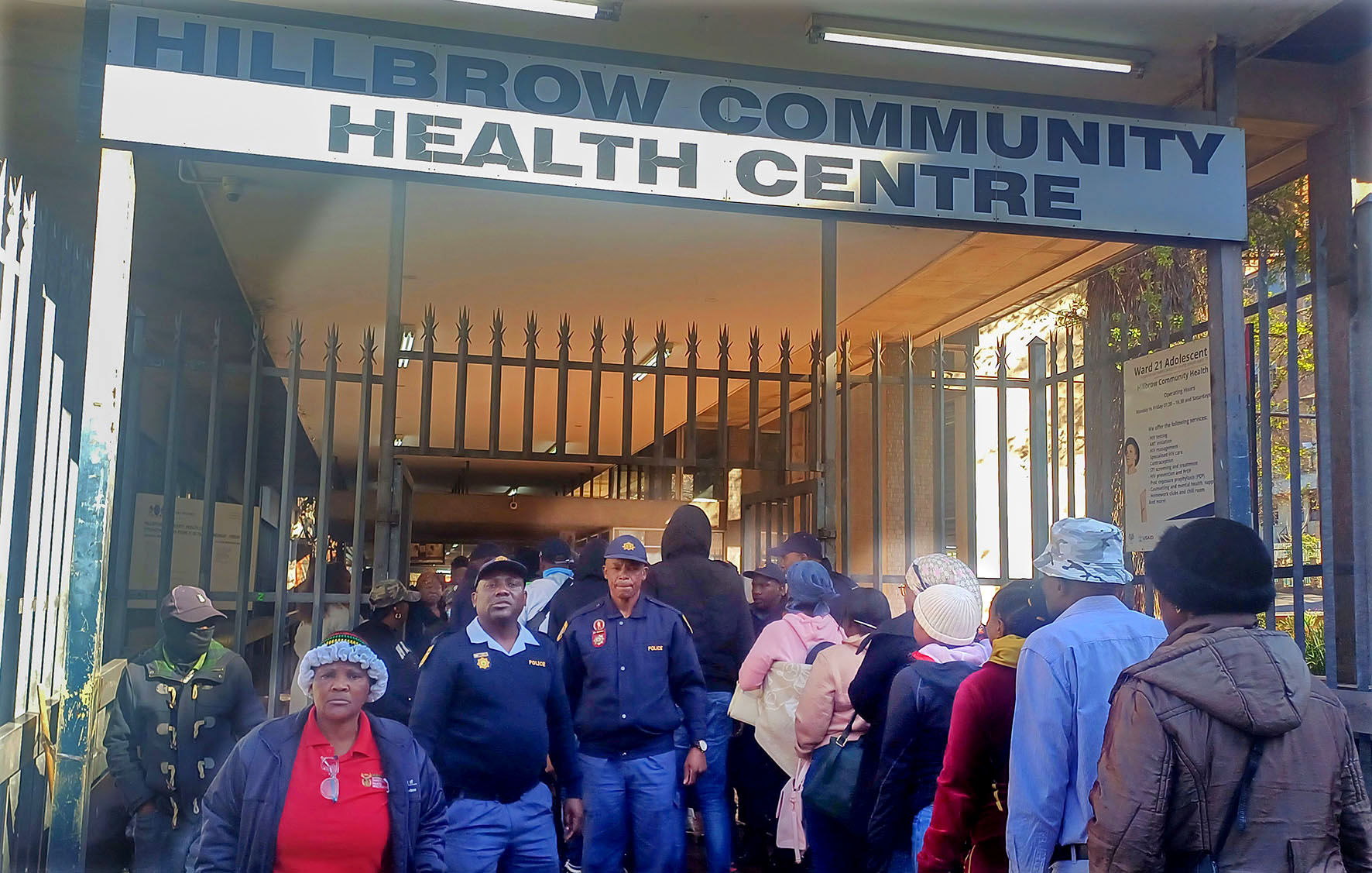
 The police intervened after Operation Dudula members prevented foreigners from entering the Hillbrow Clinic in Johannesburg on Wednesday, 25 June. (Photo: Lerato Mutsila)
 For more than a week, an asylum seeker from the Democratic Republic of the Congo, living in Durban, has been unable to get the medication his 8-year-old autistic son needs to manage his sleep problems, aggression and other behavioural symptoms of his condition.
With his supply of medication dwindling as the days go by, Tendaji (a pseudonym given to protect the asylum seeker from retaliation) said he feared for his son’s wellbeing.
“I’m trying my best, but there is nothing I can do for my son. I have less than a quarter [of his medication] left, but I can’t decrease [the dosage] to make it last. If it finishes, I don’t know what I will do,” said Tendaji.
Many African immigrants in South Africa have faced similar issues during the last couple of weeks, as members of Operation Dudula, the Patriotic Alliance and other, smaller anti-migrant groups swarmed public hospitals and clinics to stop foreign nationals from accessing healthcare.
Organising under the “Put South Africa” first banner, with claims that foreign nationals are overburdening the country’s public health system, the anti-migrant groups claim they are exercising their rights as South African citizens by stopping only undocumented migrants from seeking medical attention at public healthcare facilities.
However, section 27 of the Constitution states that everyone living in South Africa has the right to access basic healthcare services, regardless of their immigration status.
A father’s struggle for medical dignity
Tendaji’s struggles to get medication for his son make the consequences of the anti-migrant groups’ unlawful action glaringly clear: people are suffering.
Read more: New mothers denied access to Gauteng health facilities by anti-migrant groups
On 2 July, Tendaji travelled in multiple taxis with his son from his home to Addington Hospital in Durban for what he believed would be a routine doctor’s visit. However, he was greeted at the door by Operation Dudula members, who demanded to see his documentation.
“I always carry my document with me. I took out my [asylum seeker’s] document so I can show them, and they told me they are not allowing foreigners inside. I told them to look at my baby; he needs his medication. Without it, he is not going to survive; his [condition] is not going to be controllable. They did not care,” said Tendaji.
He was told to go back to his country.
“I told them I can’t go back. You think that I don’t want to go home, I don’t want to visit my family? I do, but I can’t because I’m not allowed to go back,” he said.
Tendaji said the Operation Dudula members began pushing him and threatened to beat him. He left the hospital empty-handed.
“I tried to go back the second day, but it was worse. The third day, it was worse. Now, I don’t know what to do. They block us from accessing the workplace, they even block us at home, but [doing] it at the hospital is creating great limitations for us. We are stuck, we are really stuck,” he said.
Myths about migrants and healthcare
The blatantly unlawful actions of Operation Dudula and their ilk have been condemned by several civil society organisations, the South African Human Rights Commission and the government.
However, this seems to have only emboldened the anti-migrant actions, and little has been done to prevent the members of Operation Dudula, Patriotic Alliance and smaller groups from blocking the entrances to clinics and hospitals.
/file/dailymaverick/wp-content/uploads/2025/06/1000268074.jpg "Operation Dudula members refused entry to foreign nationals at the Hillbrow Clinic in Johannesburg on Wednesday, 25 June, in contravention of section 27 of the Constitution. (Photo: Lerato Mutsila)")
Read more: Tensions rise at Hillbrow Clinic as Operation Dudula attempts to deny migrants healthcare access
They have repeatedly justified their harassment of migrants with the claim that foreign nationals are overburdening SA’s public healthcare system. However, said Sharon Ekambaram, a leading human rights activist and director at Lawyers for Human Rights, these claims are fuelled by online misinformation.
She said, “Stats SA will tell you that there are four million international migrants according to the census and the regular reporting that they do. There are fewer refugees recognised in our country as the years go by. It started with 90,000. Today it’s around 80,000. There are about 180,000 people with asylum permits who have never been able to have their claims for refugee protection processed and to be granted refugee protection in our country.”
She said the focus on migrants was a deliberate distortion of the true causes of the public health sector’s crisis, and that years of austerity and cuts to healthcare had led to overcrowded facilities, long queues and drug stockouts.
“The number of healthcare workers has been reduced. So there’s really a massive overload of work for a smaller number of people working in the public healthcare sector.
“The police, the government, the Department of Health, the Department of Home Affairs deliberately remain silent or, if not, collude because it successfully shifts away from us holding them to account for what are the real causes of the crisis in our public health sector. And that is corruption, that is mismanagement of funds at all levels,” said Ekambaram.
Orchestrated xenophobia ahead of elections
She believes the xenophobia is “being organised and orchestrated as we lead up to local government elections in 2026. We’re seeing a convergence of agendas of political parties together with what I would call reactionary forces that are coalescing around hatred, xenophobia, and othering.”
Ekambaram said decisive action was needed: authorities must issue warnings to deter such behaviour, and individuals who ignore lawful orders from law enforcement officers should be arrested.
She said that police and officials who failed to intervene were enabling these acts through their inaction. DM