



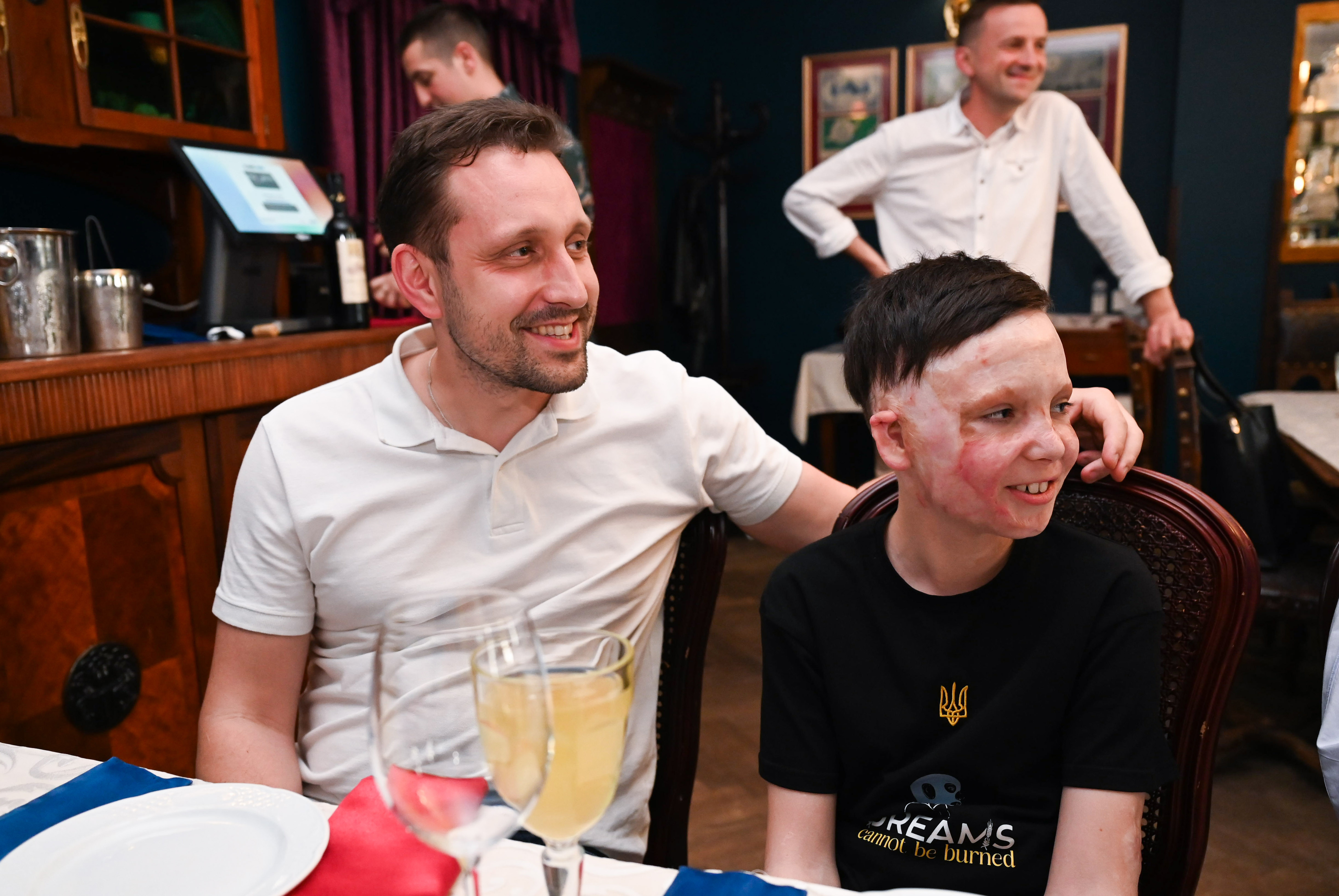
 Roman Oleksiv and his father Yaroslav. (Photo: Mykhailo Pakholiuk, MFA Ukraine)
 “Dreams cannot be burned,” says the T-shirt worn by Roman Oleksiv.
And dreams cannot be bombed, shot or otherwise obliterated either, say Ukrainians in general.
Roman has become an international symbol of Ukrainian courage and resilience. Three years ago, aged seven, he was in a shop with his mother in the city of Vinnytsia. The building was hit by a Russian missile, killing his mother instantly.
He recalls kissing her goodbye as he was pulled out of the rubble. He suffered 80% burns over his body, a broken arm, a severed muscle in his right leg and shrapnel wounds to his head, says his father, Yaroslav Oleksiv.
Roman was flown to one of Germany’s largest burn centres, Universitätsklinikum Carl Gustav Carus Dresden, which performed several operations, including many skin grafts, as well as rehabilitation.
He learned to walk again, and to dance, as ballroom dancing is his passion. He has become an international celebrity, and a film was made featuring him dancing in a mask to cover his scars.
We met him and his father at a restaurant in Ukraine’s western city of Lviv last month. He was unmasked. He said the mask became too hot, so he removed it. “When I took it off, I said ‘I believe I can fly!’” he laughed.
Ruslana Danilkina radiates similar optimism. Three years ago, after Russia attacked, she volunteered to defend her country at the age of 18. On 23 February 2023, while travelling in the Kherson district as a military communications operator, her vehicle was hit by a Russian cluster bomb, severely injuring her left leg, which had to be amputated above the knee.
She was one of the first casualties to be brought to the Superhumans Center in Lviv, which opened in April 2023. It fits military patients with prostheses and teaches them how to use the artificial body parts. It also performs complex surgery, including facial surgery, to repair war damage and provides psychological counselling to war victims and their families.
Danilkina was fitted with a prosthetic leg. Because of her quick recovery and rehabilitation, she was asked to stay on at the centre, where she is now an ambassador for Superhumans.
/file/dailymaverick/wp-content/uploads/2025/07/01645.jpg "Ruslana Danilkina. (Photo: Mykhailo Pakholiuk, MFA Ukraine)")
‘A lot to share’
She was quick to establish her positive spirit when briefing visiting African journalists last month. “Before the injury, I never wore skirts,” she said. Now she does, revealing her prosthetic left leg with an electronic knee.
“I am very active in sports. I do surfing, mountain climbing, so I have a lot to share with the patients, and I guess this is why I am here.”
She shows us the “peer-to-peer department, where there are examples of almost every injury and prosthesis, because when a patient arrives we want them to be able to relate to someone who has had the exact type of experience, and how far you can go and how much you can achieve regardless”.
Patients start their rehabilitation journeys when they are measured and customised carbon-fibre prosthesis holders are moulded to fit their bodies comfortably to connect the artificial limbs to their body by vacuum.
The more of a limb that remains, the easier the process and the greater the possible movement. Losing a leg from below the knee is relatively straightforward and does not impose too many restrictions on the patient.
Losing even one knee, “you immediately feel how life gets different and how many things are now beyond your reach. And losing both knees is considered an extremely complicated trauma.”
A patient may get a mechanical or an electronic knee, the latter for those who wish to remain more active, as she does. Some patients even return to battle.
With the electronic knee, “to take a step, you need to put pressure and just throw it.
“This is a special app that gets installed on your cellphone, and it has various modes of operation. I can run with it, I can climb the stairs, and it can get wet, like when I swim in the ocean.”
But for a patient who has lost their hip bone completely, there is no place on their body to fix the prosthesis, so it is fixed to the belt. Then walking is not just a matter of throwing the leg, as she does, but using the full force of the back and torso muscles to take just one step.
Danilkina stresses that the manufacture of the prosthesis holder is the most important part of the treatment. It has to be exact because if it does not fit the body comfortably, “the patient will not walk”.
Learning curve
With the help of equipment such as 3D printers, a prosthesis can be made in a day. But teaching a patient how to use it generally takes much longer. Danilkina says she saw one patient running on his third day, but usually it takes at least two weeks to learn to walk again; for a knee amputation, three weeks to a month; for a double knee amputation, much longer.
“Here we teach our patients to fall and get up, and how to do daily care. We teach them everything.”
We see patients walking on different surfaces, up and down slopes and navigating obstacles to get used to their artificial limbs.
Danilkina points out some patients who have lost both legs above the knee and are doing exercises on very short prosthetic legs. She explains that they are learning how to hold themselves vertically, to maintain balance and to begin to walk again, even to run, and to navigate obstacles, slopes and uneven surfaces.
Once they have learnt that, they graduate to full-length prostheses.
/file/dailymaverick/wp-content/uploads/2025/07/01082.jpg "Learning to walk again at Superhumans Center. (Photo: Mykhailo Pakholiuk, MFA Ukraine)")
Making and learning how to use prosthetic arms is a different challenge. It requires lining up the remaining active muscles in what’s left of the living arm with electronic sensors in the prosthetic arm to enable the patient to move their arm and fingers. The muscles are not physically connected to the sensors; they are pressed together so the sensors can detect and respond to the muscle movements. The more muscles that are still active in the patient, the more complex their arm and hand movements can be.
But arm movements remain restricted; the higher the amputation, the greater the restriction.
Though Danilkina is brave and resilient, determined not to allow her disability to immobilise her, she admits it is difficult. It requires constant exercise to keep her muscles strong to walk upright.
“I can swim in a pool, I can ride a bicycle, I can climb mountains, but every second of my life, regardless of all that, I feel that I am wearing a prosthesis and I feel the pain that comes with it.”
For instance, her left leg contracts from lack of exercise, which pushes it further into the prosthesis holder, and that hurts. She also experiences sharp pangs of phantom pain.
Invictus Games
She says most patients, like her, are inspired by their disabilities to achieve more in life. “We have patients who hadn’t done any kind of sports before the injury and who very recently participated in the Invictus Games.
“If a patient wants to go to a professional sport, we will get them a professional prosthesis.
“For the patients who want to return to the frontline, we provide them with high-quality electronic knee prostheses, because they need to feel very confident.”
Some patients open businesses, and the centre helps them with training and applying for grants.
Unfortunately, some patients go the other way, suffer depression and won’t use their prostheses, and some lapse into alcoholism.
“I guess looking at them made me realise that my life, my future life, depends on me and on the choices that I make. Either to live and be proactive and efficient, or succumb to weaknesses,” said Danilkina.
The Superhumans Center also performs reconstructive surgery and plastic surgery, restoring hearing, restoring faces, restoring arms and legs in often complex procedures. Recently, for instance, the surgeons transplanted part of a patient’s leg bone into his jaw.
Superhumans has also opened a centre in the city of Dnipro in the east of the country and will open a third one in Odesa to the south, on the Black Sea, by the end of 2025.
It receives no government funding, raising money through donations at home and abroad. Its major funder is the US philanthropist Howard Buffett.
The Lviv centre has fitted more than 2,000 prosthetic limbs to about 1,000 patients (who mostly have needed more than one), but this is only a fraction of the need for prosthetics, which is also partly met by other private and government prosthetic facilities.
Because it is relatively far from the frontline, Lviv has become a major humanitarian centre for those fleeing the war or recovering from it.
Mayor Andriy Sadovyi explains that the Superhumans Center is part of an “unbroken ecosystem” that Lviv is building to support war victims. Its hub is the rehabilitation centre, which comprises a prosthetics workshop, a rehabilitation facility for those who have lost limbs in the war, and treatment centres for victims of torture and those requiring psychological healing.
It also includes the main municipal hospital, which has treated 19,000 war wounded; a children’s hospital; a centre for those who have survived occupation, capture and torture; housing for those internally displaced by the war; and arts and sports facilities.
/file/dailymaverick/wp-content/uploads/2025/07/02340.jpg "Lviv Mayor Andriy Sadovyi. (Photo: Mykhailo Pakholiuk, MFA Ukraine)")
Humanity unbroken
With French government funding, Lviv is building a new line on its tram network to connect the complex to the city centre.
“This together is an ecosystem of humanity unbroken,” said Sadovyi, noting that the city of Lviv reserves 20% of its budget for buying equipment for Ukraine’s military and has provided special grants for Ukrainian companies to manufacture equipment such as drones.
For all the hopeful rehabilitation and recovery, though, the death toll of Russian President Vladimir Putin’s relentless war against Ukraine continues to rise.
/file/dailymaverick/wp-content/uploads/2025/07/01942.jpg "Lychavik cemetery, where Lviv buries its sons and daughters killed in the war against Russia. (Photo: Mykhailo Pakholiuk, MFA Ukraine)")
Sadovyi says he attends a funeral of one of Lviv’s sons or daughters every day, most of them buried in the rapidly expanded new section of the historic Lychakiv Cemetery dedicated to those who have fallen in the war against Russia, adjacent to the graves of the dead of Ukraine’s many earlier wars.
When we visited in June, one hour after the last funeral, 1,104 men and women had been buried there. Grieving, tearful relatives tended the graves.
This part of the cemetery was still unfinished and looked like an empty lot, although the architect’s pictures show the gracious, sweeping lawns and terraces of how it will eventually look. DM
Peter Fabricius was visiting the Czech Republic, Poland, Ukraine and the European Union on a journalists’ study tour sponsored by those three governments.