




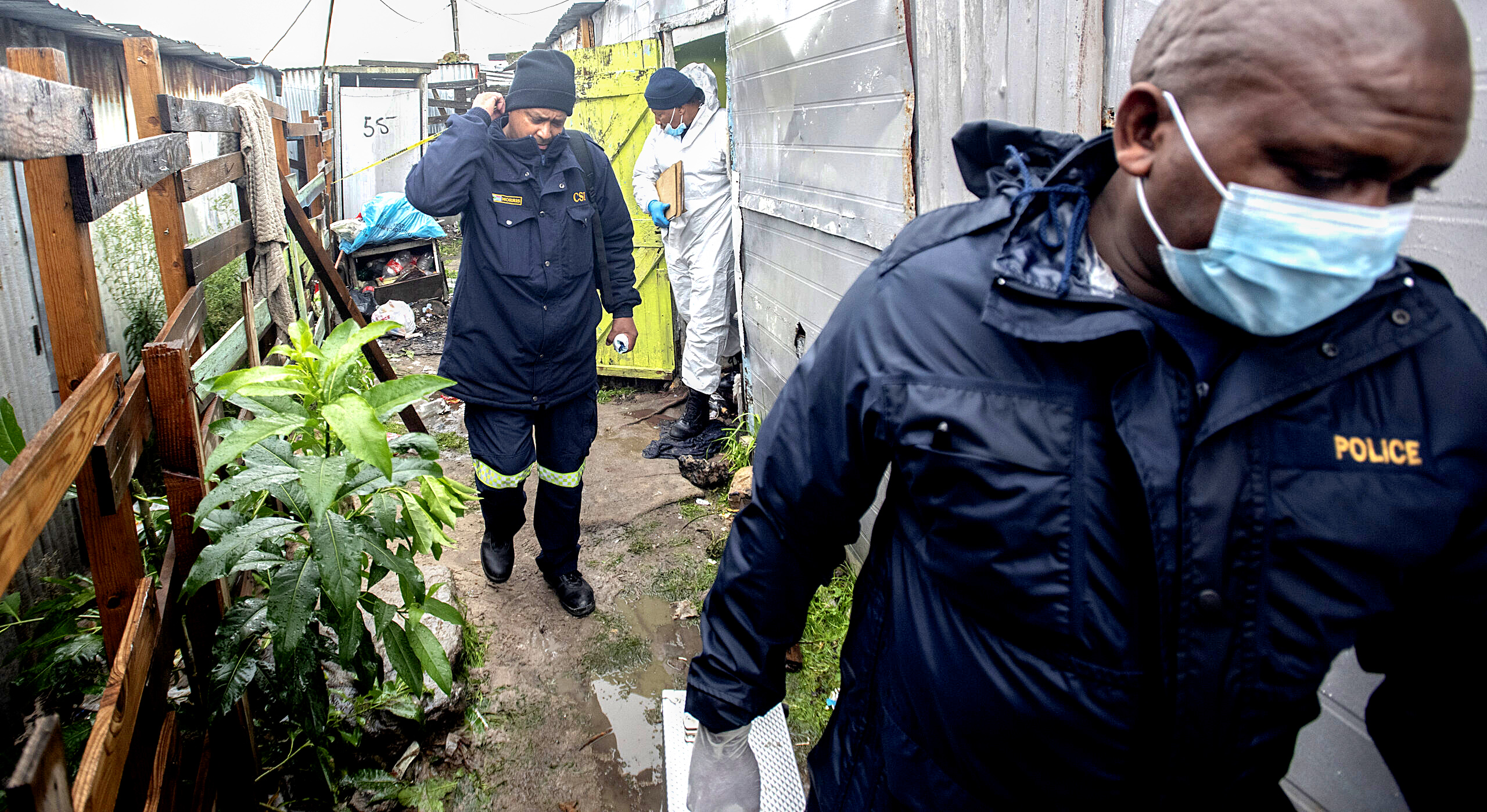
 The crime scene in Gugulethu's Kanana informal settlement where seven men were gunned down on 28 June. (Photo: Brenton Geach / Gallo Images)
 Three people gunned down inside a shack in the Covid informal settlement in Mfuleni. Five people shot dead in gang violence in Mitchells Plain. Seven people fatally shot in Gugulethu.
Mass shootings have become common in Cape Town.
Crime statistics for the fourth quarter of the 2024/2025 financial year — from 1 January to 31 March 2025 — highlight the prevalence of illegal guns in these mass shootings.
In that period, Western Cape police registered 57 dockets for multiple murders, in which 123 people died. That included 50 incidents with two victims, six incidents with three victims and one incident with five victims. During the quarter, a total of 1,068 murders were recorded.
At the announcement of the statistics, Police Minister Senzo Mchunu said firearms were the most frequently used murder weapons, followed by knives. He said one of the police’s priorities was the eradication of illegal firearms and the tightening of controls over legally owned firearms.
After a mass shooting on Saturday, 28 June in Gugulethu’s Kanana informal settlement, which claimed eight lives, Mchunu described the Cape Flats as the “killing fields” of the Western Cape.
He said police top brass must refuse “to treat this as a normal trend and keep the normal methods of policing in place. This turn of events is ugly and poses fundamental questions on the safety of people in that area.”
Anroux Marais, the Western Cape MEC for police oversight and community safety, said, “The recent mass murders we’ve seen in Cape Town over this past period are very alarming and speak of a bigger issue that I have tirelessly voiced publicly since I assumed office.
“The proliferation of illegal guns and ammunition is fuelling these killings. More needs to be done to rid our communities of illegal firearms and ammunition.”
Latest mass killings
The most recent mass shooting in Cape Town was on Saturday, 5 July, when three people were gunned down inside a shack in the Covid informal settlement in Mfuleni.
On Thursday, 3 July, five people were killed and seven wounded in different shooting incidents in several parts of Mitchells Plain. Fourteen suspects aged between 20 and 39 were arrested in connection with the murders and attempted murders. The shootings are believed to be linked to an ongoing turf war in the area.
Read more: Fourteen suspects arrested for Mitchells Plain gang shootings that left five dead, seven injured
In Kanana on Saturday, 28 June, at around 3.30am, police officers discovered the bodies of seven men, all with gunshot wounds, while another died of his injuries later.
Two days later, Lungile Anthony Madolo was arrested and charged with murdering Vuyolwethu Makongo, Siyanda Thongana, Afezile Thongana, Hlomla Thongana, Somile Vithela, Luyolo Zoneleni, Loyiso Jezile and Phumlani Zoya.
/file/dailymaverick/wp-content/uploads/2025/07/Gugulethu-2.jpg "Lungile Anthony Madolo faces eight counts of murder. (Photo: Supplied / SAPS)")
/file/dailymaverick/wp-content/uploads/2025/07/Gugulethu-1.jpg "Police are looking for Loyiso Matinisi in connection with the mass shooting in Gugulethu on Saturday, 28 June.(Photo: Supplied / SAPS)")
On 15 June, Western Cape police confiscated 24 firearms and 371 rounds of ammunition, including an AK47 assault rifle and a shotgun, during a crime prevention operation.
Organised crime
Claire Taylor, a researcher at Gun Free South Africa, said mass shootings stemmed from multiple factors, the most common of which was organised crime. She said gang warfare, taxi violence and extortion were all forms of organised crime.
“Gun availability directly enables and multiplies criminal activity. Guns are seven times more lethal than other weapons, making reduced gun availability essential to preventing mass shootings and gun violence generally,” said Taylor.
Criminologist Dr Guy Lamb, a lecturer at Stellenbosch University, said one of the root causes of mass shootings in the Western Cape was competition between organised crime groups.
“Firearms and very easy access to ammunition enable mass shootings to take place, so you have, in this kind of context, a fair number of firearms that are available to individuals within these different groups that engage in mass shootings. More importantly, there seems to be very easy access to ammunition, so that enables multiple shootings,” he said.
Read more: SA government is losing 1,800 firearms a year to criminals
David Bruce, an independent researcher and consultant at the Institute for Security Studies, said mass shootings would be reduced if illegal firearms were not widely available.
However, he said, “Mass shootings are only the tip of the iceberg in terms of firearm crime. Data on multiple killings (incidents where two or more people are killed) indicates that they account for 9% of murder victims in South Africa. Eighty percent of these incidents involve two deaths; incidents where three or more people are killed account for about 2% of murder victims in South Africa.”
What interventions are needed?
Taylor said that while effective policing and crime intelligence were critical to address shootings, “the priority must be reducing firearm accessibility as a core component to addressing organised crime in SA. Gun availability directly enables and multiplies criminal activity.”
Two critical interventions were required, she said. The first was recovering illegal firearms through intelligence-led policing (rather than ineffective stop-and-search operations), with all recovered firearms traced to identify where they originated.
The second intervention involved preventing legal firearms from entering criminal circulation.
“Since most illegal guns were originally legal, upstream prevention is essential. This requires strengthened controls over legal gun stocks through … regular audits, closing licensing loopholes and ensuring proper gun destructions,” she said.
Read more: Precision policing — a vital element of reducing firearm crime in South Africa
Lamb agreed: “If ammunition was in short supply, we wouldn’t have seen as many mass shootings taking place.”
He said several measures could be implemented.
“One is that police are pursuing operations that look to reduce the availability of guns by confiscating and seizing weapons that are illegally held, through high-density operations such as Operation Shanela.
“Part of the problem is we need to work more around where the firearms are coming from. There is a need to tighten up firearm registration issues around civilian firearm owners, because they are the most at risk of having their firearms stolen from them,” said Lamb.
He said there had been a problem in the past of firearms going out of police armouries and into criminal hands, and there was a need for an overhaul of how police armouries were managed.
Bruce said the police needed to implement an integrated firearm crime reduction strategy.
“It should be possible to use data on firearm crime in a far more sophisticated way. This should enable the SAPS to identify and arrest those responsible for firearm crime, and to stop the supply of illegal firearms.
“It makes much more sense to focus on firearm crime as being the main underlying element of various types of crime, including gang violence, taxi violence and mass killings. Though most robberies are probably not linked to the use of firearms, there are many firearm robberies. Where robberies turn lethal, this is mainly linked to the use of firearms,” he said.
Government’s response
Police Minister Mchunu said the mass shootings in Cape Town underscored the urgent need to address deeply rooted familial conflicts and improve community engagement.
In September last year, Mchunu signed a cooperation agreement between the Eastern Cape provincial government, the Nelson Mandela Bay Metropolitan Municipality and the South African Police Service, stating that it marked a critical milestone to enhance safety and security in communities.
Following this was a cooperation agreement to fight crime in Cape Town, which supposedly marked a departure from the public spats over policing in a city that makes headlines for high levels of gangsterism and extortion-related violence.
Meanwhile, in ongoing efforts to deal holistically with serious violent crime incidents in Cape Town, a multidisciplinary policing approach is proving effective.
When asked what could be done to prevent mass shootings, the Western Cape government’s Marais said: “More boots on the ground definitely helps to deter criminality and reduce occurrences of violent crime and murder.
“This is evident in the consecutive decline in the murder rate, especially in our gang priority areas where our Law Enforcement Advancement Plan [Leap] officers are deployed. Leap is the Western Cape government’s flagship programme in our efforts to reduce violent crime and murder. Leap serves as a valuable force multiplier to the South African Police Service, adding an additional 1,000 boots on the ground on any given day.
“They have been successful in confiscating large quantities of unlicensed firearms and ammunition since inception. These actions directly contribute to the measurable decline in murder rates across the Western Cape.” DM