




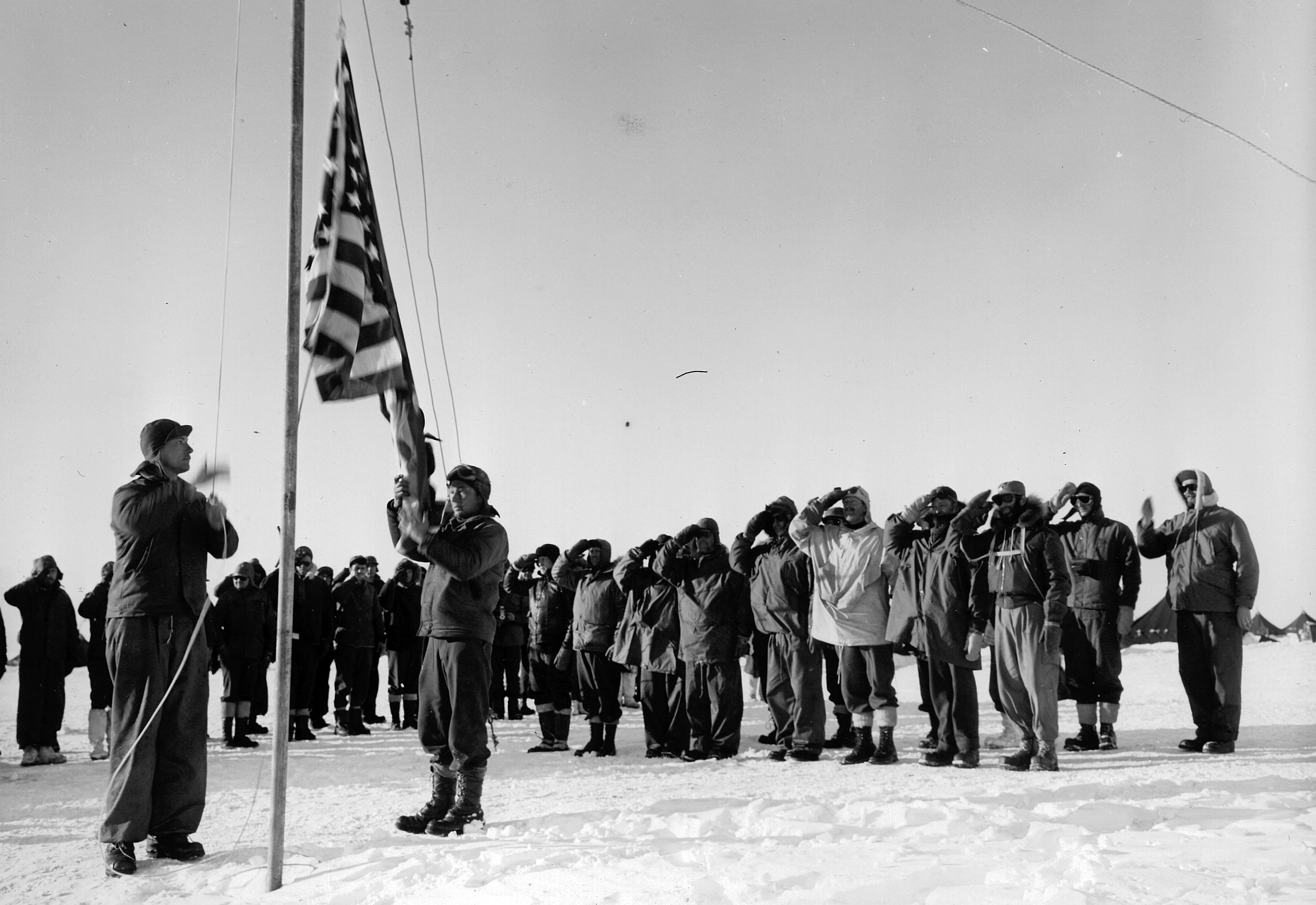
 The US navy salutes the nation’s flag during “Operation High Jump”, the
1946-47 Antarctic expedition led by Rear Admiral Richard Byrd. (Photo: US Navy / USAP Photo Library / Public domain)
The US navy salutes the nation’s flag during “Operation High Jump”, the
1946-47 Antarctic expedition led by Rear Admiral Richard Byrd. (Photo: US Navy / USAP Photo Library / Public domain) Washington was, for decades, the seemingly implacable keystone of Antarctic governance. But the US delegation failed to table a single discussion paper at the 47th Antarctic Treaty Consultative Meeting (ATCM).
The Milan-hosted meeting — which deliberated the future of Antarctic science, conservation and tourism projects — was held between 24 June and 3 July.
But the meeting is also about geopolitics, a continent carved up into territorial slices larger than Greenland. And it’s about managing the expectations of the influential countries who made those claims, which remain frozen under the treaty.
This dramatic drop in engagement — from contributing over 10% of working and information papers at the 2024 ATCM in India, to offering only the depository-state procedural note in 2025 — seems to mark a striking collapse in US participation in Antarctic diplomacy.
Answers to our request for comment were not received by the deadline on Tuesday, 8 July.
Virtuoso to metronome
“It has tabled only one paper. That paper is the one it tables every year as the depository, the responsible state for the 1959 treaty and the Madrid Protocol,” said Professor Alan Hemmings, an Antarctic governance expert at Canterbury University in New Zealand. “This is done by a very professional part of the State Department for all the treaties for which the US is depository.”
The meeting document database, locked during the Milan ATCM, flushes out what had been feared by observers ahead of the event. The US registered late and offered little more than that.
“If you want a comparison,” Hemmings proposed, “at last year’s ATCM in India there were something like 249 main papers, working papers or information papers. The US was contributing more than 10% of the total significant diplomatic papers for the ATCM.”
Today there are 29 treaty signatories with vetoes at the decision-making table. To get there, you’re meant to do a lot of science. But — once you’re there — there is no legal obligation to keep doing a lot of science (there is also no agreement on what a lot of science is). Those signatories include Australia, China, Germany, the UK, Russia and South Africa.
/file/dailymaverick/wp-content/uploads/2025/07/US-South-Pole-station-2018.jpg "The US station at the South Pole, 2018. (Photo: Mike Lucibella / USAP Photo Library / Public domain)")
Watch: Antarctica’s Precipice — Reimagining the South Pole without US Commitment
In a webinar hosted by Daily Maverick ahead of the tightly sealed, closed-door meeting in the Italian fashion capital, Hemmings had warned of looming US dysfunction in the world’s most prestigious scientific pact. With just two weeks to go, he said, he had heard from “a considerable number of people” that the US had only just confirmed its delegation. Its agenda papers had been a no-show.
Now available for public scrutiny, the meeting database confirms that Hemmings, a working scientist and academic in Antarctica since the early 1980s, was correct.
The delegation had also not secured a bureaucratic green light essential to engaging meaningfully in treaty talks.
“It had not got the sign-off for its brief. So, what it is able to do without that is not at all clear,” he suggested at the time.
Perpetual dissonance
Hemmings highlighted “chaos” stemming from the Trump administration’s faltering approach to polar science, suggesting that the apparent dysfunction had trickled down to treaty preparations.
“On a positive note, there’s a degree of consistency here,” Hemmings quipped. “There’s a sort of chaotic approach in relation to ice-strengthened and ice-breaking vessels.
“There’s obviously chaos in relation to the administration’s approach to science generally, including polar science in both polar regions, but significant in the Antarctic as well.”
/file/dailymaverick/wp-content/uploads/2025/07/AntarcticaMeeting2025.jpeg "The treaty’s environmental protection committee meets ahead of the main opening plenary in late June. (Photo: Antarctic Treaty Secretariat X account)")
Asked why Donald Trump’s 2026 financial year budget request seeks to cancel the lease for the Nathaniel B. Palmer, the only back-up to the Antarctic icebreaker Polar Star, fellow webinar panellist Professor Klaus Dodds noted “you’ve got to find some third-party leasing pretty jolly quickly or else you’re going to be in trouble in terms of supporting your polar programme”.
The Royal Holloway, University of London, geographer is an expert in Antarctic geopolitics.
“You can't do these things on the fly,” Dodds pointed out. “And my fear is that this is all part of engineering crisis, chaos and havoc. Of course, it then ushers in further cuts and reductions and you somehow blame it on those who’ve been given a terrible legacy to deal with.”
‘Ghost in the machine’
The discussion documents submitted ahead of the meeting may now be public. However, the minutes of the live closed-d0or talks will likely only be viewable in a few months.
Perhaps more worrying than delegation’s flagged meeting performance is its reported disengagement from the treaty’s intersessional period — the months between formal meetings where much of the substantive negotiation and collaboration occur.
According to Hemmings, “the US has been largely absent from the intersessional discussions since the last ATCM”.
Thus, a Western leader of the Antarctic Treaty System effectively absented itself from shaping the continent’s future over the past year.
The academic described the US as a “major player in the history of the ATS” — and now a fading “ghost in the machine”.
‘Poisoned chalice’
Several factors appear to have converged to produce this diplomatic snafu.
As Hemmings noted, the delegation in Milan was likely smaller than usual and stripped of its long-standing NGO participants — including, reportedly for the first time in nearly three decades, representatives from the International Association of Antarctica Tour Operators (Iaato).
Even the top US officials attending were relatively new to their leadership roles.
Head delegate Ona Hahs, a lawyer by background, was only attending her second ATCM. The new US representative to the Committee for Environmental Protection (CEP) was doing so for the first time.
“These kinds of transitions happen,” Hemmings acknowledged, “but in addition to all these other problems, there are these new people who have been given a poisoned chalice.”
/file/dailymaverick/wp-content/uploads/2025/07/First-treaty-meeting-1.jpg "Opening day of the first consultative meeting of the Antarctic Treaty, initiated by the US. It was held in Canberra, Australia, in 1961. (Photo: ATS Image Bank)")
Missing section at the ‘higher levels’, sagging symphony
Sustained disengagement by the US threatens to weaken the balance of power within the ATS.
President Joe Biden’s former Antarctic policy chief, William Muntean pointed out that “no new administration has Antarctica high on its to-do list”.
Yet, “previous new administrations have allowed professional Antarctic experts to meaningfully engage on Antarctic issues.
“By submitting no papers to the ATCM, it appears that the higher levels of the US Department of State were concerned enough by routine action to block that normal engagement, but not interested enough to provide alternative positions.”
Pianissimo on purpose: ‘At the mercy of other countries’
Now an analyst with the Center for Strategic and International Studies, Muntean argued that the absence of papers did not mean the US no longer supported the treaty or Antarctica.
“However, if the US does not shift its Antarctica policy into gear, it will remain adrift and lose influence in the region and the ATCM, which will leave advancing its interests at the mercy of other countries.”
According to a preliminary paper on 2025 Antarctic research trends — led by the University of the Arctic — China is now the world leader in south polar science.
“There’s a considerable lowering of expectations,” Hemmings added. “Good people hope the US doesn’t try to say very much. And that tells you everything …
He noted that “so many” officials were “anxious about not attracting the attention of people higher in the administration”.
This year, silence may have passed.
“For now the US can get away with this,” Hemmings said. “What will it be like next year?” DM