



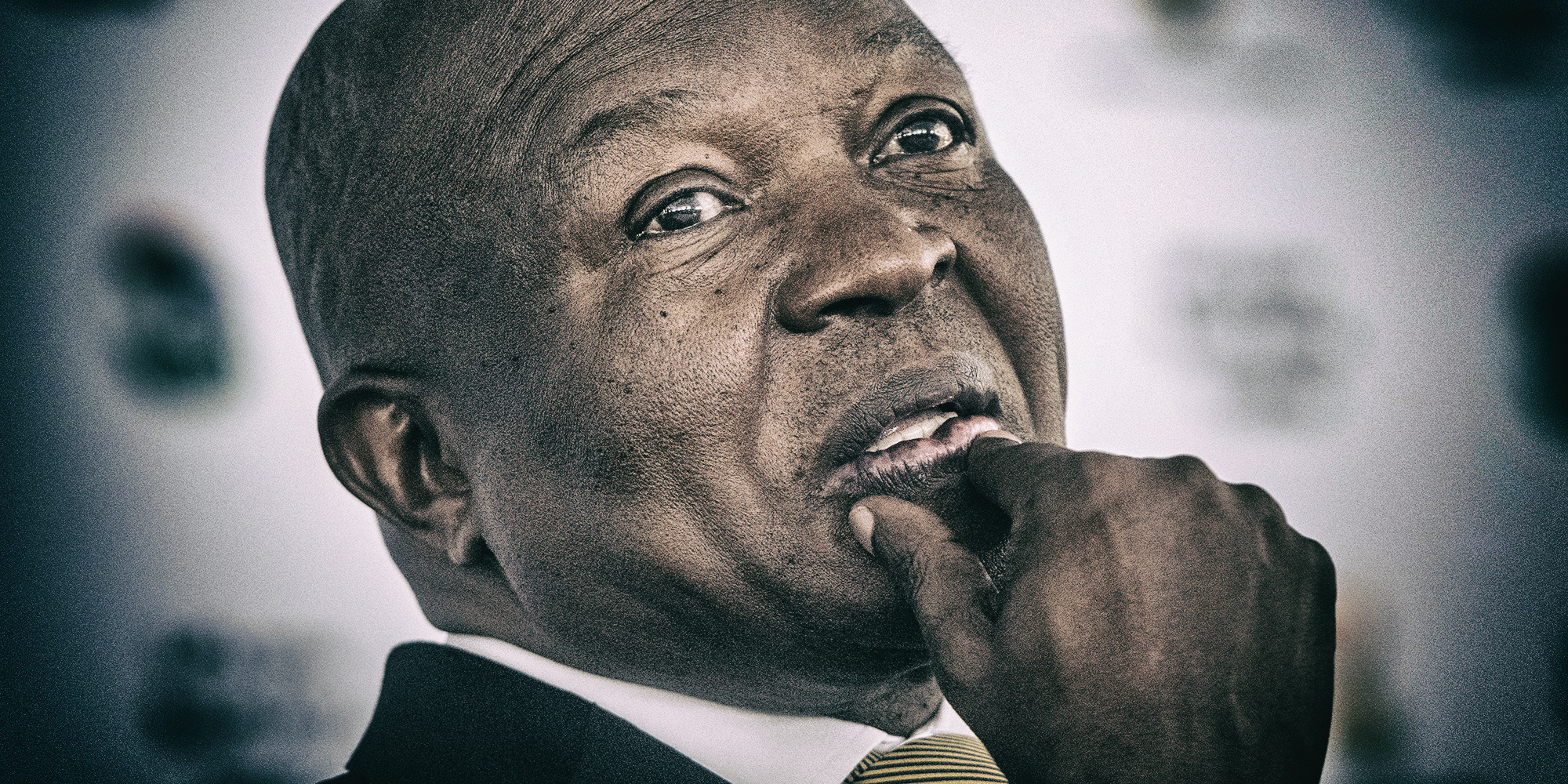
 Former deputy president David Mabuza died on 3 July 2025. (Photo: Gallo Images / Brenton Geach)
 South Africa’s former deputy president David Mabuza has died at 64 years old in Mpumalanga after a short illness, President Cyril Ramaphosa announced on Thursday, 3 July 2025.
As deputy president to Ramaphosa until early 2023, Mabuza left no particularly remarkable legacy that is publicly and widely acclaimed.
But Ramaphosa praised his “leadership and mobilisation abilities in his role as the Leader of Government Business in Parliament; leading the South African National Aids Council (and) coordinating anti-poverty initiatives”.
Ramaphosa also praised Mabuza’s lifelong activism: he was a student activist with the Azanian Students Organisation (Azaso) and later became a teacher in what would later become Mpumalanga. The province is where his political life is written as premier and where he rose to national prominence.
Herein lies his true political obituary too. Mabuza excelled as a political entrepreneur and provincial boss, building a foundation for what he hoped would eventually propel him to the Union Buildings as president.
For a while, it looked like that would happen, but Mabuza died defeated by the very political chess game he was once master at.
Read more: Ramaphosa confirms death of former deputy president David Mabuza, aged 64
A teacher by profession, Mabuza perfected the art of power politics once the ANC came to power and when provinces became fiefdoms for regional politicians. With unprecedented access to provincial fiscal capital, he, along with the Free State’s Ace Magashule and the North West’s Supra Mahumapelo, turned this capital to power and the three became what was known as the Premier League of the ANC.
Because constituencies in the ANC are crafted by how many branches are built at ward, regional, district and provincial structures, the more you blow up branches and sign-ups, the greater your power.
Mabuza clicked to this and ballooned the relative ANC backwater province to its second largest after KwaZulu-Natal, thus propelling himself into a national power-broker position in the party. He was reverentially called “DD” by his comrades who were in awe of his money, power and tactics as a different culture gripped the ANC once it fell victim to the sins of power and incumbency.
It mattered nothing to his admirers and those who emulated him that the province was beset by the grand corruption that would later become known as State Capture for the entire time he was premier from 2009 to 2018.
Mpumalanga is now a beautiful basket case, as are the Free State and North West, all testimony to how the Premier League refashioned their stewardships for mass extraction and enrichment that has never yet properly been tallied. The outcomes are however clear in the development deficits in the hinterland where all the provincial fiscal transfers should have made more meaningful dents in rural poverty.
Mabuza seemed untouchable despite multiple scandals, thus earning him the moniker “The Cat”. He claimed an assassination attempt or attempts and was treated in Russia for alleged poisoning 10 years ago and then again in 2021, according to reports.
It would fill many pages to go into full detail of what his political reign is renowned for. As an education provincial minister in 1998, the province suddenly grew its matric pass rate in utterly implausible multiples from 51% to 72%. This earned it the moniker “Mamparalanga” for the wool that the politicians tried to pull over the country’s eyes.
Political assassinations of whistle-blowers started in earnest in Mpumalanga in the run-up to the 2010 World Cup when corruption around the Mbombela Stadium construction cost. In 2009, a substantial amount of cash (between R4-million and R14-million) was stolen from Mabuza’s home in a crime not yet fully explained.
In 2018, the New York Times published a long-form investigation into school building corruption in the province. The businessman Fred Daniels has campaigned for more than a decade, alleging Mabuza used his position to usurp land by organising sham protests and occupations. The list goes on and on.
The most devastating account of Mabuza’s reign as Mpumalanga premier is by the journalist Sizwe Sama Yende who covered most of the late politician’s time in office. He writes in the book “Eerie Assignment” about the growth of political assassinations and the climate of fear that gripped the place. Sama Yende himself faced an attempted hit.
Mabuza contested and won the deputy presidency by throwing in his lot with the reformist Ramaphosa in 2017, who, with The Cat’s support, then trounced Nkosazana Dlamini-Zuma, an RET (radical economic transformation) candidate. Mabuza changed his game as his big prize — the Presidency — came into view. He became a more conventional politician, sometimes even showing statesmanlike qualities.
The deputy president was loyal to Ramaphosa, taking on assignments with performative diligence if without political enthusiasm — he was also ill for a large part of his tenure. But Mabuza wasn’t cut out for straight-up governance and seemed to thrive instead in the cloak and dagger of regional politics.
His desire for the top job was cut short by a campaigning Paul Mashatile who became ANC deputy president in 2022, leaving Mabuza an also-ran. Mabuza quit soon after, returning to his Mpumalanga farm. His family foundation is well known for its philanthropy and support for differently abled people.
David Dabede Mabuza was born in Phola, Mpumalanga, on 25 August 1960 — he died on 3 July 2025 and is survived by his wife Nonhlanhla Patience Mnisi and his children. He served as South Africa’s deputy president from February 2018 until his resignation in February 2023. DM