




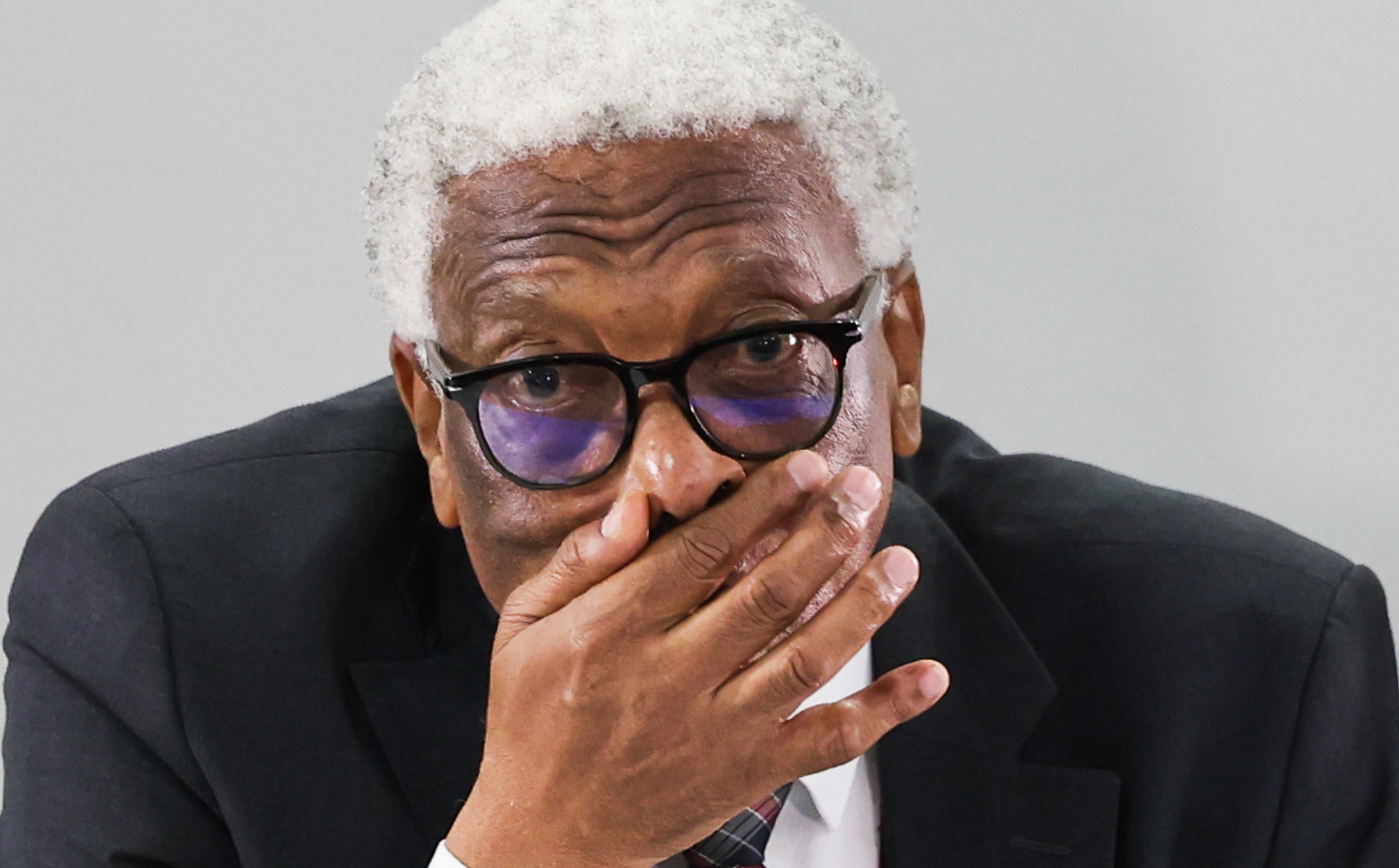
 Eastern Cape Judge President Selby Mbenenge at his Judicial Conduct Tribunal hearing on 3 June 2025. (Photo:Gallo Images / Lubabalo Lesolle)
 When forensic, legal and linguistic expert Dr Zakeera Docrat testified at the Judicial Conduct Tribunal of Eastern Cape Judge President Selby Mbenenge in May, her qualifications – a BA Hons (cum laude), a LLB MA (cum laude) and a PHD from Rhodes – were vigorously interrogated by Mbenenge’s legal team.
At stake that day was the interpretation of emojis sent between Mbenenge and Andiswa Mengo, a court secretary, in a series of messages between June 2021 and November 2022.
The 64-year-old Mbenenge has not denied the “relationship” with Mengo and has remained insistent it was consensual.
Tribunal president, retired Judge Bernard Ngoepe, has opened a new frontier during this landmark inquisitorial process, including the surgical excavation of the semiotics (meaning) of emojis used by both parties in this matter.
Read more: Judge’s sexual harassment hearing pits the old guard against a brave new world
In September 2023, a three-judge panel of the Judicial Conduct Committee (JCC) ruled that there was a prima facie case to be made of gross misconduct against Mbenenge, which, if confirmed, could lead to impeachment.
Mengo, 41, lodged the complaint with the JSC in January 2o23. Mbenenge was placed on special leave.
The tribunal investigation began in January this year. The communications between the two consisted of WhatsApps using emojis, photographs (some of which were deleted), as well as communication in isiXhosa.
/file/dailymaverick/wp-content/uploads/2025/05/GroundUp-Mbenenge-sex-emojis.jpeg "Dr Zakeera Docrat gives evidence at the Judicial Conduct Tribunal in May 2025. (Photo: Office of the Chief Justice)")
When is a peach a peach?
When is a peach a peach and an eggplant an eggplant? What does the ear with the hearing aid mean, or the dripping syringe?
Back in May, advocate Muzi Sikhakhane, representing Mbenenge, seemed surprised to learn late into her expert testimony that Docrat spoke isiXhosa fluently and was thus able to read and understand the messages she was asked to testify on.
Sikhakhane had told Docrat that his team planned to bring their own expert.
And so on Wednesday, Dr Vincent Mello, who has a doctorate from Unisa and is a member of the Unicode Consortium, which aims to standardise emoji coding, testified. He said he was an “independent” operator who worked for various companies, which he declined to name.
Unicode, Mello told the tribunal, is what enables a device to select from around 3,600 emojis, and their code, for messaging platforms to facilitate quicker communication.
How deep is your love?
If Docrat’s evidence to the tribunal was 3D in depth, scope and nature, Mello’s expertise was code-deep, bottom floor – looking at the architecture that holds the code.
Read more: Judicial Conduct Tribunal highlights contested gendered and cultural understandings of emojis
Docrat had testified that Mbenenge’s use of a banana, peach, eggplant and dripping syringe emojis had “sexual connotations” and had indicated that he had wanted to be intimate with her.
“This was not a discussion about vegetables,” she replied at some point, concerning the peaches and eggplants.
Docrat testified that Mbenenge’s advances were, in her opinion, unwanted, and Mengo’s responses – often featuring “hysterical laughing” and “embarrassed monkey” emojis – were because she did not know how else to react, as he was her boss.
 Mechanical code
Mello methodically and mechanically went through the evidence he had prepared, addressing the technological architectural code involved. He informed the tribunal that he also used Emojipedia as a resource.
“When you type the word ‘running’, for instance, you will be given the option of choosing an emoji of someone depicted as running,” he said.
Later, during cross-examination by evidence leader advocate Salomé Scheepers, Mello was asked to do exactly this on a phone other than his own. When the emoji failed to reflect, he agreed that not all applications or versions allowed for this.
He said he had observed the use of emojis on “approximately” 189 occasions in this matter, including “rolling on the floor laughing”, the “see no evil monkey”, the “winking face”, “the thinking face”, “the flushed face”, “winking face with tongue”, “squinting face with tongue”, “eyes”, “folded arms”, “raising hands”, “crossed fingers”, “face palm”, “smiling face with halo”… on and on he went, counting each time Mbenenge or Mengo used one.
He said Mbenenge had used emojis 97 times while Mengo had done so 69 times. When asked about the peach and the eggplant, which he had not yet highlighted, he replied, “The peach would be the bum and the eggplant the male private part.”
This kind of talk is mild considering some the descriptions that have been put before the tribunal, including that Mbenenge had allegedly also pointed to his erect penis in his trousers on one occasion, allegedly saying, “You want to suck it?”
Mello agreed that he could not testify on the deeper meaning people attached to standardised emojis and that he did not have any forensic legal linguistic expertise to do so.
He also acknowledged that he had not published any research that had been peer-reviewed, that anyone could join the Emoji Consortium, and all they had to do was pay a membership fee.
He also told the tribunal that he conducted his research out of interest in this bold new technological frontier.
The tribunal continues. DM