




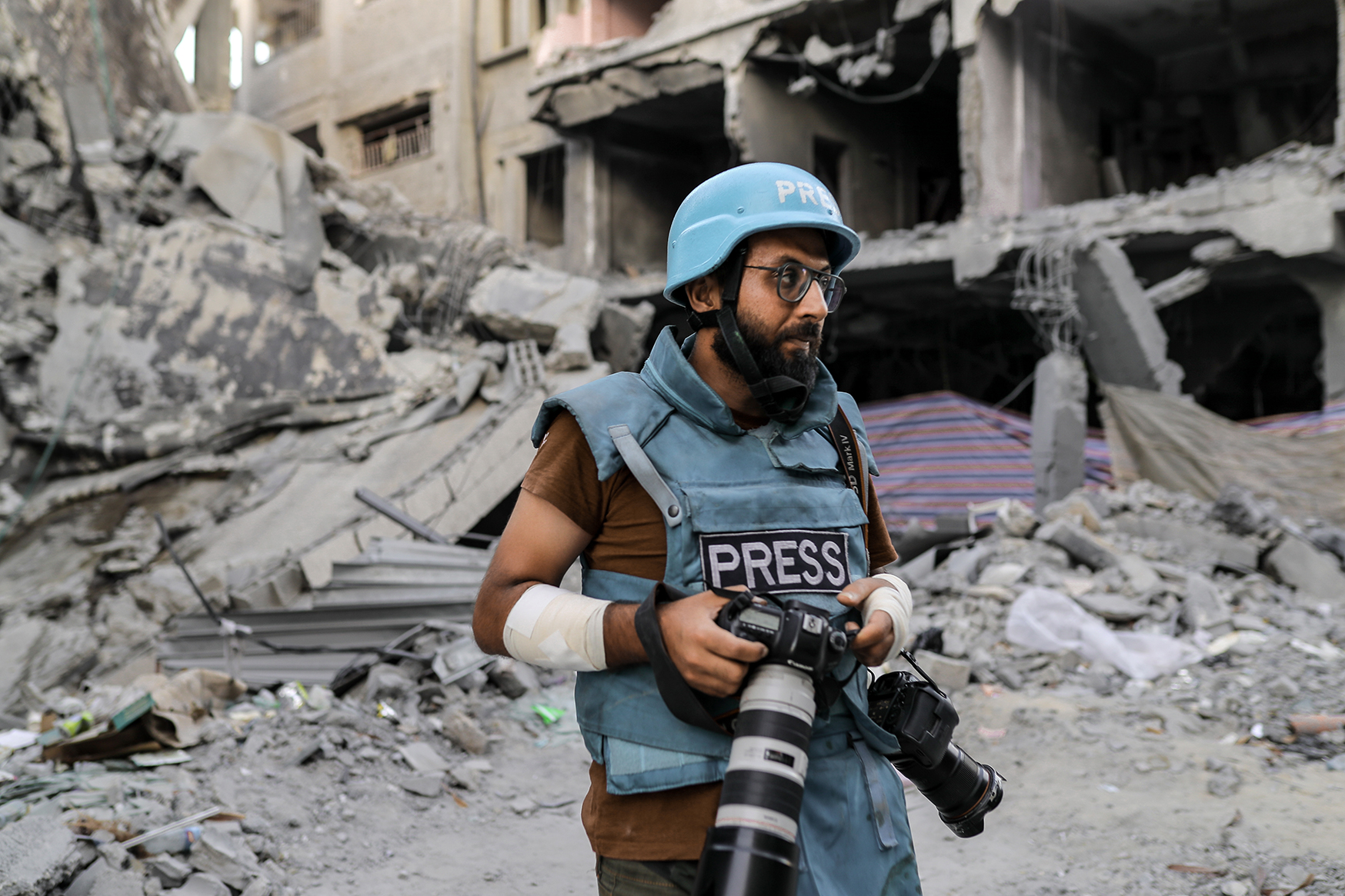
 Palestinian photojournalist Belal Khaled spent 300 days recording the devastation wrought by Israel in the Gaza Strip. (Photo: Supplied / Belal Khaled)
 Please note some of the images may be disturbing for sensitive readers.
“I was always thinking … maybe I’m going to lose my life, maybe I’m going to get injured. Maybe I’m going to lose my house, my family… All of these risks came to my mind, because we are human before we’re journalists.”
These were the words of Belal Khaled, a Palestinian photojournalist who spent 300 days documenting the devastation wrought by Israel’s attacks on the Gaza Strip in the wake of the 7 October 2023 Hamas assault on Israel that killed 1,200 people and saw 251 taken hostage. Since then, Israeli forces have killed more than 55,000 Palestinians in the Gaza Strip, according to the Palestinian Ministry of Health in Gaza. This includes a large number of journalists working on the frontline.
Political leaders and activists in South Africa and other countries have condemned Israel’s actions in Gaza as genocide against the Palestinians. South Africa has brought a case against Israel at the International Court of Justice for alleged violations of the Genocide Convention.
/file/dailymaverick/wp-content/uploads/2025/06/DSC02100-copy.jpg "Palestinians grieve as they receive the dead body of a relative from the morgue of Nasser Hospital in Khan Yunis, Gaza on 25 December 2023. (Photo: Belal Khaled / Anadolu via AFP)")
/file/dailymaverick/wp-content/uploads/2025/06/AH4I6356.jpg "An injured boy cries at a hospital as the Israeli attacks continue in Deir Al-Balah, Gaza on 7 November 2023. (Photo: Belal Khaled / Anadolu via AFP)")
Read more: Middle East crisis
For Khaled and his colleagues, every day of work has meant confronting the real possibility of injury or death. However, he said, this never stopped him from heading out into the field.
“If we’re thinking about this risk and we take a step back, no one in the world will see the truth. No one will take an action against the genocide. We will not get solidarity and support for Palestine, because … if we didn’t do this, it becomes a silence, and silence is a part of the crimes also,” he said.
Khaled was speaking at an event hosted by the nonprofit organisation Gift of the Givers in Cape Town on 25 June.
/file/dailymaverick/wp-content/uploads/2025/06/AH4I8790.jpg "A girl who lost one hand, with the other injured in Israeli bombing of their home in northern Gaza on 17 November 2023. (Photo: Belal Khaled).")
/file/dailymaverick/wp-content/uploads/2025/06/AH4I7391.jpg "Smoke rises after Israeli airstrikes destroy buildings in Gaza City on 9 October 2023. (Photo: Belal Khaled / Anadolu Agency via AFP)")
Damning death toll
Khaled called on international journalists to remember and write about the hundreds of journalists who were being targeted and killed in Gaza.
“They are your colleagues. We need to talk about them. We need to tell their stories,” he said.
“I lost a lot of my close friends… More and more of my colleagues — we were speaking on the same things, working together, covering [developments] together — and one day, I lost them. Why? Because they’re covering the truth.
“I really would love to see real action on the ground for the Palestinian journalists. I would love to see … a funding organisation, just to fund the journalists there with protection equipment. The people there, they don’t have the best, they don’t have a helmet.”
/file/dailymaverick/wp-content/uploads/2025/06/DSC01290.jpg "Al Jazeera's Gaza bureau chief, Wael Al-Dahdouh, at the funeral ceremony of of Al Jazeera cameraman Samer Abu Daqqa on 16 December 2023. Daqqa was killed by an Israeli drone strike in Khan Yunis after being wounded and prevented from receiving first aid by Israeli forces. (Photo: Belal Khaled / Anadolu via AFP)")
According to data collected by the Committee to Protect Journalists (CPJ), updated on 16 June, 185 journalists and media workers have been killed in the region since 7 October 2023 — 177 Palestinian, two Israeli and six Lebanese individuals. A further:
- 113 journalists were reported injured;
- Two journalists were reported missing; and
- 86 journalists were reported arrested.
The CPJ noted that it was investigating numerous unconfirmed reports of other journalists being killed, detained, hurt, threatened or going missing, as well as reports of damage to media offices and journalists’ homes in Gaza.
Read more: Media under siege: The alarming toll of war on Palestinian journalists in Gaza
The United Nations (UN), in a statement on 6 June, condemned the Israeli military’s “pattern of killing journalists in Gaza, which remains the deadliest place in the world to be a journalist”. The UN Human Rights Office in the Occupied Palestinian Territory said it had verified the killing of 227 Palestinian journalists in Gaza since 7 October 2023.
/file/dailymaverick/wp-content/uploads/2025/06/AH4I9324.jpg "Palestinian children wait in line to receive food prepared by volunteers for displaced Palestinian families in Rafah, Gaza on 10 February 2024. (Photo: Belal Khaled / Anadolu via AFP)")
Fahmida Miller, an international news correspondent and television producer at Al Jazeera Media Network, said that media censorship and restriction of journalists should not happen in any situation, but particularly in Gaza, “where we are relying on a small pool of journalists to be our eyes and ears”.
“Politics, perhaps, has pushed censorship in newsrooms, but we have to remember that the gagging of journalists can’t happen at any time. An attack on a journalist in Gaza is an attack on the profession globally. I think we, increasingly, have to see, accept, and challenge that,” she said.
/file/dailymaverick/wp-content/uploads/2025/06/AH4I6213.jpg "Residents and civil defence teams rescue a Palestinian person from the rubble of a building that collapsed following an Israeli attack in Khan Yunis, Gaza on 7 December 2023. (Photo: Belal Khaled / Anadolu via AFP)")
Many of the journalists in Gaza, along with their fellow citizens, are unable to feed themselves and their families, said Khaled. Israeli blockades on aid and supplies to the region have made life increasingly difficult.
“We need to support them… We also need to be their voices when they cannot. They don’t have good relations like us here. They don’t have time to connect to the world. So, each journalist needs to be a messenger from the journalists in Gaza,” he said.
Read more: ‘Beyond catastrophic’ — conditions worsen in Gaza as Israel continues aid blockade
Blockade on truth
This month, more than 200 international newsrooms and press freedom advocacy groups, including Reporters Without Borders (RSF) and CPJ, called on Israel to immediately end its near-total ban on international media entering Gaza. The organisations also called for the full protection of Palestinian journalists.
“Israeli authorities are banning foreign journalists from entering and ruthlessly asserting their control over information. This is a methodical attempt to silence the facts, suppress the truth, and isolate the Palestinian press and population,” said RSF director-general Thibaut Bruttin.
/file/dailymaverick/wp-content/uploads/2025/06/AH4I3836.jpg "An injured child hugs his injured sister after their house was bombed in the city of Khan Yunis. (Photo: Belal Khaled).")
/file/dailymaverick/wp-content/uploads/2025/06/AH4I0051.jpg "Jemil holds the lifeless body of his child killed in an Israeli attack in Khan Yunis, Gaza on 19 November 2023. (Photo: Belal Khaled / Anadolu via AFP)")
The UN stated that the apparent targeting of Palestinian journalists in Gaza, combined with Israel’s denial of access to the region for foreign journalists — except for a few visits controlled by the Israeli Defense Forces — appeared to indicate a “deliberate attempt by Israel to limit the flow of information to and from Gaza and prevent reporting on the impact of its attacks and denial of humanitarian assistance”. DM