




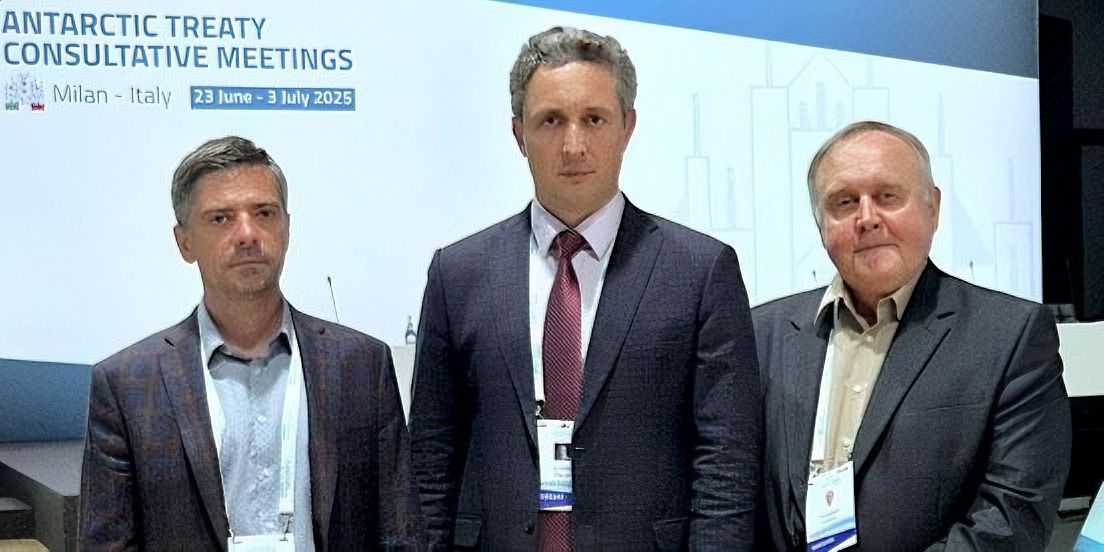
 Pavel Lunev with fellow Russian delegates at the ATCM in Milan. (Photo: AARI press statement)
 It may not be insignificant that Russia’s delegation at the Antarctic Treaty Consultative Meeting (ATCM) in the Italian fashion capital includes Pavel Lunev.
Until April 2023, Lunev had been head of the Russian state firm responsible for mapping Antarctica’s oil, gas and other minerals — at least since the region’s mining ban entered into force in 1998.
That firm is owned by Rosgeo — the Kremlin’s mineral explorer.
Indeed, Lunev would land a weighty promotion after Rosgeo’s seismic survey ship had once more headed via Cape Town to the Antarctic seabed in the austral summer of 2023 for another season of “scientific research”.
That event sparked environmental protests at the port city’s V&A Waterfront — one of South Africa’s most popular tourist destinations — and a letter of demand by 29 South African groups, which called on Pretoria to intervene.
Pretoria’s answer at the time?
The Russian state mineral explorer was free to pursue its interests under the treaty’s “freedom of scientific investigation” principle — also allowed by the region’s mining ban.
Moscow’s response? Giving Lunev a top job in Antarctica: that is, heading the Russian Antarctic Expedition, the state agency that executes Moscow’s operational interests in the frigid southern frontier.
/file/dailymaverick/wp-content/uploads/2025/06/Lunev-PMGE.jpg "Pavel Lunev shortly before leaving the Polar Marine Geosurvey Expedition, the Rosgeo firm responsible for charting Antarctica's hydrocarbons and other 'mineral resources'. (Image: Screenshot PMGE VK account)")
Who is Pavel Lunev?
A trained palaeontologist with tousled hair and a smile fit for the cover of Outside magazine, Lunev now appears in a suit and tie in a Russian press statement on the delegation’s work in Milan — wearing a look that says, “I’m not outside right now.”
Lunev previously told Daily Maverick that geological and geophysical surveys by Rosgeo’s Polar Marine Geosurvey Expedition (PMGE) was “no different from the work conducted by other members” signed up to Antarctica’s environmental laws.
Indeed, some of PMGE’s work includes standard sciences such as glacial evolution.
The Rosgeo subsidiary had also probed “the glacial processes, dynamics and evolution of the ice sheet, and the stages of Antarctic glaciation” and “the nature and foundation of the Earth’s crust”, said Lunev.
/file/dailymaverick/wp-content/uploads/2025/06/German-Leitchenkov-Chile-presentation.jpg "Professor German Leitchenkov, an Antarctic geoscientist at Russia's state marine geology institute, presents his joint paper on geological sampling beneath the East Antarctic ice sheet at a conference of the Scientific Committee on Antarctic Research, in Chile, August 2024. (Photo: Supplied)")
However, recent developments also involve:
- A July 2024 Russian-Chinese Antarctic geology paper that suggests nothing about prospecting, but appears in the state mining journal. Paper author Professor German Leitchenkov, a PMGE collaborator who has extensively researched Antarctica’s mineral “potential”, presented his research on sub-ice sampling at an international Antarctic science conference held in Chile in August 2024;
- PMGE’s stated goals up to at least 2030, which include identifying the Southern Ocean’s “mineral raw material potential”;
- A 2022 PMGE petroleum geology paper, which describes the “high oil and gas potential” in the D’Urville Sea off East Antarctica;
- A February 2020 Rosgeo statement, which used Cape Town port to announce 70 billion tons of hydrocarbons off East Antarctica (500 billion barrels or 15 times global annual oil consumption); and …
- Documented claims betraying the Russian state’s geopolitical motivations: “The works of the PMGE aimed at studying the geological structure and mineral resources of the Antarctic are of geopolitical nature. They ensure guarantees of Russia’s full participation in any form of possible future development of the Antarctic mineral resources — from designing the mechanisms for regulating such activities up to their direct implementation,” PMGE revealed in 2017.
/file/dailymaverick/wp-content/uploads/2025/06/MIning-journal-screenshot.jpg "Leitchenkov's joint paper in a July 2024 edition of the Russian state journal, the 'Exploration and Protection of Mineral Resources'. (Image: Screenshot)")
Westminster releases findings on Russian hydrocarbon surveys
Meanwhile, Westminster’s newly released findings on the UK’s Antarctic interests, issued this month, devote a section to “commercial mining” and the Russian activities uncovered by Daily Maverick.
According to the report, “the Russian state-owned vessel [Akademik] Alexander Karpinsky has conducted seismic surveys in Antarctic waters, identifying potential hydrocarbon reserves estimated at 70 billion tonnes” — an activity that “raised serious concerns” during the inquiry.
In addition to findings published in October 2021 and May 2022, in May 2024 Daily Maverick also revealed that the Karpinsky had spent six summers since 2011 surveying for oil and gas in an area counterclaimed by Argentina, Chile and the UK.
Asked to explain the Russian activities during Westminster’s May 2024 inquiry, UK Polar Regions head Jane Rumble claimed that “Russia has been tackled on this before and, in fact, has assured the ATCM on multiple occasions that this is a science programme, so we’ll keep it under review”.
Just, in fact, two ‘assurances’
The June 2025 inquiry findings quote Rumble’s claim.
However, the ATCM database contains no record of any government, including Rumble’s, “tackling” Russia “on this” matter.
As for “multiple assurances”, Russia had offered just one by the time Rumble made her claim. It was offered nearly a quarter of a century before at the 2002 Warsaw ATCM — where the Russian delegation did argue scientific intent in a draft document published by Daily Maverick.
Yet, this draft also refuses to rule out “utilisation of the Antarctic mineral wealth” which may only occur “in the indefinitely remote future”.
Russia delivered one additional “assurance” — on 24 May 2024, but only after Rumble had delivered her testimony on 8 May.
A media firestorm erupted after Rumble’s testimony, capped by Chilean president Gabriel Boric twice tweeting that Santiago would defend its claimed territory against oil exploitation.
So, not everyone has approached Russia’s self-declared interests in Antarctic oil and gas like a geopolitical wet-floor sign.
In February 2024, Washington — the treaty depositary — placed the Karpinsky under energy sanctions. And the US delegation had led an initiative reaffirming Antarctica’s mining ban at the 2023 ATCM in Helsinki, Finland.
Ukraine, immediately after the 2024 ATCM in Kochi, India, said Russia was blocking environmental initiatives, which “once again confirms that the true intentions of its presence in Antarctica is mining”.
Russia also reaffirmed the ban in Helsinki and Rumble, in her inquiry defence, said that “there isn’t any evidence that would point to a breach of the treaty. You would need different equipment between surveying and actual exploitation. There is not a shift to it, but, yes, we are watching it very closely.”
Rumble has not responded to queries sent since last year.
This is ‘manifestly prospecting … what the Russians are doing’
Some experts disagree that the act of putting a symbolic signature on the reaffirmation of the mining ban refutes the documented reality of Rosgeo’s activities.
Westminster’s inquiry findings, in fact, point out that the “Article 7” mining ban “prohibits ‘any activity relating to mineral resources, other than scientific research’”.
While the ban does not define a “mineral resource” activity, the inquiry findings do.
“Any activity relating to mineral resources,” the findings say, “includes prospecting, exploration and exploitation for commercial purposes”.
And it is Antarctic governance expert Professor Alan Hemmings, of New Zealand’s University of Canterbury, who told Daily Maverick in a recent webinar that the “Karpinsky has been engaged in what is manifestly mineral prospecting”.
Hemmings explains: “Article 7 prohibits mineral resource activities, and mineral resource activities were defined in an earlier treaty that didn’t enter into force quite carefully. And among the things that constitute mineral resource activities was prospecting.
“That’s what the Russians are doing.”
Why is Russia in Milan?
It is unclear what submissions the Russian delegation will be making at this year’s ATCM, which concludes on Thursday, 3 July.
Yet, since the details of these “prospecting” activities have not been tabled at any ATCM, it is highly unlikely that Moscow’s envoys are now in Milan to formally discuss that contentious matter.
The agenda remains opaque because the meeting has been a closed-door event since the treaty was signed in 1959 and that is why the press is stopped from reporting on the live substance of the 10-day talks.
This year, the Russian statement from Milan says, the discussions are expected to focus on matters such as science and tourism.
Lucia Sala Simeon, the only journalist reportedly at 30 minutes of the “public” opening plenary, noted that she was briefly allowed into the venue.
“I was accompanied by a member of staff — who kept a close eye on me,” notes the Milan-based reporter. “I was the only journalist there.”
She added: “I had to leave the room and was escorted out; in the next few days, I would no longer be allowed inside the venue, not even in the lounge. So, I’ll be staying outside in the garden, like a homeless [person].”
/file/dailymaverick/wp-content/uploads/2025/06/Pavel-and-the-penguins.jpg "Pavel Lunev with the Russian ATCM delegation in Milan, posing in front of a life-size image of emperor penguins. In recent years, the Chinese and Russian delegations have blocked the penguins' rescue plan. (Photo: AARI press statement)")
Italy, South Africa — reactions, non-reactions
Italy’s foreign ministry has not responded to Daily Maverick’s multiple queries first sent August 2024.
Treaty party South Africa, under a revamped “conservation”-focused delegation, in an interview said Pretoria’s “non-aligned” stance was an advantage in negotiating with the most obstructive actors at the consultative table.
Thus, Russia and China, which have — among others — used their vetoes to block an emperor penguin rescue plan at recent ATCMs.
South Africa says it supports emperor penguin protection.
“We want a much more active engagement with the Russian and Chinese delegations,” said South Africa’s lead negotiator, Ashley Johnson. “Perhaps we can edge them closer to a conservationist approach.”
Rosgeo’s defence of its activities, shared with Daily Maverick in October 2021, can be read here. However, Russian authorities have not responded to our repeated attempts to reach them since Lunev’s most recent response in May 2022.
The Russian delegation did not respond to queries on Sunday. DM