




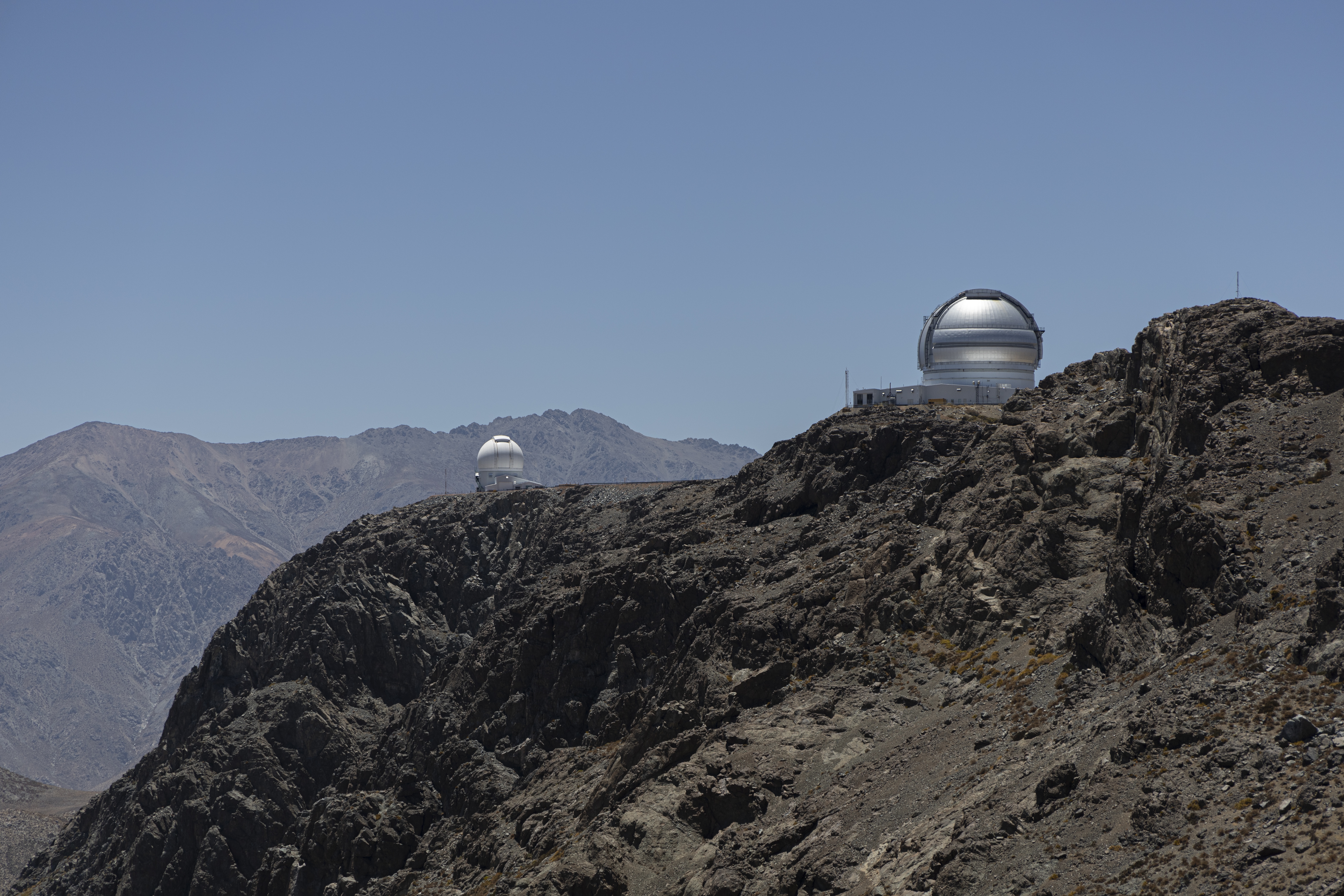
 epa11116093 The VIctor M. Blanco Observatory Telescope, located on Cerro Tololo, in the Coquimbo region, in Santiago, Chile, 24 January 2024 (Issued 31 January 2024). On the tops of the Pachon and Tololo hills, two imposing mountains that look at each other in the heart of the Elqui Valley, the main gateway to the Atacama Desert, in northern Chile, four large astronomical observatories stand out on the horizon that hold the telescopes that generate the greatest scientific impact in the southern hemisphere. EPA-EFE/AILEN DIAZ
 Located on Pachon Hill in the northern region of Coquimbo, the 8.4-meter (27-1/2-foot) telescope has a 3,200-megapixel camera feeding a powerful data processing system.
"It's really going to change and challenge the way people work with their data," said William O'Mullane, a project manager focused on data at Vera Rubin.
The observatory detected over 2,100 previously unseen asteroids in 10 hours of observations, focusing on a small area of the visible sky. Its ground-based and space-based peers discover in total some 20,000 asteroids a year.
O'Mullane said the observatory would allow astronomers to collect huge amounts of data quickly and make unexpected finds.
"Rather than the usual couple of observations and writing an (academic) paper. No, I'll give you a million galaxies. I'll give you a million stars or a billion even, because we have them: 20 billion galaxy measurements," he said.
The center is named after American astronomer Vera C. Rubin, a pioneer in finding conclusive evidence of the existence of large amounts of invisible material known as dark matter.
Each night, Rubin will take some 1,000 images of the southern hemisphere sky, letting it cover the entire southern sky every three or four nights. The darkest skies above the arid Atacama Desert make Chile one of the best places worldwide for astronomical observation.
"The number of alerts the telescope will send every night is equivalent to the inboxes of 83,000 people. It's impossible for someone to look at that one by one," said astrophysicist Francisco Foster.
"We're going to have to use artificial intelligence tools."
(Reporting by Jorge Vega; Writing by Fabian Cambero; Editing by Adam Jourdan and Sandra Maler)