




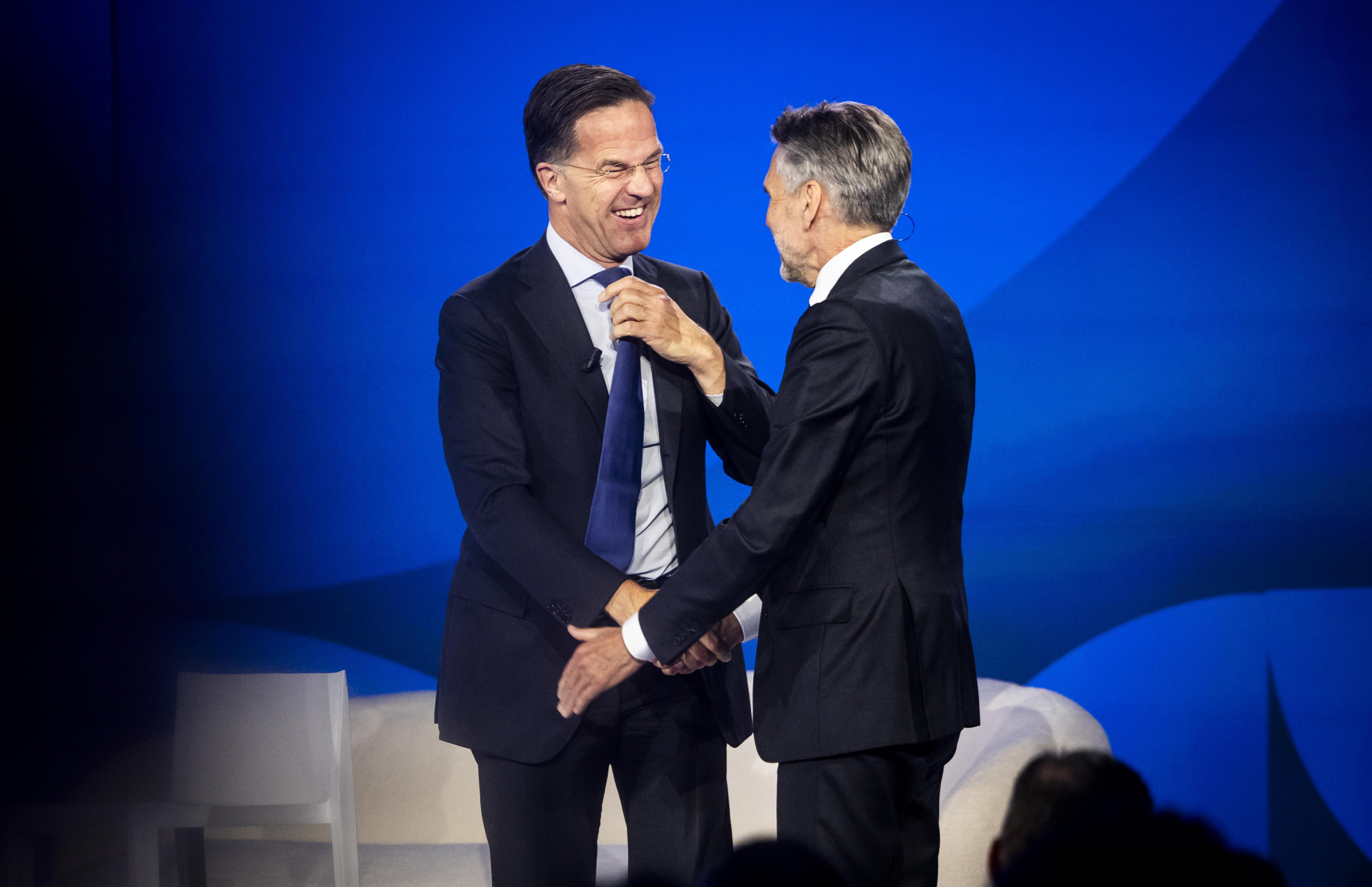
 NATO Secretary General Mark Rutte (L) and Dutch Prime Minister Dick Schoof attend the NATO Summit at the World Forum in The Hague, the Netherlands, 24 June 2025. The Netherlands hosts the NATO Summit in The Hague on 24 and 25 June, the first such summit to be held in the country. EPA/IRIS VAN DEN BROEK
 The two-day gathering is intended to signal to Russian President Vladimir Putin that NATO is united, despite U.S. President Donald Trump's previous criticism of the alliance, and determined to expand and upgrade its defences to deter any attack from Moscow.
"There is total commitment by the U.S. president and the U.S. senior leadership to NATO," Rutte told a public forum before the formal opening of the summit. He added, however, that such backing came with an expectation that European countries and Canada spend more on defence.
The Kremlin accused NATO of being on a path of rampant militarisation and bent on portraying Russia as a "fiend of hell" in order to justify a big increase in defence spending.
The summit and its final statement will be short and focused on heeding Trump's call to spend 5% of GDP on defence - a significant jump from the current 2% goal. It is to be achieved both by spending more on military items and by including broader security-related spending in the new target.
Appearing relaxed before the expected arrival of Trump later on Tuesday, Rutte described the spending issue as "this huge pebble in the shoe, this huge irritant, which is that we are not spending enough as Europeans and Canadians, and they want us to equalise with what the U.S. is spending".
The war between Israel and Iran and the uncertain status of a ceasefire announced overnight by Trump make the summit much less predictable than Rutte - a former prime minister of the Netherlands hosting the gathering in his home city - and other NATO member countries would like.
Ukrainian President Volodymyr Zelenskiy said he planned to meet Trump in The Hague - although Zelenskiy will not take part in the summit itself, as NATO officials have sought to avoid any clash between Trump and other leaders over the war in Ukraine.
Zelenskiy told a Sky News interview broadcast on Tuesday that the two leaders' teams were working on organisational details and the timing of the meeting.
Asked about the possibility of an end to the three-year war in Ukraine, Rutte said: "I cannot predict when it will happen." He also praised Trump for engaging with Putin.
Russia has cited its neighbour's desire to join the U.S.-led transatlantic alliance as one of the reasons why it invaded Ukraine in 2022.
Russia denies any plan to attack NATO, but Kremlin spokesman Dmitry Peskov said it was "largely a wasted effort" to assure the 32-member alliance of this because it was determined to demonise Russia.
"It is an alliance created for confrontation ... It is not an instrument of peace and stability," he said. NATO was founded by Western countries in 1949 to resist the threat from the communist Soviet Union.
(Reporting by Bart Meijer; Writing by Makini Brice and Keith Weir; Editing by Dominique Vidalon and Kevin Liffey)