




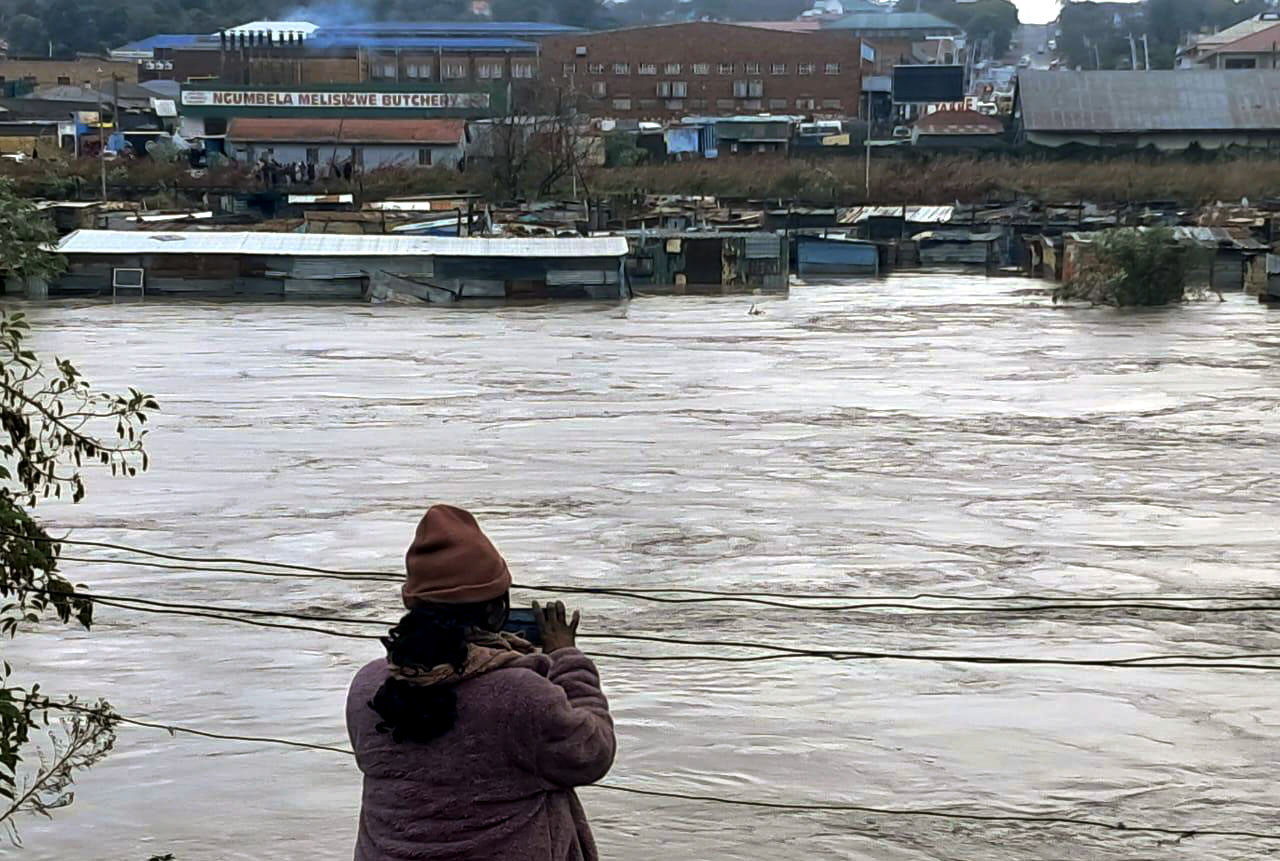
 Localised flooding in Butterworth and surrounding areas in Eastern Cape caused widespread destruction. (Photo: Ali Sablay / Gift of the Givers)
 While extreme weather events are becoming more intense, the recent Eastern Cape flooding escalated into a disaster because of failures in governance and implementation, not just the rainfall itself, say experts.
South Africa has excellent disaster management legislation on paper, but a lack of capacity and a reactive “biscuits and blankets” approach create immense vulnerability, especially for those living in unsafe, marginal areas.
The country’s multi-layered early warning system begins with national weather services such as the South African Weather Service (SAWS) and filters through provincial and local channels.
While technically sound, these systems often break down, particularly in reaching the people who need the warnings most. This is especially problematic in rural or informal urban settlements, and during night-time events when communities are most vulnerable.
Both Professor Coleen Vogel, a specialist in disaster risk reduction and professor from the Global Change Institute at the University of the Witwatersrand, and the SAWS agreed that communication and serious engagement and trust building with communities are major weaknesses.
Weather alerts and action
SAWS meteorologist and weather forecaster Lehlohonolo Thobela told Daily Maverick the most important lesson from this recent incident is that better communication with the affected communities is needed as well as more engagement with communities to teach them about being proactive rather than reactive to the weather warnings.
Thobela said this event was forecasted with sufficient lead time, and early warnings were issued to disaster management teams and the public. This was not the case during the 2022 KwaZulu-Natal floods.
“The weather warnings are distributed through different media outlets as soon as they are decided upon by the weather offices. The weather warnings are also sent through disaster management WhatsApp groups, which are also used to send information to communities in rural areas,” Thobela said.
Thobela said South Africa’s current forecasting and alert systems are adequate to cope with the increasing frequency of extreme rainfall and flood events as the warning system has developed to give more detail.
They now not only outline what the weather will be, but also elaborate what impacts the weather will have.
For example, if an area has been identified to expect heavy rainfall, the impact-based system will elaborate what the heavy rains will do, such as causing localised flooding, heavy traffic on the roads, electricity cuts, uprooted trees and so on.
Disaster management and community readiness
/file/dailymaverick/wp-content/uploads/2025/06/AFP__20250612__626F624__v1__HighRes__SafricaWeatherFlood.jpg "A resident of an informal settlement scrapes mud out of her home after flooding in Mthatha on 12 June 2025. (Photo: Emmanuel Croset / AFP)")
But despite these early warnings, the recent event’s destructive force overwhelmed the Eastern Cape, and 92 people died. Almost 1,600 structures and close to 5,000 people were affected. More than 200 schools were damaged, affecting thousands of students.
The province held a memorial service on Thursday, 19 June, for the deceased.
Read more: Deadly Mthatha flood underscores worsening factors increasing risks for SA
Vogel told Daily Maverick that while South Africa has a world-class Disaster Management Act on paper, its implementation is hampered by a lack of capacity and governance, especially in poorer provinces such as the Eastern Cape.
Vogel said that disaster risk reduction often takes a backseat to other pressing issues such as service delivery and crime prevention.
She stressed that a key lesson from these flooding events is that a better balance is needed. “We urgently need improved communication and working with affected communities and more proactive community engagement regarding weather warnings,” Vogel said.
Vogel took part in drawing up the initial Disaster Management Act for South Africa in 2002, which has been updated regularly and linked more closely to climate change.
“One of the things that we were trying to say in the Disaster Management Act is that we should really be twinning whatever development we do, all our plans, all our integrated development planning that we’re doing in cities… with an eye on climate change now going forward,” Vogel said.
This is where Vogel believes more capacity, more attention and more resources are needed.
When it comes to effective early warning systems, Vogel said: “I don’t think it’s only the government’s job to do this.
“In other countries like Bangladesh, they have fairly similar kinds of events but the communities have bonded together. They’ve got community action teams. They’ve got community-based adaptation. People and schools are linked into alert systems.
“Once that alert clicks in, there should be systems in place that go all the way down to communities who hopefully… [have] one, two or three key figures in the community who have gone through some kind of training,” Vogel said.
South Africa is starting to do that. Vogel said they are doing quite a lot of community-based adaptation, but that the roll-out needs to be much quicker, stronger and on a much bigger scale.
Early warnings for all
/file/dailymaverick/wp-content/uploads/2025/06/ED_375570.jpg "Am informal settlement between the M19 and Quarry Road in Durban during the 2022 floods. (Photo: Darren Stewart / Gallo Images)")
As one of the 101 countries that have early warning systems, South Africa is a signatory of the Early Warnings for All Initiative (EW4All) – an initiative launched by the UN secretary-general at COP27 to ensure all countries have early warning systems by the end of 2027.
But as in other countries, the system has limitations in South Africa.
Francois Engelbrecht, a professor of climatology and director of Wits University’s Global Change Institute, previously told Daily Maverick that the system’s limitations were made apparent during the 2022 KwaZulu-Natal floods when serious failures occurred at some point in the early warning cycle, resulting in the death of 500 people..
First, he said the initial weather alert was not strong enough, and the highest levels of warning were issued late when the flood event and the heavy rainfall were already in motion.
However, as mentioned by Vogel, even with accurate alerts and technical guidance about imminent impacts, early warning systems may fail because of a lack of uptake and community engagement, including in the most vulnerable communities.
The effectiveness of disaster management varies. Vogel said in bigger metros, they have good alert response teams, but that this is not the case in the smaller municipalities that are constrained by capacity.
“What needs to be put in place as quickly as possible is more of this community-based action,” Voge said.
The University of KwaZulu-Natal and others had been working with a community living in Quarry Road for about seven years before the 2022 KwaZulu-Natal floods, training them what to do when a disaster occurs. They also had a functioning WhatsApp group.
“They were one of the only communities to help save many lives, because they’d been walked through these incidents several times. There was a level of trust that the community had with the alert officials,” Vogel said.
Challenges on the ground
Vogel said there were strong Eastern Cape officials who had been working on disaster management for a long time.
I don’t think we can sit in our communities and say it’s government’s fault and they should have come to help us. Yes, it is their obligation and they should come and do their job. But it is going to take all of us to try and get around these problems because these events are going to be coming quicker, faster and with greater magnitude.”
“The well-meaning and the political will is there. But obviously, you’ve got many, many communities and you’ve got to try and cover everything and really try and mobilise… It’s a big job, ” Vogel said.
“I don’t think we can sit in our communities and say it’s government’s fault and they should have come to help us. Yes, it is their obligation and they should come and do their job. But it is going to take all of us to try and get around these problems because these events are going to be coming quicker, faster and with greater magnitude,” she said.
To effectively manage weather-related disasters, Vogel said standardised protocols need to be integrated with a comprehensive early warning system.
This system should ensure that alerts from weather services are systematically disseminated through regional officers to frontline services such as fire departments, ambulance services and hospitals– in other words, line functions that reach all levels.
Unfortunately, Vogel said, it often takes major disasters involving loss of life and significant damage to serve as a “sad wake-up call” for these measures to be taken seriously
“The President’s visit to the flood victims shows the political care and the will to try and do the best they can… I don’t think there’s a sense that people don’t care and that the government isn’t paying attention to this. The problem is trying to pay attention to this in light of where we’re sitting,” Voge said.
Balancing ideal and practical in disaster risk reduction
In many communities, especially those with limited resources, implementing a fully equipped early warning system isn’t feasible.
Instead of waiting for ideal solutions or an early warning system with all the bells and whistles, Vogel said it would be better to install functional, simpler systems that can still save lives and buy time until upgrades are possible.
We’ve moved now in the disaster management space away from management to risk reduction. So we try to reduce the risk before the event occurs rather than doing the ‘biscuits and blankets’ approach after the event has occurred.”
She said this pragmatic approach is essential in cities such as Johannesburg, where unchecked development in flood-prone areas continues despite known risks. Vulnerable populations are often pushed into these high-risk zones because of their proximity to employment, increasing their exposure to disaster.
Vogel said disaster management needed to shift from reactive responses to proactive risk reduction.
“We’ve moved now in the disaster management space away from management to risk reduction. So we try to reduce the risk before the event occurs rather than doing the ‘biscuits and blankets’ approach after the event has occurred,” she said.
The focus, she said, is now on planning and building resilience before disasters strike, rather than only relying on emergency relief efforts after the fact. This includes considering flood lines in urban planning and enforcing regulations that prevent unsafe development.
Early warning systems must reach communities more effectively
South Africa has a tiered early warning system for severe weather, starting with national weather services and filtering down through various agencies to local emergency responders. When thresholds are crossed, response teams are mobilised.
The effectiveness of these systems varies by location, however,and critical delays can occur.
To improve responsiveness, Vogel said that having designated community representatives as direct points of contact for alerts can help ensure faster, localised mobilisation.
Still, without rapid, widespread communication, lives remain at risk during sudden weather events.
“That’s why the Quarry Road system worked so well, because they had a WhatsApp system, they had trained and made people aware when is it really urgent to move, when isn’t it urgent to move, what risk is high risk, what risk is low risk and they had built up trust over time... It takes time,” Vogel said.
Vogel gave credit to the SAWS for the work it is doing on this. “We punch way above our weight in all the international work that we do on climate change and with the weather services.”
She said there was always room for improvement and it could be better mobilised, but it was trying its best.
“We’re highly alert in South Africa… The issue now is how quickly can we make this more mainstream, making sure that everyone can play their role and not only depend on government to only do the job,” Vogel said.
Eastern Cape Premier Oscar Mabuyane’s office did not respond to Daily Maverick’s media request by time of publication. If received, his response will be added. DM