



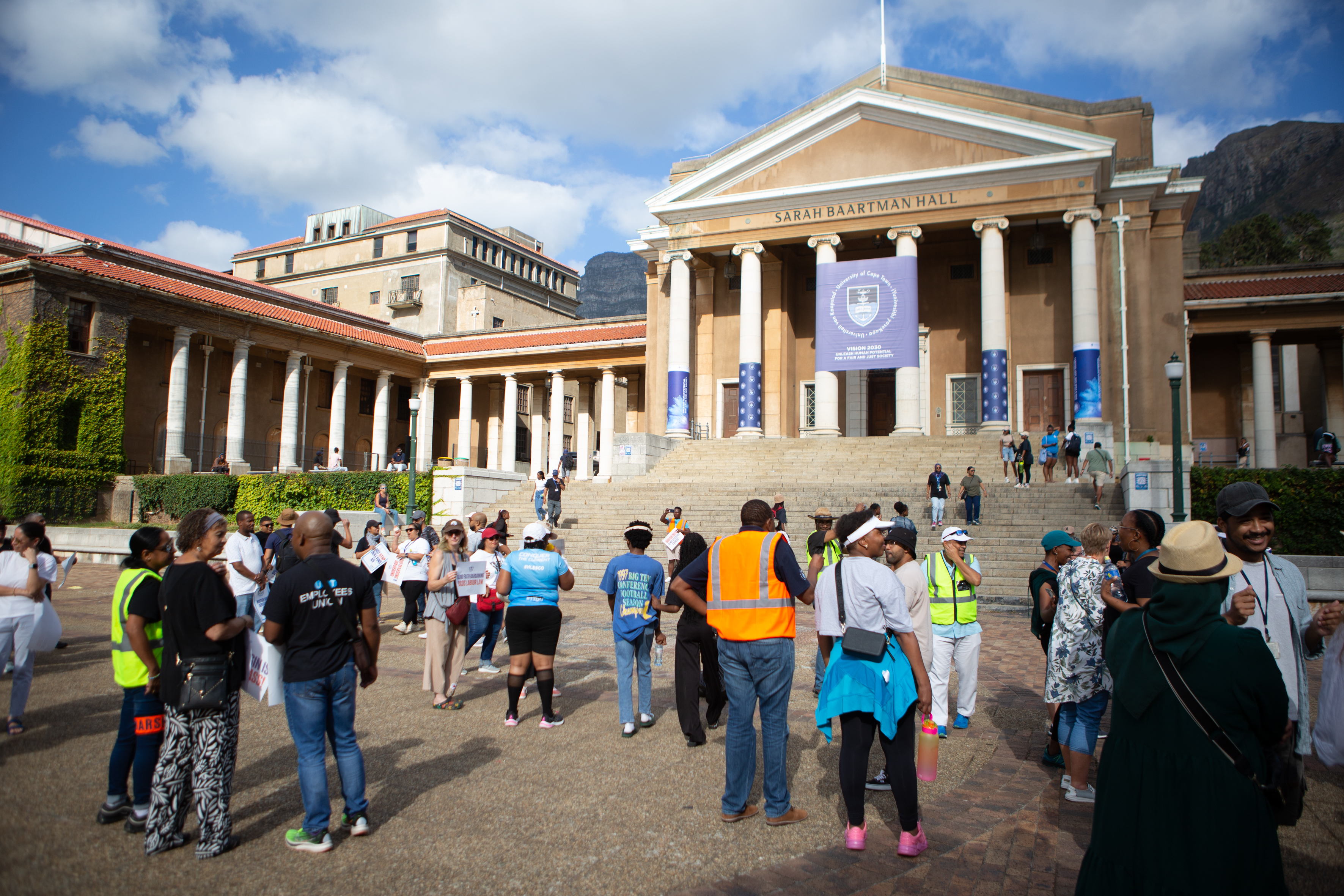
 UCT staff during the UCT Employees' Union strike over salary increases and employee benefits outside the Sarah Baartman Hall on 8 February 2024 in Cape Town, South Africa. (Photo: Gallo Images / Misha Jordaan)
 Illusions of safety
On a Monday morning in March 2024, Professor Susan Levine, the head of the anthropology department at the University of Cape Town (UCT), received an email from a man who claimed to be “Benjy ‘Ben’ Steingold” of Tzfat, the famous “holy city” near the Sea of Galilee in northern Israel. Levine, who had never met or even heard of Steingold, was wary — the events of the previous weekend, when it came to the actions of her colleagues and fellow Jews, had shaken her badly. As she read from the top, her fears were confirmed.
“This may be the most important email you have ever received in your life,” the message began. “Please read to the end as it could give you the opportunity to change your eternal future.”
That “eternal future”, according to Steingold — or whatever the sender’s real name happened to be — would, unless Levine altered course, involve a particularly biblical form of punishment. Because she had allegedly “vilified Israel” by spreading “untruths and lies”, she was destined “in this incarnation or another reincarnation” to live under one of four enemy regimes: Hamas, Hezbollah, Isis or the Ayatollah’s Iran.
For the next 10 paragraphs, as payback for the motion that Levine had brought before the UCT senate the previous Friday, Steingold quoted a potent mix of Torah and American literature. Through it all, an undercurrent of menace flowed in a steady and self-assured stream, as exemplified in a citation from the Midrash (ancient commentaries on the Hebrew scriptures): “If you are kind to the cruel, in the end, you will be cruel to the kind.”
Two days later, on 13 March 2024, Levine would include these details in a sworn statement for the South African Police Service. At around the same time, the UCT authorities would deem the threat to her life significant enough to warrant full-time private security.
In the third paragraph of her statement, Levine would succinctly explain the motion that she had proposed to the university senate on 8 March:
“The motion was one which urged UCT to cut ties with Israeli institutions of higher education until such a time that they acknowledge the value of Palestinian lives in Gaza and [call] for an end to what the International Court of Justice calls ‘plausible’ [genocide].”
As it turned out, despite her refusal to rescind — aside from the Steingold threat, there was an attempt by UCT staff to place pressure on members of Levine’s family, with one colleague even passing on the message that her life would be “ruined” — the motion for an academic boycott did not win the requisite votes.
Still, although she could not know it at the time, Levine’s experience was fated to form a core part of one of the most significant court cases in the 195-year history of UCT.
Lodged by Professor Adam Mendelsohn on 22 August 2024, the Western Cape Division of the High Court application would attempt to overturn a pair of momentous resolutions that had been passed by the UCT council, the university’s highest decision-making body, on 22 June of that same year: first, the resolution not to adopt the international definition of anti-Semitism that encompassed anti-Zionism; and, second, the resolution to prohibit collaboration with academics or research groups affiliated to the Israel Defense Forces or the broader Israeli military establishment.
In its 150-page answering affidavit, the UCT council — represented by its chairperson, Norman Arendse — would refer to these resolutions jointly as the “Gaza resolutions,” thereby making it plain that they were a direct response to Israel’s ongoing military offensive and the rulings of the International Court of Justice (ICJ). On page 17 of the affidavit, shortly after reiterating UCT’s “zero-tolerance attitude to anti-Semitism” and acknowledging that the Jewish people had in the past been “victims of gross atrocities and genocide” themselves, Levine’s experience was mentioned for the first time.
The context, as the UCT papers explicitly stated, was that “those who expressed views in support of the Gaza resolutions” were likely to face “threats, intimidation or reprisal” if their identities were revealed. Mendelsohn, the affidavit alleged, was “probably aware” of Levine’s experience, and therefore should not have disregarded the “safety and wellbeing” of council members by going public with the case.
As examples of Mendelsohn’s alleged breach, UCT cited the publication of his founding and supplementary affidavits on Politicsweb, “with council members’ identities disclosed … regardless of the request [for anonymity]”. Also cited was reporting on the case “in pro-Israel and right-wing media in the United States”, specifically an article in Breitbart Media by its senior editor Joel Pollak, dated 15 March 2025.
What was not cited was a lengthy feature published in Haaretz, Israel’s most progressive mainstream newspaper, on 24 September 2024. Titled “‘Scary Time to Be a Zionist': Is Africa’s Top University No Longer a Welcoming Place for Jews?”, the piece, authored by South African journalist Tali Feinberg, quoted Mendelsohn extensively.
With a link to the original founding affidavit, published on Politicsweb on 29 August 2024, Feinberg noted that the resolutions (which were — and are — yet to be implemented) “should be seen within the broader context of South Africa’s fraught relations with Israel”.
Here, while Feinberg failed to mention the exceptionally close relationship in the 1970s and 1980s between the Israeli establishment and the white supremacist apartheid regime, she did observe that “the ruling African National Congress has long backed the Palestinians”. Likewise, while she failed to acknowledge the threats directed at Levine, the fears of certain members of UCT’s Zionist student body — most of whom would only speak to her on condition of anonymity — were the central focus of her piece.
As graduate student Esther (not her real name) told Feinberg: “If someone assaulted me for wearing a T-shirt that said ‘Am Yisrael Chai’ [‘The people of Israel live’], it wouldn’t be seen as anti-Semitic. It would be ‘anti-Zionist.’ The overlap between the two is no longer allowed to exist.”
In these inherently contested words, by Daily Maverick’s reckoning, lay the essence of the case. Levine, who in the interests of academic freedom allowed us access to her story and her name, was for us an archetypal local representative of a deeply disturbing global phenomenon — the split in world Jewry, between Zionists and anti-Zionists, that was now violently shaking the foundations of some of the most prestigious universities on Earth.
What if Einstein was an anti-Semite?
“I am an academic, writer and member of the organisation South African Jews for a Free Palestine (SAJFP), currently residing in Cape Town,” Jared Sacks testified. “I do not disclose my residential address because SAJFP members are often subject to harassment and threats from individuals who support Israel and the ideology of Zionism.”
As the opening paragraph of the application for the admission of the SAJFP as amicus curiae (friends of the court) in the case of Mendelsohn versus the UCT council, an affidavit that Sacks deposed on behalf of his organisation on 9 June 2025, the assertion — like Levine’s story — was far from hyperbolic. A mere six weeks before, as reported by Daily Maverick, Sacks had been physically assaulted by an attendee of the Jewish Literary Festival in Cape Town, for the apparent offence of protesting Israeli war crimes in Gaza.
The incident, it turned out, was nothing new to Sacks. As a PhD graduate in Middle Eastern Studies from Columbia University in New York, he had served as a teaching fellow on undergraduate courses that delved into the highly flammable terrain of Palestinian rights.
“I have first-hand knowledge of the current climate of political repression related to pro-Palestine activism at universities in the United States,” Sacks declared in his affidavit, “including at Columbia, where a number of former colleagues and former students have been subject to harassment, doxxing, assaults, institutional pressure, procedurally unfair disciplinary processes, and unjust termination of employment due to their research and speech on Palestine.”
By Daily Maverick’s understanding, this anchoring of the UCT case in the international context, a point that the affidavit would repeat from multiple angles, was one of the primary motivations for the SAJFP applying as amicus curiae — in disentangling the religion of Judaism from the ideology of Zionism, Sacks testified, his organisation aimed to “debunk the anti-Semitic notion” that there had ever been anything like a homogenous Jewish perspective, either globally or locally, on the actions of the State of Israel.
Clearly, in emphasising “the role that anti-Zionist and non-Zionist Jews have played in shaping discourse on [the UCT campus]”, the affidavit was not only rejecting the attempt by Mendelsohn — director of the university's Kaplan Centre for Jewish Studies — to speak on behalf of all Jewish students and staff; it was also affirming the SAJFP’s support for free speech and institutional autonomy, particularly in the form of the Gaza resolutions.
But as important, “with billionaire philanthropists and politicians running roughshod over protected speech” at universities in the United States, the SAJFP was drawing attention to the “distinct possibility” that what had been playing out “at places like Harvard and Columbia” would “become an issue at South African universities as well”.
The question for the Western Cape Division of the High Court, of course, would be whether the SAJFP was overstating its case. And here, to offset Mendelsohn’s opposition to the application, the organisation came armed with expert witnesses.
At the top end, aside from the testimonies of Professor Steven Friedman and Professor Isaac Kamola, two local academics with deep knowledge of the issues, the SAJFP submitted an expert affidavit from Professor Joan Scott of the Institute for Advanced Study in Princeton, New Jersey — the same institute that Albert Einstein had joined in the 1930s, after seeking refuge from Nazi Germany.
Scott, as Sacks well knew, had long been a leading global critic of the definition of anti-Semitism as laid down by the International Holocaust Remembrance Alliance, or IHRA — the very definition that the UCT council had rejected in its Gaza resolutions of June 2024, and the very definition, as articulated in his founding papers, that Mendelsohn appeared to be insisting upon.
In paragraph 14 of her supporting affidavit, somewhat remarkably, Scott invoked the spirit of Einstein himself.
“Under the IHRA definition,” she testified, “rejecting the idea of a Jewish state with borders and an army, as Einstein once did, could land even the most famous Jew of the 20th century in the position of being accused of anti-Semitism. Though he was sympathetic to Zionism, Einstein’s comparison of Menachem Begin’s Herut Party massacres during the Nakba to the Nazi Party would have fallen afoul of [the IHRA definition]. In today’s academic world, he could have been fired for making such a comparison.”
In other words, according to Scott, a celebrated Jewish scholar in her mid-80s who had witnessed — and commented upon — some of the worst anti-democratic impulses of 20th-century America, the Zionist radicals of 2025 would have burnt no less a luminary than Einstein.
It was for this reason, she continued in her affidavit, that one of the original authors of the IHRA definition, Professor Kenneth Stern, came to regret what he called the “weaponising” of the definition, arguing — in an opinion piece for The Guardian published in 2019 — that “its misuse undermines efforts to detect and combat real instances of anti-Semitism”.
In the same vein, Scott added, this was also why more than a hundred Israeli and international civil society organisations, in April of 2023 — as reported, again, in The Guardian — “urged the United Nations to reject this definition”.
Ultimately, for Scott — as for Friedman and Kamola — the IHRA definition had quickly become anathema to the very idea of academic freedom. Scott, however, had been watching its effects play out on US Ivy League campuses in real time. Republican politicians, she testified, “many of them anti-Semites themselves”, were now using the “expressions of discomfort” of Zionist students and faculty to foreground anti-Semitism at the expense of all other forms of racial discrimination.
“[Zionist] students express their discomfort in terms of feeling ‘unsafe’ or ‘threatened,’” she added, “when there is little or no evidence of any physical danger they have experienced.”
And so Daily Maverick could not help but wonder: was this also the reality of Zionist fears on the UCT campus, as reported by Feinberg in Haaretz? The answer, it appeared, would be for the Western Cape Division of the High Court to decide.
For the moment, what could not be disputed was how things were turning out in the US. “The IHRA definition is now a political test for enjoying rights of free speech and academic freedom,” Scott testified. “Those who support Israel have rights of free expression, those who criticise it are punished and banned.”
The money problem
On a Saturday morning in mid-March 2025, almost a year to the day after UCT had assigned full-time security to Professor Levine, the university council was asked to make a difficult decision. With the threat of US federal funding cuts looming, most likely in the form of an abrupt halt to grants from the National Institutes of Health (NIH), the executive orders of President Donald Trump could no longer be ignored — for one thing, as the largest recipients of NIH grants outside of the US, the university’s medical researchers were now at serious risk.
For another thing, as every member of the council was keenly aware, pro-Israel donors had already withdrawn funding — and more were threatening to withdraw — on the back of the Gaza resolutions of the previous year.
Although it had not been placed on the agenda for discussion, a motion was therefore tabled that the university should rescind the resolutions and withdraw its opposition to Mendelsohn’s high court application. In a closely contested vote, the motion failed to pass.
A few short hours later, as stated in the council’s answering affidavit, Joel Pollak of the right-wing US outlet Breitbart Media ran an article under the title, “South African university votes to keep boycott of Israel despite losing two-thirds of donor funding”. Before the end of the following week, in a similarly alarmist piece in the local Jewish Report (authored, like the Haaretz feature, by Feinberg), Rolene Marks of the South African Zionist Federation (SAZF) would also note her concerns.
“This self-inflicted crisis threatens vital resources and undermines UCT’s global standing,” Marks stated on behalf of the SAZF. “It exposes the ideological capture of its leadership at the direct expense of academic freedom, financial stability and student welfare. Council members have a fiduciary duty to act in the best interests of the university, yet some are wilfully disregarding this obligation. Their hatred of Israel outweighs their responsibility for UCT’s future.”
By Daily Maverick’s reading, this was an uncanny summary of one of the principal arguments from Mendelsohn’s founding affidavit of August 2024 — the notion that, by failing to take account of “UCT’s finances, existing relationships … and reputation”, the council had acted in an “irrational” manner.
But if Mendelsohn was indeed the source of the leaks, as alleged in the UCT answering papers, he would not admit as much to us. In response to a series of questions sent on 12 June, in which Daily Maverick also sought clarification on the publication of the names of council members, he noted his “surprise” at our email — we should “surely know”, he wrote, that it would be “improper” for him to respond while legal proceedings were pending.
Given Mendelsohn’s extensive interviews with Feinberg, we noted, we too were surprised. Still, irrespective of the source, the tenor of the media campaign against the UCT council was unmistakable — the underlying message was that the university had been financially punished for taking on the Zionists.
The SAJFP, for its part, was unimpressed. Referring in a footnote to an attendant statement from Mendelsohn’s supplementary affidavit, the organisation pointed out the obvious: “The assumption that ‘Jewish connected’ donors would have a homogeneous reaction to resolutions against Israel’s actions in Palestine is not only incorrect … it also panders to historical anti-Semitic tropes of a Jewish cabal working in unison and employing financial power to promote its political agendas.”
Of course, if the SAJFP was implying that there was no such cabal, the optics weren’t working in its favour.
Further down in its application, the organisation got at the heart of the matter, noting that since 7 October 2023 the “risk to university autonomy and academic freedom” from private donor money had become extreme, “particularly at Ivy League universities” in the US.
“Wealthy donors (with the support of politicians) have drawn on the IHRA's conflation of anti-Zionism with anti-Semitism to pressure universities like Harvard and Columbia to ban student groups like Jewish Voices for Peace and Students for Justice in Palestine,” Sacks testified. “Donor pressure has also forced the suspension and expulsion of students for peaceful protests, the militarisation of campuses by armed police and the resignation of university presidents that sought to push back on their demands.”
Unlike Harvard, the SAJFP noted, where philanthropic contributions “made up about 45 percent of all revenue in the 2024 financial year”, private donor funding made up “only ten percent” of UCT’s revenue in 2024. Still, with the overall trend in South Africa towards “increased reliance on such funding”, one of the dangers — as the SAJFP saw it — was that donors’ political views would soon play an outsized role at our universities too.
A major milestone, according to the SAJFP, had been passed in the signing of a contract between UCT and the Donald Gordon Foundation (DGF) in 2023, wherein the latter had agreed to fund the creation of a neuroscience institute (at a cost of R200-million over a 10-year period) on the proviso that UCT’s “zero-tolerance attitude to anti-Semitism” was anchored in the IHRA definition.
As the UCT council’s answering affidavit made clear, on 6 August 2024 — around six weeks after it had passed the Gaza resolutions — the DGF informed the university of its “decision to cancel … the donor agreement”. In total, the council devoted all of 24 paragraphs to the contract’s background, arguing that the IHRA clause had never been used or intended as a dealbreaker and expressing the hope that the relationship with the DGF could be restored.
But Mendelsohn, in his own papers, had left no room for doubt — not only had the UCT council sacrificed the neuroscience institute on the altar of its Gaza resolutions, he testified, it had burnt the chances of a mooted “R400- to R500-million from the DGF” for a new academic hospital too.
And likewise for the SAJFP (although from the diametrically opposed stance), there was nothing ambiguous about the DGF contract.
“If the DGF donor agreement were to be enforced,” Sacks testified, “this would mean that Zionism’s adherents on campus would be protected by the IHRA in the same way as a racial group or religion. Meanwhile, the agreement would institutionalise discrimination against those who oppose Zionism by branding them with the false label of anti-Semitism.”
The Western Cape Division of the High Court, then, was being asked to pass judgment on one of the most heated and divisive topics of the modern era — a touchpoint that was pitching students against professors, voters against politicians, Jews against Jews. For anti-Zionists like Levine and Sacks, the violence that their brethren were capable of was hardly a joke; but for Mendelsohn too, who in September 2024 had requested additional security from the university, the stakes were sky-high.
On 23 and 24 October 2025, the matter would be heard before a full Bench. Arguing for the admission of the SAJFP as amicus curiae would be Geoffrey Budlender, a graduate of UCT and one of the most respected senior counsels in South Africa. According to Sacks, Budlender had agreed to take on the case pro bono.
Given that Budlender, himself a Jew, had recently been honoured with the George Bizos Human Rights Award, it was likely to be an uncompromising show, a battle worthy of the oldest university in the country.
Would South Africa, as in the ICJ case, offer the world a lesson in moral courage?
Daily Maverick, for one, wasn’t betting against it. DM