




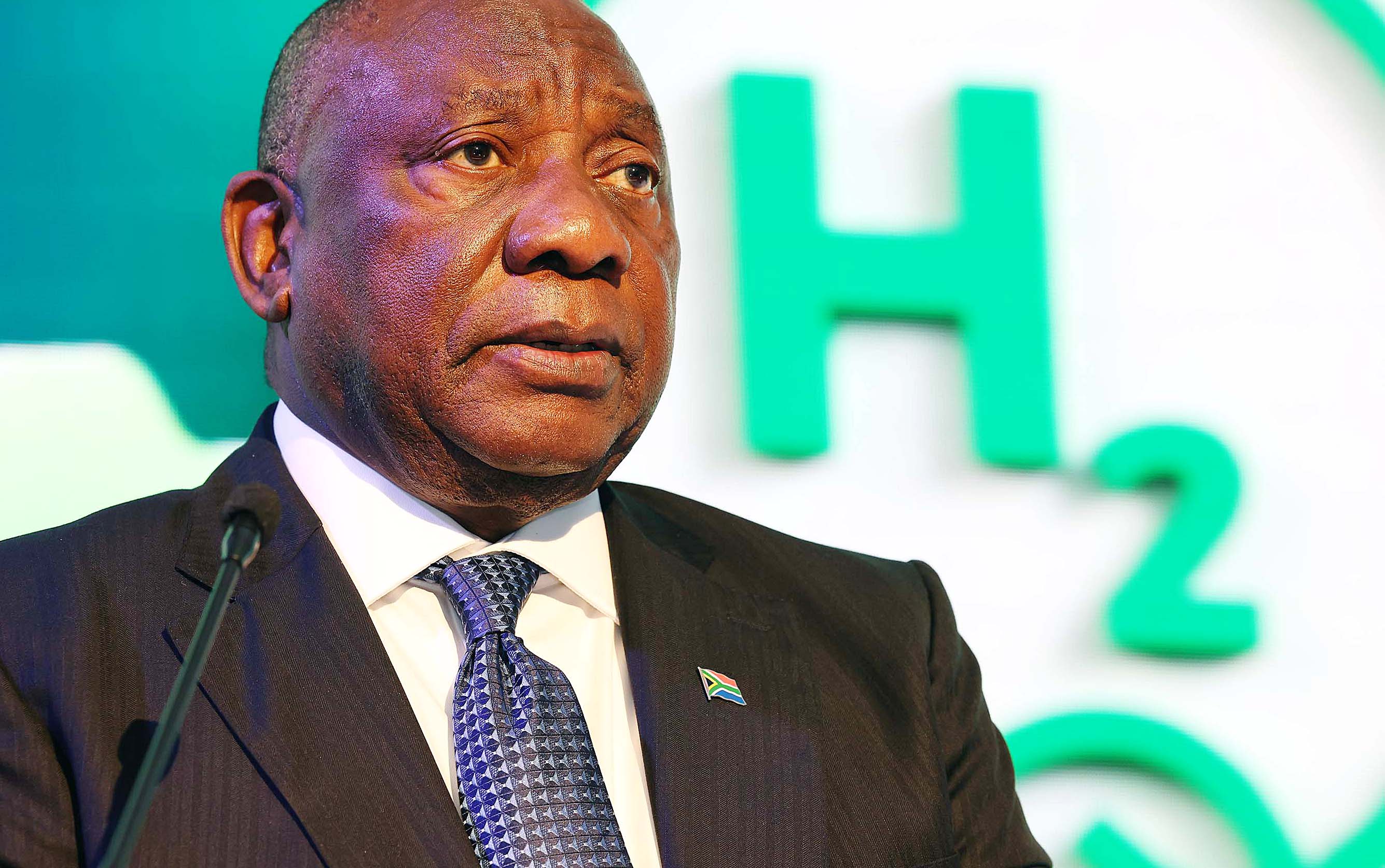
 President Cyril Ramaphosa addresses the inaugural Africa Green Hydrogen Summit at Century City Square, Cape Town. on Thuirsday. (Photo: Jairus Mmutle / GCIS)
 “Africa is uniquely positioned to become a major player in green hydrogen because it has abundant renewable resources that manifest themselves in high solar irradiation, strong winds and hydropower potential,” said President Cyril Ramaphosa.
He was speaking at what was once called the South Africa Green Hydrogen Summit, now positioned as the Africa Green Hydrogen Summit, in Cape Town on Thursday.
“The vast land of our continent lends itself to large-scale renewable energy projects. We are therefore perfectly placed to leverage the global shift towards cleaner energy sources for our collective advantage as the entire continent.
“Green hydrogen is a way to marry our continent’s mineral riches with our renewable energy endowments to decarbonise particularly heavy industries, to create jobs, to stimulate investment and to unlock inclusive growth across the various borders,” said Ramaphosa.
Green hydrogen is produced by using renewable energy sources such as wind or solar power to split water into hydrogen and oxygen through a process called electrolysis.
This hydrogen can then be used as an emission-free energy source and carrier for applications such as fuel cells or industrial processes, and is seen as being key to decarbonising “hard-to-abate” or “hard-to-electrify” sectors such as long-haul transport, chemicals, and iron and steel.
Green hydrogen is of particular interest in South Africa because of the country’s strategic advantages.
The independent non-profit economic research institution Trade & Industrial Policy Strategies says that “South Africa’s rich endowment of ideal weather conditions for solar and wind-power generation, technological capabilities around the Fischer-Tropsch process, and access to platinum resources place the country at an advantage for developing the hydrogen value chain and being a key supplier into the global hydrogen market.”
Read more: South Africa’s ‘green hydrogen’ dream — hype or hope?
Ramaphosa noted that more than 52 large-scale green hydrogen projects had been launched across the continent, including in South Africa.
“To date, South Africa has invested more than R1.5-billion in our Hydrogen South Africa programme,” he said.
Yet despite the President’s bullishness, the reality of green hydrogen projects in South Africa and beyond paints a more complex picture.
Daily Maverick reported in April that Namibia’s HyIron Oshivela plant successfully produced green hydrogen for the first time, giving South Africa’s neighbour to the northwest the lead in its implementation of its green hydrogen-related plans.
South Africa’s Hydrogen Society Roadmap, adopted in 2021, outlines an ambitious vision. While the initiative — which includes plans for a Hydrogen Valley industrial cluster and the Boegoebaai project in the Northern Cape — is substantial on paper, its implementation has lagged significantly behind Namibia’s.
Pilot project
A pilot project in Sasolburg is producing green hydrogen for domestic use, and the Koega green ammonia project in the Eastern Cape is “at an advanced planning stage” for four additional flagship hydrogen projects, said Ramaphosa on Thursday.
Read more: Namibia beats SA to green steel milestone before Coega can even get out the gate
Beyond suboptimal implementation, there are also complications, which Ramaphosa duly acknowledged.
Chief among them: cost.
“We are very much alive to the reality that green hydrogen production faces a number of challenges. There is the cost factor. Capital intensity and the high costs of financing are significant barriers, as is the cost of green hydrogen relative to other energy sources such as natural gas, for instance,” he said.
Earlier this year, Daily Maverick was told that the ambitious plan to produce “green steel” in the Freeport Saldanha industrial zone had been shelved, with Sasol and ArcelorMittal citing high costs and shifting priorities.
Globally, the steel industry is responsible for roughly 2.6 billion tonnes of carbon dioxide emissions a year, which is about 8% of global emissions.
When the conventional coal-fired blast furnaces are replaced with ones that run on carbon emission-free green hydrogen, the steel that is produced is, accordingly, considered green steel.
Read more: South Africa’s ‘green steel’ dreams stumble as feasibility challenges emerge
The difficulties in realising green hydrogen projects are shared internationally.
A study published in the journal Nature Energy earlier this year, which tracked 190 projects over three years, found that by 2023 only 7% of the announced green hydrogen production globally had been realised. A large part of the reason is renewable energy and electrolyser costs.
Lack of competitiveness
A Potsdam Institute for Climate Impact Research researcher and the lead author of that study, Adrian Odenweller, as well as co-author Falko Ueckerdt, said: “Green hydrogen will continue to have difficulties meeting the high expectations in the future due to a lack of competitiveness.”
The Just Energy Transition Project Management Unit in the Presidency and the Industrial Development Corporation of South Africa previously confirmed as much with Daily Maverick, explaining: “Currently, grey hydrogen (from steam reformation of methane gas) costs $1.50/kg to produce. Green hydrogen produced via electrolysis of water using renewables-generated electricity costs $5 to $6/kg. Approximately 60% of this cost is for electricity, 30% for electrolysers and 10% for transport, storage and other externalities.
“So, a reduction in price depends very much on renewable electricity generating costs falling still further. Additionally, the appropriate pricing of carbon taxes is another factor that will contribute to project viability.
“The costs of green electricity and of electrolysers will reduce, but not overnight. Furthermore, penalties in key global markets on goods produced using non-green technologies are ramping up over the next decade. We can anticipate that the right price point will be reached within the next few years.
“Based on the downward price trajectory of renewable energy and electrolyser costs, it has been projected that South Africa will reach $1.50/kg by 2037.”
Speaking at the summit on Thursday, Energy and Electricity Minister Dr Kgosientsho Ramokgopa said, “Africa’s choice is whether to be a passive site of resource extraction or a proactive architect of the green energy economy.
“With the right policy framework, investment enablers and regional coordination, green hydrogen can and must be [the] backbone of a new African industrial era.
“South Africa’s approach to green hydrogen is not aspirational, it is deliberate, structured and already under way. As a country, we have a clear choice to develop hydrogen not just as a climate response but as a catalyst for reindustrialisation, economic transformation, regional competitiveness and energy sovereignty,” said Ramokgopa. DM