




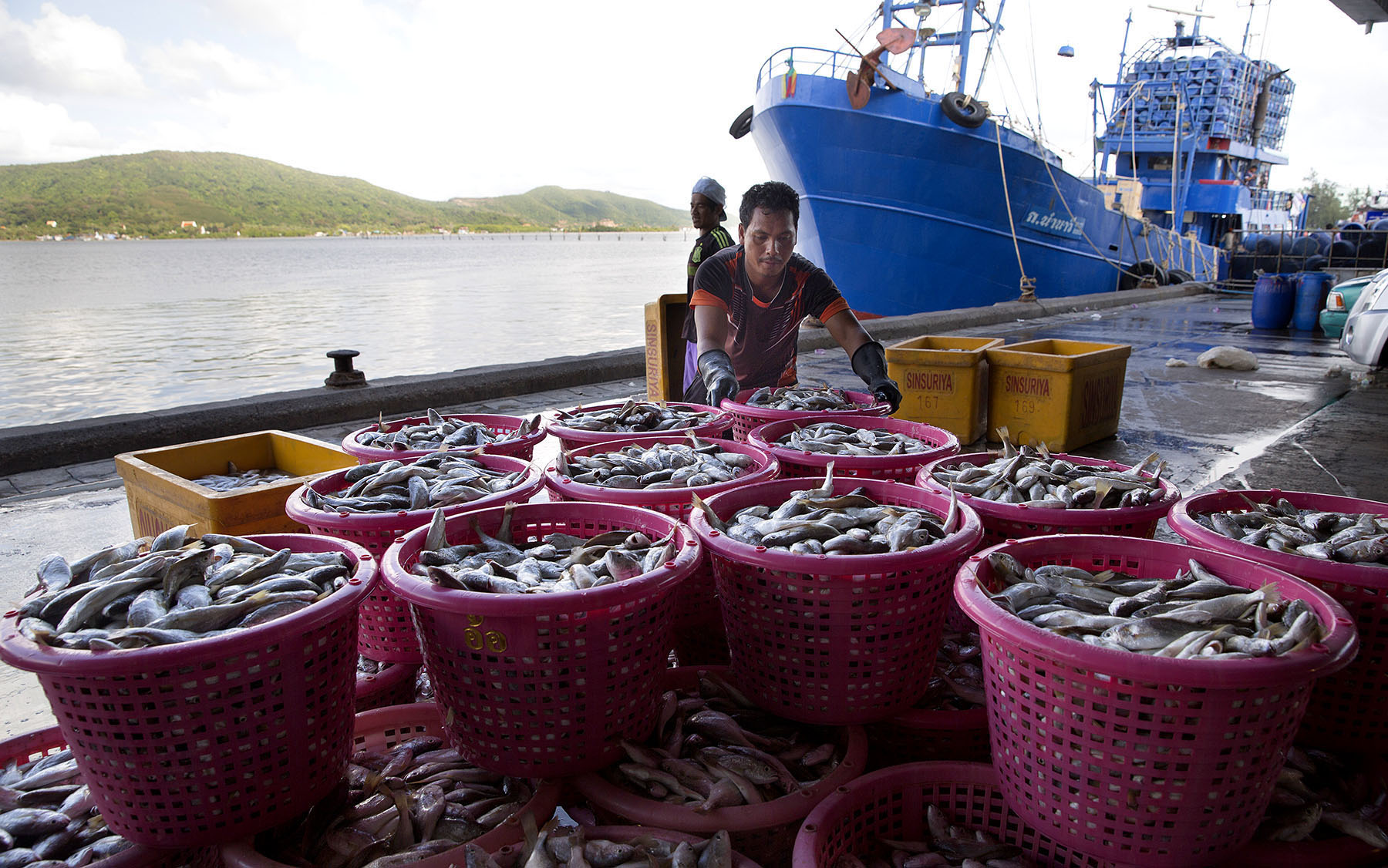
 Fishing boat workers help to sort fish from a boat at the port in Songkhla, Thailand, on 2 February 2016. (Photo: Paula Bronstein / Getty Images)
 South Africa has added further impetus to the establishment of a new international treaty to protect the world’s often lawless High Seas.
This comes after Forestry, Fisheries and Environmental Affairs Minister Dion George added his signature to the list of 134 nations who have all signalled their support for the new treaty, during a meeting of the United Nations Ocean Conference this week in the French Riviera seaside city of Nice.
However, to become international law, at least 60 nations also need to ratify the treaty. So far, only 49 nations have done so – so 11 more formal ratifications are needed for it to enter into force.
Due to its lengthy official title, the proposed treaty is more commonly referred to as the High Seas Treaty (or the BBNJ Agreement).
(The formal title is the Agreement under the United Nations Convention on the Law of the Sea on the Conservation and Sustainable Use of Marine Biological Diversity of Areas Beyond National Jurisdiction).
The High Seas (international waters that lie beyond official national maritime borderlines) cover nearly half the planet, but are seen as woefully underprotected – with only 1.5% currently safeguarded within marine protected areas.
/file/dailymaverick/wp-content/uploads/2025/06/seas-3-pic-Phil-Inglis-Getty-Images.jpg "The Saya de Malha Bank off the coast of Mauritius and Seychelles has been earmarked among several future Marine Protected Areas on the Indian Ocean High Seas. The banks support the largest seagrass meadow in the world, along with a wide variety of reef fish such as parrotfish, surgeonfish and rabbitfish. (Photo: EPA-EFE / DAI KUROKAWA)")
The High Seas Alliance, a partnership of more than 50 marine and environmental conservation groups helping to drive the initiative, believes the treaty will pave a path towards establishing several new High Seas marine protected areas.
Treaty members would also help to assess the impact of harmful activities (such as overfishing, underwater mining and blasting) and also advance “ocean equity” by ensuring greater support for developing countries.
More details about the objectives of the agreement have been summarised in this fact sheet compiled by the High Seas Alliance.
Notably, neither Russia nor Japan have signed the agreement. While the US, Canada, China and India have signed up, they have not ratified it yet.
Here is an updated list of all signatories and countries that have ratified the agreement.
/file/dailymaverick/wp-content/uploads/2025/06/seas-2-Treaty-progress-map-source-High-Seas-Alliance.jpg "A map showing countries that have signed or ratified the new treaty. (Source: High Seas Alliance)")
/file/dailymaverick/wp-content/uploads/2023/03/ISS-Today-High-Seas-Treaty_2.jpg "Exclusive economic zones are shown in white and High Seas, or areas beyond national jurisdiction, are shown in light green. (Source: Sumaila et al. in prep / Global Ocean Commission / The High Seas and Us: Understanding the Value of High-Seas Ecosystems)")
From paper to action
In a media statement on 10 June, Minister George said the decision to sign up had “highlighted South Africa’s key role in advancing equity, science-based governance and environmental stewardship in the high seas” and also underlined the country’s “long-standing commitment to strengthening the rule of law in ocean affairs”.
“The ocean is a life source – essential for climate regulation, food security, livelihoods and economic development, particularly in developing economy states. Unfortunately, the world’s oceans face escalating threats from climate change, biodiversity loss and marine pollution, and these impacts demand urgent, inclusive and science-based action,” his department said.
Despite this optimistic sentiment, however, several observers have noted that translating rhetoric from paper into real action is a much trickier business, requiring strong political will and funding – including major investment in basic naval and maritime patrol vessels.
Read more: Africa must help steer the endangered High Seas Treaty out of dire straits
The High Seas Alliance further notes that signing the agreement does not establish consent for states to be bound to the treaty, “but it does express the willingness of the signatory state to continue the treaty-making process and for it to proceed to ratification”.
/file/dailymaverick/wp-content/uploads/2023/06/11547575.jpg "Prince Albert II of Monaco (left) shakes hands with Singapore’s foreign affairs minister, Vivian Balakrishnan, after delivering remarks following the adoption of the text of the High Seas Treaty at the United Nations headquarters in New York on 19 June 2023. (Photo: EPA-EFE / Justin Lane)")
“Signing also creates an obligation to refrain, in good faith, from acts that would defeat the object and the purpose of the treaty. Ratification is when nations formally consent to the new international law, and this often entails ensuring that their national laws are consistent with it.
“The speed and process to ratify varies by country. In some countries, the act of ratification is simply a leader’s decree, while in others parliamentary approval is needed.
“Depositing an instrument of ratification is the formal step by which a country officially confirms its consent to be bound by an international treaty. This is the last step in the ratification process, following the domestic approval.”
/file/dailymaverick/wp-content/uploads/2025/06/seas-1-Annabelle-Chih-Getty-Images.jpg "Fishery workers sort and process sharks for auction at Xingang Fishing Pier in Taitung, Taiwan, on 21 April 2025. (Photo: Annabelle Chih / Getty Images)")
‘A tidal wave of hope’
Rena Lee, Singapore’s ambassador for international law, has emphasised the need for much broader public participation to ensure greater global buy-in and to “give the agreement real power and effectiveness”.
Rebecca Hubbard, director of the High Seas Alliance, said the “surge” of 17 new ratifications this week marked “a tidal wave of hope and a huge cause for celebration”.
“With just 11 more ratifications needed for entry into force, it could be just a matter of weeks before the 60 is achieved,” she suggested.
Read more: Why Africa must show unity and seize new ocean governance opportunities in 2025
The European Union and several small island nations have been among the strongest supporters of the new plan to strengthen ocean protection.
European Commissioner for Oceans and Fisheries Costas Kadis declared: “The EU is proud to have ratified the BBNJ and it calls, jointly with Palau and Seychelles, for all countries to join the High Ambition Coalition on BBNJ to support its ambitious implementation.
The Australian-based Minderoo Foundation has also announced a AUD 10-million (about $6.5-million) pledge to accelerate the creation of Marine Protected Areas (MPAs) in the High Seas.
This latest commitment adds to the $51.7-million already committed in a joint donor pledge made in 2024, bringing the total committed by 12 funders to kickstart the development of MPAs on the high seas to $58.2-million. DM