




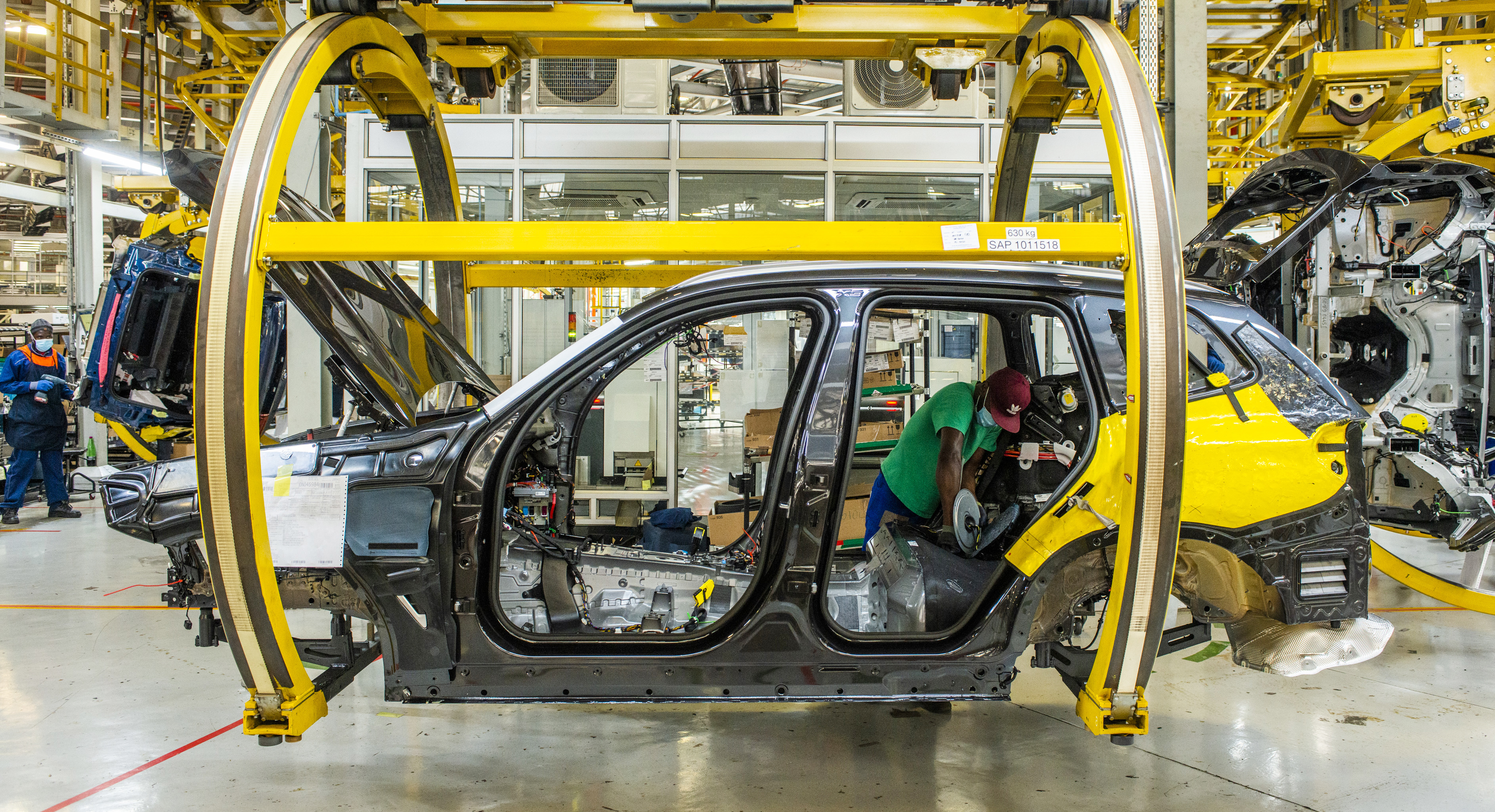
 The production line at the BMW Rosslyn plant in Midrand. (Photo: Waldo Swiegers / Bloomberg via Getty Images)
 South Africa’s automotive industry may have enjoyed a high-revving May in local markets, but the road ahead is looking increasingly precarious. Local vehicle sales surged 22% year-on-year, according to the latest Automotive Business Council (Naamsa) data, yet exports dropped 14.6% overall, with passenger vehicle exports plummeting by nearly 35%.
The African Growth and Opportunity Act (Agoa), a long-standing US trade programme that allows duty-free access for eligible African exports – including South African vehicles – faces renewed uncertainty under the Trump administration. With the White House pushing for reciprocal tariffs and stricter eligibility reviews, South Africa’s preferential access could be one executive decision away from suspension.
/file/dailymaverick/wp-content/uploads/2025/06/Thembinkosi-Pantsi-NADA-National-Vice-Chairperson-1024x683-1.jpg "Nada vice-chairperson Thembinkosi Pantsi. (Photo: Nada)")
Speaking to Daily Maverick, Nada’s vice-chairperson Thembinkosi Pantsi painted a picture of both resilience and distress. “We’re adapting, we’re consolidating, and we’re innovating to survive,” he said, referring to the shift toward multi-brand dealerships and used vehicle expansion. “But make no mistake – we are nearing a cliff edge.”
The automotive sector value chain in its entirety supports around 110,000 jobs, according to data from Naamsa, Stats SA and trade union data, with countless families relying on those employed in the sector to put food on the table. The industry – if you include both manufacturing and sales – contributed 5.3% to our GDP in 2023, and is the single largest manufacturing sector.
Read more: The US-South Africa relationship stands at a dangerous crossroads
Local sales surge, but export markets faltering
While May saw strong domestic demand – driven partly by an influx of East Asian vehicle imports – it also underscored a growing contradiction: consumers want affordability, but the domestic industrial base relies on export volume to remain viable.
“We are seeing more Chinese brands enter the market with cost-effective models,” said Pantsi. “This is good for consumer access, but doesn’t help the thousands employed in export-geared manufacturing.”
Volkswagen SA chairperson and managing director Martina Biene echoed the sentiment during her keynote address at Nada Connect in March of this year. “Sometimes, as a local manufacturer, we don’t feel as valued as we should be,” she said. “There’s a lot of investment here – jobs, skills, community development – but little relief from systemic pressures.”
Biene disclosed that VW SA had spent more than R130-million on diesel generators to cope with load shedding. “Every day I run them, it’s R1.6-million in cost. That goes straight into the vehicle price,” she said. Add port congestion, road freight insecurity and policy drift, and “you get a toxic mix,” she warned.
Read more: Private sector signals big appetite for transforming SA’s logistics landscape
What this means for you
If global trade shocks persist and local manufacturing continues to contract, thousands of jobs across the auto value chain could be lost. Consumers may benefit from cheaper import options, but the broader consequences – shrinking local industry, fewer employment opportunities and weakened export competitiveness – pose a long-term economic risk.
The off-and-on again Trumpian promise – tariffs
Trump’s revived steel and aluminium tariffs have reignited fears of a protectionist spiral. Pantsi warned that such moves could “compound local challenges” and further disrupt trade patterns.
“Tariffs don’t only raise costs. They erode investor and consumer confidence,” he said. “We need urgent interventions – rebates, subsidies and export duty relief.”
Biene concurred, calling for incentives over protectionism. “We contribute massively to GDP and jobs. But sometimes it feels like the government is dazzled by short-term imports at the expense of long-term industrial strategy.”
She said Agoa’s uncertainty was more than symbolic. “Agoa isn’t a given,” Biene warned. “If we lose that access, it’s not just a dent in our balance sheets – it’s a question of whether we keep local production viable.”
Pricing inaction
For every vehicle exported, dozens of suppliers – from tyre producers to seat manufacturers – depend on consistent output. A dip in export volumes, Pantsi noted, ripples across the entire automotive value chain.
“The automotive industry is the second-largest contributor to GDP after mining. If we allow it to shrink, the consequences will be systemic,” he said.
Beyond the 110,000 people the sector employs directly, it supports hundreds of thousands more through components, logistics and retail.
Both Pantsi and Biene urged the government to move past platitudes. “We need a granular, not generic, state response,” said Pantsi. “Targeted logistics reform. Decisive Agoa diplomacy. Training institutions revived. It’s the details that matter now.”
The sector at a T-junction
Despite strong local sales buoyed by competitively priced imports, the export decline is a red flag.
“We have the infrastructure, the people, the expertise,” Pantsi said. “What we lack is policy certainty and logistical coherence.”
Biene was blunter: “We’re here for the long haul. But we can’t keep pouring money into diesel and delays. The government needs to decide if it wants this sector to thrive – or merely survive.” DM.