



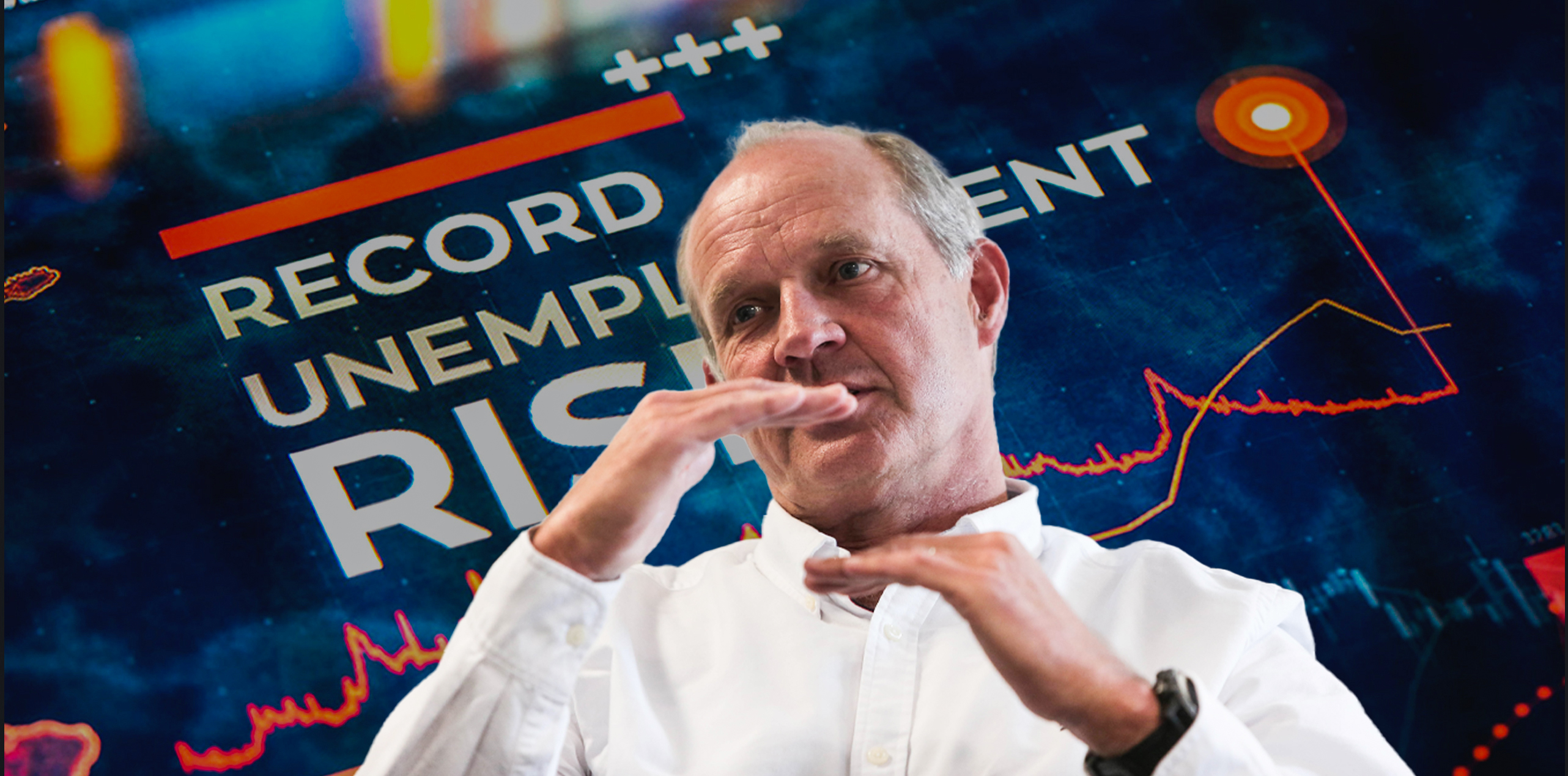
 Illustrative image. | Unemployment graph. (Photo: fticonsulting.com / Wikipedia) | Capitec CEO Gerrie Fourie. (Photo: Gallo Images / Sunday Times / Alaister Russell)
 For as long as I can remember, one of the “facts” that has almost defined so many of our conversations has been that we have the world’s highest unemployment rate.
It’s the kind of point that underpins everything else; it puts political parties under pressure to claim they’re trying to create jobs, it is the easiest way to understand how our economy is not working.
We get reminders of this at least four times a year when Statistics South Africa releases its Quarterly Labour Force Survey. So many parts of our political commentariat erupt when we are reminded that so many people don’t have jobs.
For the past five years or so, I’ve found it really odd that the people who are given the most time to talk are union leaders. These are literally the people who have jobs talking about the people who don’t have jobs.
And, famously, the ANC and the government often say nothing. In fact, I remember once asking Thulas Nxesi, who was the Minister of Labour and Employment at the time, why he was so silent on the issue.
His response, that it was not his job to create jobs, but actually the role of the private sector, seemed to miss the point somewhat.
So I was hugely interested to read in BusinessLIVE that the outgoing CEO of Capitec, Gerrie Fourie, reckons we’re understanding this in completely the wrong way.
He says that we assume that the 32.9% of South Africans of working age who are unemployed are not actually working.
Instead, he thinks, they are working. They’re just working in the informal sector.
As he puts it: “If you go to the townships, most people have backrooms to rent out; everyone is doing something.”
‘Formal unemployment’
While economists can (and do … endlessly) argue about the definition of “formal unemployment”, what perhaps we really need to consider is a figure around how many people do something and receive an income in return for it.
Because, as Fourie points out: “If we really had a 32% unemployment rate, we would have had unrest.”
I have to say, I do think that’s true. If there were so many people who had literally nothing to do, and did not receive money as income, we would have much more violence than we actually do.
And yes, social grants do play a role. But there are many millions of people who do not get a social grant, and have no formal job.
At the same time, the Organisation for Economic Cooperation and Development (OECD) has said for some time that our businesses face more regulation than in any other OECD-member country.
Now, while regulation per se should not really hamper businesses, I think in South Africa it probably does.
Some of the regulations seem unnecessarily onerous, but, more importantly, they open opportunities for corruption.
And there is also an almost fatal lack of understanding from the government about the role so many informal businesses play.
For example, during the pandemic, informal food markets were closed, along with spaza shops. That had the impact of making food more expensive just at the entirely wrong time.
But we also don’t really know how big the informal sector is.
At least until 2019, our informal food sector - including spaza shops, hawkers, street traders and bakkie traders - employed more people than the formal food sector.
That means that for every single person you see working in a supermarket, there is at least one other person in the informal sector.
And that’s just in food!
Sustainable living
You can imagine how many other people make a sustainable living from cutting hair or in the beauty industry, or simply washing cars.
The people you see outside so many hardware stores hoping and praying they will get some work are making some money too.
The problem, if there is one, seems to be that we want to focus on the formal sector. The sector that is regulated, and appears to have too many regulations.
Instead, perhaps we should be focusing on simply creating the space for people to do something and be paid money in return. In other words, we should be trying to make people richer to reduce poverty.
Of course, I could argue against myself here.
Other research has shown that our economy is overly concentrated, basically many sectors are dominated by just a few companies. And getting new companies into those sectors is quite tough.
We may not grow our economy without some kind of targeted intervention that results in de-concentration either.
Changing a definition doesn’t change anything, obviously. But, it does allow us to focus properly on what the real problems are.
The real problem is poverty; we need more people to get more money for what they do.
No matter how you define it. DM